phenomenon

helium flash

A thermonuclear runaway event in red giants where helium ignites explosively but does not cause a supernova.
54 related articles

Description

A helium flash is a brief but violent thermonuclear runaway that occurs in the cores of low- and intermediate-mass stars (roughly 0.8 to 2 solar masses) as they evolve into red giants. When the core's hydrogen is exhausted, it contracts and heats up until helium begins to fuse, but because the core is degenerate, the ignition is explosive rather than gradual. This event releases a burst of energy that does not destroy the star but restructures its interior, allowing it to settle into stable helium burning.

History

The theoretical prediction of the helium flash was made in the 1940s by astrophysicists such as Fred Hoyle and Martin Schwarzschild, who recognized the role of electron degeneracy in stellar cores. The term 'helium flash' was coined to describe this sudden ignition.

How it works

In a degenerate electron gas, pressure depends only on density, not temperature. As the core heats toward helium ignition, the temperature rises without the pressure increasing to expand the core. When helium fusion ignites, it rapidly heats the core, but the degenerate pressure cannot respond immediately, causing a runaway. The energy release lifts the degeneracy, the core expands, and helium burning proceeds calmly afterward.

In practice

Understanding helium flashes is essential for modeling the evolution of red giants and the production of carbon and oxygen, which are later dispersed into space and incorporated into future stars and planets.

Fun fact

The helium flash lasts only a few minutes, but the energy released is comparable to the total energy the Sun would emit over millions of years, yet it is invisible from outside because it is absorbed by the star's outer layers.


Concept graph →

Related articles · 54

Stellar2026-08-302 minarXiv:2608.29649
Narrow Searchlight Beams: How Rare Gamma-Ray Bursts Produce the Most Energetic Particles
A particle with an energy of $$10^{18}$$ eV hitting Earth's atmosphere is like a tennis ball traveling at 200 km/h slamming into a wall. Astrophysicists have debated for decades where such projectiles come from. Gamma-ray bursts, brief and powerful explosions of gamma radiation, have long been suspected as accelerators.
Supernova 1987A: Twenty Thousand Years Before the Explosion
Twenty thousand years ago, the star that would become supernova 1987A put on a ring. Not one — three. The two outer ones, like lampshades, tilted relative to the equatorial ring, and the star's light, struggling through them, barely reached an observer who happened to be in the plane of the equatorial ring.
High Energy2026-08-162 minarXiv:2608.15527express
Invisible Particles Change the Dance of Neutron Stars
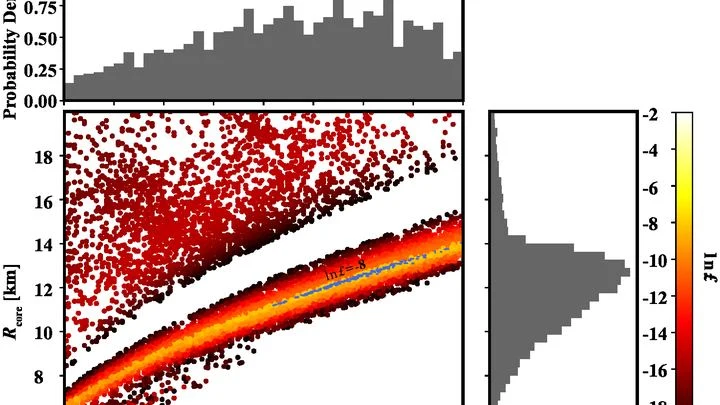
A neutron star is the remnant of an exploded star, compressed so tightly that a teaspoon of its material would weigh as much as a mountain. Inside such an object, protons and neutrons are packed tightly together, and under enormous pressure, hyperons, particles containing a strange quark, can appear.
High Energy2026-07-281 minarXiv:2607.26137express
A Hidden Black Hole Lurks After a Cosmic Meal
In a distant galaxy about 290 million light-years away, the object HLX-1 lies hidden. It once flared brighter than hundreds of billions of suns, but now it has quieted down. From 2018 to 2022, the Hubble, Chandra, and Swift space telescopes tracked its fading.
Galaxies2026-07-253 minarXiv:2607.22966
A Chick in a Dust Shell: How a Red Quasar Emerges
In the deep field of JWST, among thousands of galaxies, astronomers zoomed in on the source JADES-GS 209777 – and saw a cosmic chick. Its "shell" is a thick cocoon of gas and cosmic dust that long hid the growing black hole at its center. But at a redshift of 3,711 (1,8 billion years after the Big Bang), the shell began to crack.
Cosmology2026-07-242 minarXiv:2607.22050
Bickford's fuse of a cosmic firework: what the early light of 17 supernovae revealed
17 supernovae from the ZTF DR2 sample lit up ahead of schedule. In the first hours and days after the explosion, they emitted more light than standard models predict. Astronomers compare this to a Bickford fuse: before the blinding flash tears across the sky, a precursor spark runs through the outer layers.
High Energy2026-07-212 minarXiv:2607.18972express
A Bright Flash from the Universe's Youth
The hunter of ancient light, the James Webb Telescope, aimed its mirrors at a tiny patch of sky and caught a strange beacon. The object, with the working name beacon_1420-$$5253_{4770}$$, flashed and faded. At first, it was logged as a candidate for the most distant galaxy, as if we were seeing it just 300 million years after the big bang.
Stellar2026-07-113 minarXiv:2607.10452
Local Big Bang: Explosive Outflows at the Birth of Massive Stars
In the quiet of cold molecular clouds, where interstellar gas under gravity condenses into dense clumps, the birth of massive stars is one of the great puzzles of astrophysics.
Microquasar Cygnus X-3: The PeVatron Powering the Cygnus Bubble
For a long time, astronomers searched for the 'factories' of the most energetic cosmic rays — particles that carry the macrocosm compressed to the size of an atomic nucleus. Colossal star-forming regions like Cygnus OB2, where winds from young giants collide, were prime suspects.
The Arrow Piercing the Disk: Recipe for an X-ray Flare
Deep space, galactic center. A supermassive black hole is surrounded by a scorching disk of gas and dust. And then, through this fiery veil, a star shoots by every few hours — like an arrow loosed from the bow of gravity. Each passage triggers a dazzling X-ray flare that for a moment outshines the entire galactic nucleus.
Neutrino sparks from the galactic forge: IceCube confirms proton acceleration in the Fermi bubbles
Nearly a decade and a half ago, the Fermi gamma-ray telescope spotted mysterious "bubbles" — giant plasma blobs, as if inflated by invisible lungs, towering tens of thousands of light-years from the Galactic center.
Galaxies2026-06-152 minarXiv:2606.17141express
Cosmic Cocktail Without the Secret Ingredient
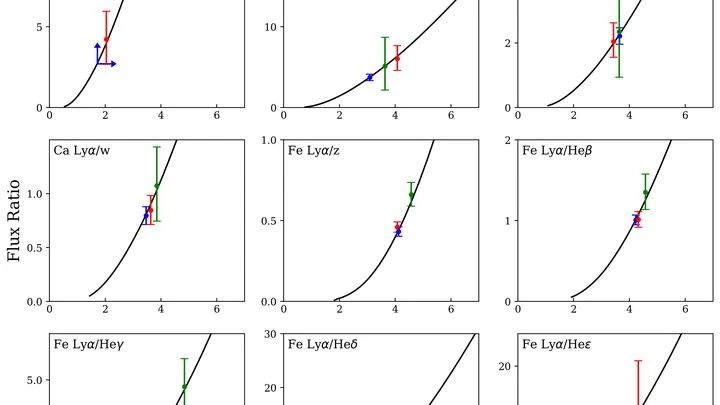
The Perseus galaxy cluster is a giant metropolis of thousands of star islands, bathed in an invisible ocean of scorching gas. Like urban smog, this gas preserves traces of all the chemical factories that have operated in galaxies for billions of years: supernova explosions that scatter freshly forged atoms across the surroundings.
High Energy2026-06-081 minarXiv:2606.09992express
The Star That Couldn't Become a Gamma-Ray Burst
A shockwave erupts from the star's surface, and for a brief moment, a blinding flash of ultraviolet and X-rays is born. This very event, named EP260321a, was spotted by the Einstein space telescope in March 2026. The light took about 450 million years to reach Earth.
High Energy2026-06-082 minarXiv:2606.10014express
Chemical Physics2026-06-072 minarXiv:2606.08846express
Invisible Molecule Teaches Chemistry of Space
Two guitar strings are stretched on the same neck. They are almost identical, but one is slightly shorter — and they sound different. That's roughly how the two isomers of ethanimine work: molecules with the same set of atoms but rotated differently in space. Astronomers spotted this molecule in the dense clouds near the center of our Galaxy.
Magnetic Thermos of Stars: Birth of a Micronova
In the constellation Scorpius, 3,000 light-years from Earth, a dead star steals matter from a living one. A white dwarf in the system IGR J17014-4306 — a superdense carbon-oxygen ball with the mass of the Sun but the size of Earth — siphons hydrogen from a normal companion star.
Neutrino Lighthouse: The Hidden Heart of Supernova SN 2021foa
In April 2021, in a galaxy 35 megaparsecs away, supernova SN 2021foa erupted. It immediately puzzled astronomers: its spectrum feverishly switched between hydrogen and helium lines — as if the star, in agony, was frantically shedding its outer layers.
Dance on the Razor's Edge: How the Star-Black Hole Balance Is Decided by Seven Percent
Picture a tightrope walker balancing over an abyss. Every step changes the rope's tension, and the slightest shift in center of gravity can prove fatal. That's roughly what the dance of an ordinary sun-like star around a black hole of ten solar masses looks like when the orbit is highly elongated.
Galaxies2026-05-282 minarXiv:2605.29616express
A Dusty Flare at the Heart of a Galaxy
A bonfire that no one sees, but everyone feels the warmth: that's how astronomers found a flare in a distant galaxy. Not by its light, but by the infrared radiation of heated dust. The galaxy SDSS J010320.39+140152.5 caught attention when its center suddenly blazed in the infrared, as if someone had thrown logs onto an invisible fire.
Stellar2026-05-162 minarXiv:2605.16760express
How Stars Lose Their Hydrogen Envelope
In the crowded center of the galaxy, two stars orbit so close together that one strips the outer layers off the other, like wind blowing off a coat. What remains is a hot helium core, a star without a hydrogen envelope.
High Energy2026-05-152 minarXiv:2605.16487express
The Star That Exploded Twice
A light bulb that doesn't burn out but flares brighter and brighter until it blows the whole fixture apart. That's roughly how the most massive stars in the universe die. When a star's core heats up to billions of degrees, pairs of particles (electrons and their antimatter counterparts, positrons) begin to form.
Galaxies2026-05-132 minarXiv:2605.13231express
Molecular Cradles Under the Shock Wave
A supernova is the final explosion of a massive star, scattering its material over light-years. Inside the expanding shell, a neutron star remains, and the shell itself continues to plow through interstellar gas for thousands of years.
High Energy2026-05-082 minarXiv:2605.07827express
Helium in the Thermonuclear Fire of a Supernova
A match flares from both ends. First the head ignites, and a moment later the flame engulfs the wooden stick. Something similar may happen in some Type Ia supernovae — except the match is a white dwarf (a star the size of Earth), and the flame is a thermonuclear explosion.
Galaxies2026-04-272 minarXiv:2604.24494express
The Milky Way's Hot Halo in Simulation
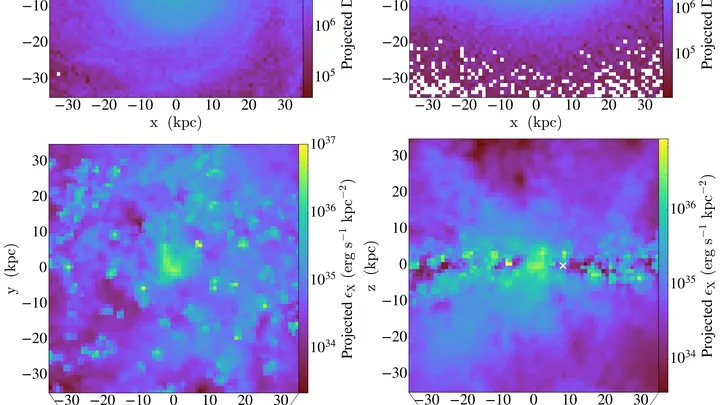
Around our Galaxy, like an invisible crown, stretches a tenuous cloud of gas heated to millions of degrees. It is called the galactic halo. Seeing this glow directly is difficult: it emits soft X-rays that are absorbed by Earth's atmosphere.
High Energy2026-04-242 minarXiv:2604.22975express
A Hot Cocktail in the Heart of Perseus
A giant cauldron of simmering soup stretches across millions of light-years. This is the atmosphere of the Perseus galaxy cluster — a cloud of scorching gas held together by gravity. Until recently, astronomers thought that in the center of this cauldron, the gas was calmly cooling, ready to condense into new stars.
Stellar2026-04-231 minarXiv:2604.21402express
How a Supernova Shoots Out a Lone Spinning Star
Be stars are rapidly rotating luminaries with bright gas disks. Usually, a companion star spins them up: mass flowing from the neighbor whirls the star like a bullet in a rifled barrel. But there are also lone Be stars without a partner: their origin long remained a mystery. New research shows that solitaries can be born from a supernova explosion.
Materials2026-04-222 minarXiv:2604.20424express
Why a Battery Can Burst Into Flames
A lithium-ion battery is like a multi-story building where lithium ions live on every floor. When you charge the battery, the ions move from floor to floor, and the whole building warms up a bit. Usually, this heat dissipates evenly, like from underfloor heating. But sometimes one spot gets too hot, and then the whole building can go up in flames.
Atomic Physics2026-04-171 minarXiv:2604.16640express
Thorium Nuclear Clock Ticks with a Whisper of Light
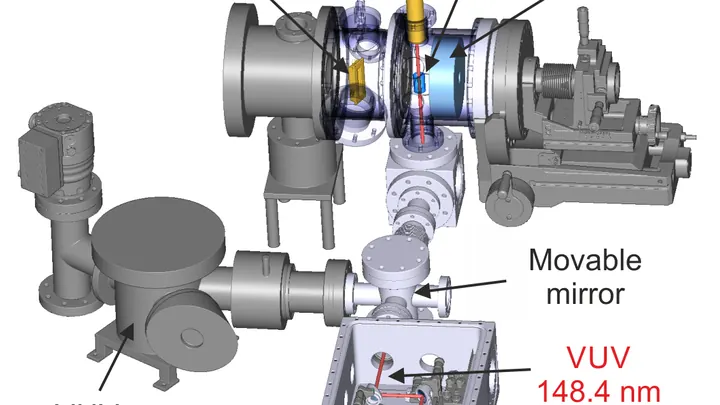
A laser beam as faint as a whisper of light has stirred a thorium-229 nucleus into a higher energy state. Most nuclei demand a blast of energy, but thorium-229 has such a tiny energy gap that even this gentle nudge works.
Galaxies2026-04-152 minarXiv:2604.14292express
Giant Bubble Fails to Cool a Hot Heart
At the heart of the Ophiuchus galaxy cluster floats a bubble of hot plasma the size of several galaxies. It rises like a giant hot-air balloon in the atmosphere, leaving a wake behind it — a region where gas is set in motion.
Galaxies2026-04-141 minarXiv:2604.13267express
Caught: The Light That Lit Up the Young Universe
After the Big Bang, the Universe was filled with cold gas — mostly neutral hydrogen and helium. It enveloped the cosmos like a morning fog, impenetrable to light. The Dark Ages began. When the first galaxies ignited, their radiation, like a searchlight beam, started knocking electrons out of atoms.
High Energy2026-04-111 minarXiv:2604.10378express
Echo of a Gamma-Ray Burst: Neutrons Chase the Light
Gamma-ray burst GRB 221009A flared so brightly that it was dubbed the 'brightest of all time.' The LHAASO observatory detected gamma rays from it with energies up to 13 TeV — thousands of times more energetic than particles in an X-ray machine.
Stellar2026-04-061 minarXiv:2604.05040express
Lithium Reveals the Secrets of Young Stars
Lithium is like a thermometer dipped into a star's interior. This light element is destroyed at temperatures around 2.5 million degrees, so its abundance on the surface tells us how deeply the star's material has been mixed.
High Energy2026-04-011 minarXiv:2604.01196express
Delayed Radio Echo of a Neutrino Flare
In 2017, the IceCube detector caught a neutrino from the distant galaxy TXS 0506+056. It was like hearing a phone ring from across the ocean: the signal came from where the most energetic particles in the Universe are born. At the same time as the neutrino, astronomers spotted a gamma-ray flare, and two to three years later, radio waves. Why was the radio late?
Neutrons Leave a Trace
A dark matter detector is like a super-sensitive microphone listening for silence. It picks up tiny heat jolts, phonons, that occur when a particle grazes a crystal. But instead of silence, the instruments have been hearing noise for years: a slew of weak signals below a few hundred electronvolts.
Medical Physics2026-03-161 minarXiv:2603.15913express
A Beam That Spares Healthy Cells
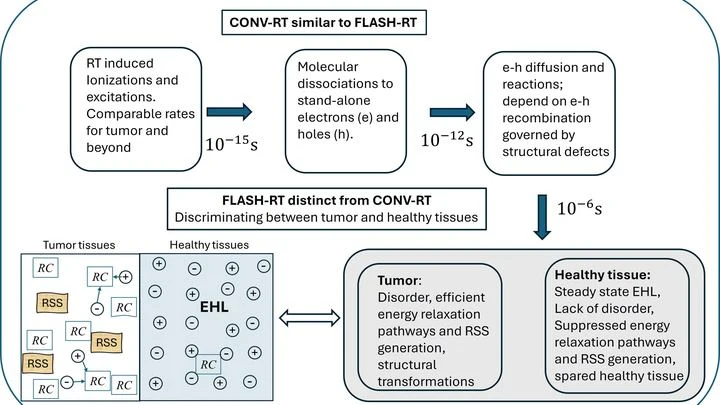
Two cities: one with neat, straight streets, the other with a tangle of alleys. If you send a powerful flood of water through both, in the first the water quickly drains away through channels, while in the second it swamps everything. That's roughly how tissues behave under ultrafast radiation therapy, known as FLASH.
Stellar2026-02-271 minarXiv:2602.23900express
A Runaway Star Born from an Explosion
Deep in the Galaxy, runaway stars are sometimes born. A monstrous force, a supernova explosion, flings them from their usual place. One such wanderer has recently been found: a star of the LP 40-365 class, a fragment of a white dwarf that survived an incomplete explosion.
Stellar2026-02-232 minarXiv:2602.20311express
Stellar Flares Ignite Each Other
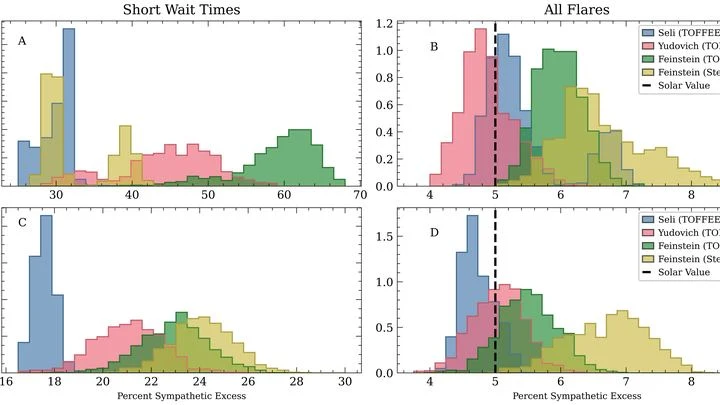
The Sun occasionally produces flares — powerful bursts of energy that last from minutes to hours. Most are random, like raindrops hitting a roof. But sometimes one flare seems to ignite another: the second begins almost immediately after the first, even though they occur in different locations. Astronomers call these sympathetic flares.
High Energy2026-02-221 minarXiv:2602.19018express
How a Neutron Star Cooled Off in Just Four Days
In April 2023, Japanese satellites detected a super-intense X-ray burst on the neutron star MAXI J1752–457. The star cooled down in 4 days — five times faster than usual. Like someone cracked open a cosmic window.