Light That Doesn't Break the Crystal express
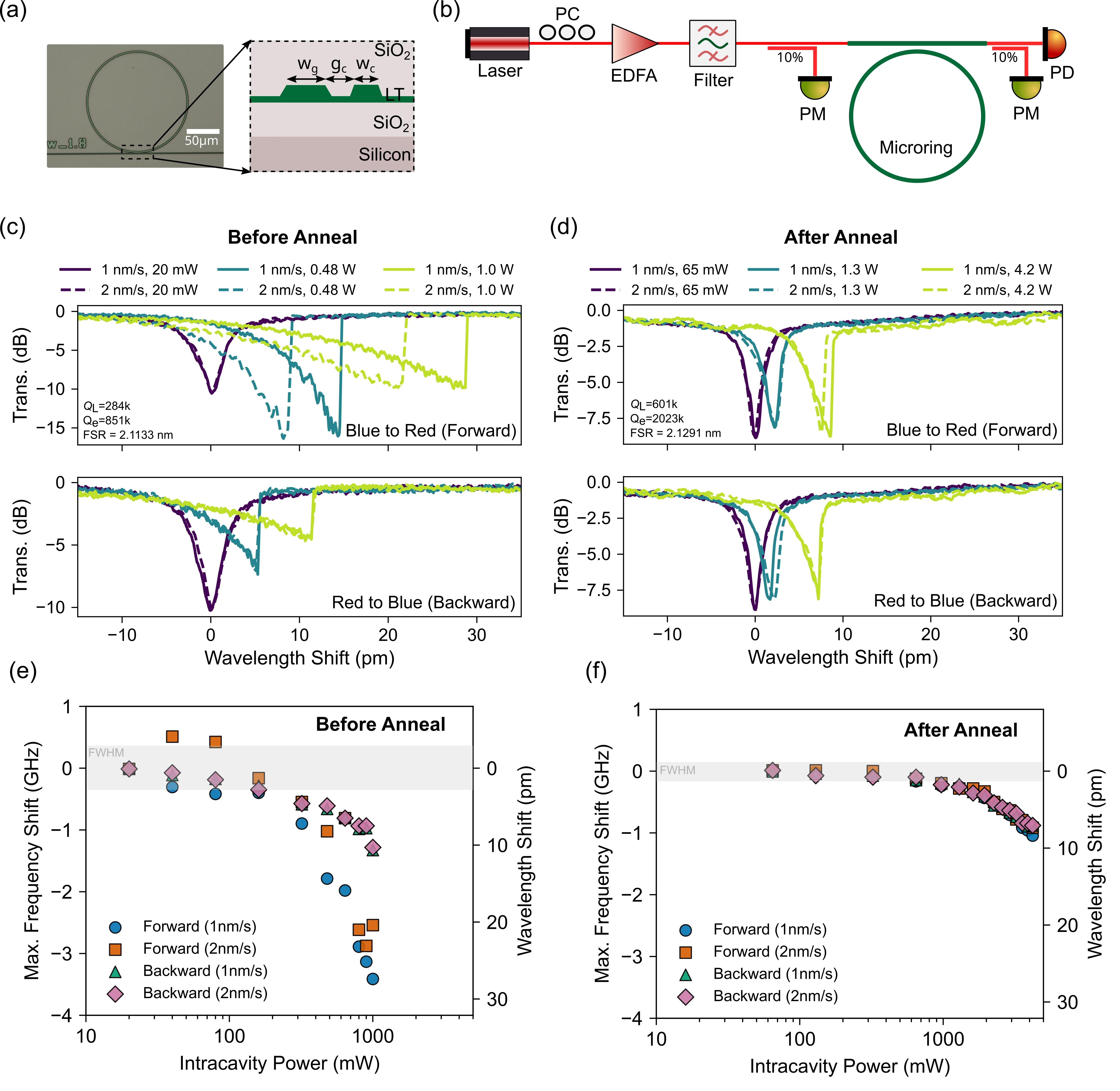
Light in a tiny ring is like water in a closed channel: if you push the flow too hard, the walls start to shake and the channel changes shape. In optical microrings, the water is played by a laser beam, and the walls are a crystalline track thinner than a hair. Usually, powerful light "burns" the material: it alters its properties, shifts the frequency, and ruins the tuning. Here, however, the engineers took a thin film of lithium tantalate and, after annealing, slow heating and cooling, obtained rings that hold 4 watts of circulating power. That's like a garden hose withstanding the pressure of a fire truck without swelling.
But power isn't needed for its own sake. On the same crystal, they built a modulator — a device that switches light on and off like a faucet turns water. It's only 2 millimeters long, and switching takes just 3 volts, less than a coin battery. The modulator holds its phase steadily and doesn't "drift" under voltage, which is crucial for optical communication in the range where telecom lasers operate.
Such rings and modulators are building blocks for future photonic chips: instead of electrons running through wires, photons run through waveguides. If the blocks can handle powerful light without losing their tune, you can build faster, more energy-efficient communication systems, lidars, and even quantum devices.
4 watts in a microring is like focusing a desk lamp's light into a spot thinner than a human hair, and the crystal barely heats up or changes its properties.