A microcavity is a tiny optical resonator, typically a few micrometers to a fraction of a millimeter in size, that confines light to a small volume. These structures enhance light-matter interactions by trapping photons for extended periods, leading to effects like strong coupling, lasing, and nonlinear optical phenomena. Microcavities are essential in modern photonics, enabling compact lasers, sensors, and quantum information processing.
History
The concept of optical cavities dates back to the Fabry-Pérot interferometer (1897). Microcavities emerged in the 1990s with advances in microfabrication, particularly with the development of microdisk and microsphere resonators. Photonic crystal cavities were demonstrated in the late 1990s.
How it works
Microcavities use mirrors or total internal reflection to confine light. Common designs include Fabry-Pérot cavities with two parallel mirrors, microspheres or microtoroids that support whispering-gallery modes, and photonic crystal cavities with periodic dielectric structures. The confined light forms discrete modes with specific frequencies and spatial distributions. The small mode volume and high quality factor (Q) increase the interaction time between light and matter, amplifying effects like spontaneous emission enhancement (Purcell effect) and nonlinear frequency conversion.
In practice
Microcavities are used in vertical-cavity surface-emitting lasers (VCSELs), optical filters, biosensors for detecting single molecules, and in quantum optics experiments for generating single photons and entangled photon pairs.
Fun fact
In a microcavity, the rate of spontaneous emission can be enhanced by a factor proportional to the quality factor divided by the mode volume, a phenomenon known as the Purcell effect, which can make a single atom emit light much faster than it would in free space.
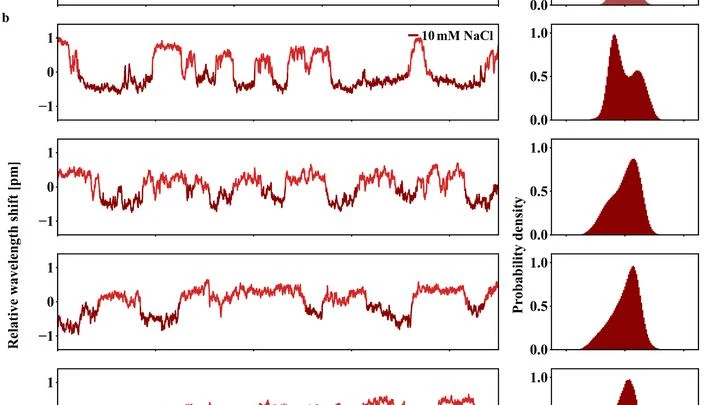
In a dark room, you can hold a glowing sphere without touching it: walls of light push it away but do not burn it. That is roughly how the trap built in Rio de Janeiro for yeast cells works. A conventional optical tweezer, that is, a focused laser beam, acts like tweezers made of light, but the light itself pierces the cell from side to side.
Organic light-emitting materials are like a busy intersection without traffic lights. Molecules receive energy but, instead of honestly giving it back as light, they often turn into dead ends: they form dark pairs (exciplexes — short-lived complexes that do not emit) or collide with each other, losing charge.
A protein in a cell is not a frozen sculpture but a restless mechanism. Its parts are constantly vibrating, and these movements determine how it grabs molecules, transmits signals, or builds the cellular scaffold. But filming the life of a single protein was hampered by two nuisances at once. First, the movements last millionths of a second — ordinary cameras simply cannot catch them.
Imagine photographing a statue in dim light. You face a dilemma: take one bright shot or a series of dim frames from different angles. In the first case, quality is limited by photon noise, the graininess that arises from a lack of photons, while in the second, details overlap, making it harder to reconstruct the 3D structure.
Dozens of copper coils in an MRI scanner pick up the faint response from tissues, like microphones trying to catch a whisper in a noisy hall. Each microphone drags a thick bundle of wires behind it. The wires press on each other, create electrical interference, heat up, and add risk for the patient.
A typical laser is a cavity where light bounces between mirrors and gets amplified. But you can ditch the mirrors and make light circulate inside a tiny particle smaller than the light wave itself. That's how the new lasers work: nanoparticles of indium phosphide sitting on perfectly smooth gold.
A guitar string is stretched between two mirrors. A beam of light bounces back and forth between them, and the string shudders at every touch. Sometimes the light loses energy — the string takes it and dissipates it as heat, like a fading sound. Other times, the string shifts the pitch of the light itself, changing its color but barely dimming it.
Two white sheets lie in the sun — one rough, one smooth. Which one heats up less? The rough one scatters light more strongly, so it seems it would stay cooler. But if the coating is made of many transparent glass beads, the logic changes. Light wanders through it like in a thick fog, and at some point it stops noticing individual droplets.
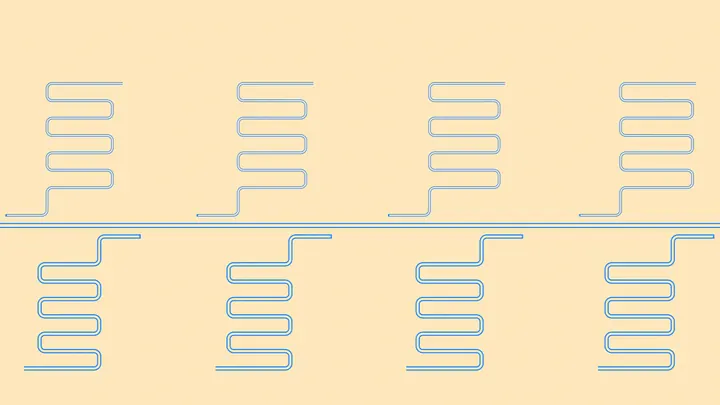
A quantum computer is like an orchestra where every musician-qubit must play in perfect silence. But when you have many such orchestras that want to perform together, they need a reliable conductor-communicator.
A drummer beats a rhythm, and the drumhead vibrates in time. If you strike often enough, the vibrations overlap, and a nearly stationary zone, a node, forms at the center. A similar effect occurs with microwaves in a material whose properties change over time. When the changes resonate with the wave, its motion freezes.
A freshly polished niobium surface shines like a mirror. But within minutes, a dull oxide film, invisible to the eye, forms on it. For a superconducting qubit, this film is like sand in an hourglass: it causes the quantum state to decay prematurely.
Quantum computers and sensors operate at microwave frequencies, but transmitting their signals over long distances is conveniently done via optical fibers, which use light.
A gas bubble in water sings loudly — this is Minnaert resonance: the heavy liquid prevents the bubble from compressing quickly, forcing it to vibrate. In air, there's no such effect: air is too light. But if you dress the bubble in a soft silicone shell, like rubber, it plays the role of the water mass. You get an 'elasto-bubble'.
A green flashlight beam dives into a pool and reaches the bottom with barely any loss. Water is transparent to green light, which is why it's used for underwater communication. But to send video or sensor data, the light needs to be switched on and off very quickly — billions of times per second. Ordinary lasers are too slow and unstable for this.
You can squeeze light between two mirrors like a spring in a vise. It bounces back and forth, growing denser: that's how you get ultra-bright beams. But there's a limit: at too high a brightness, the mirrors start to shake. The light rocks them the way wind rocks a swing, and some energy leaks into that jitter.
A microwave signal that doesn't jitter from interference is needed in both radar and telecommunications. Until now, a clean signal was obtained on bulky setups where lasers and resonators sat on an optical table. Now engineers have packed everything into a box the size of a cup—166 milliliters.
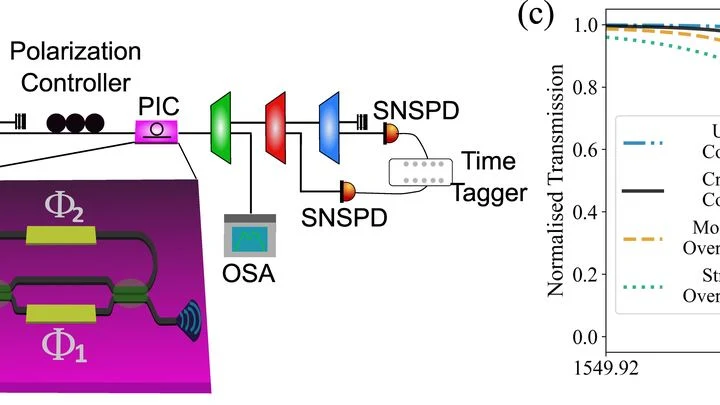
If light could be bottled, scientists would have the perfect assembly line: one bottle — exactly one photon, no stray drops. Such single particles of light are needed for quantum computers and secure communication: they carry information that cannot be eavesdropped on unnoticed.
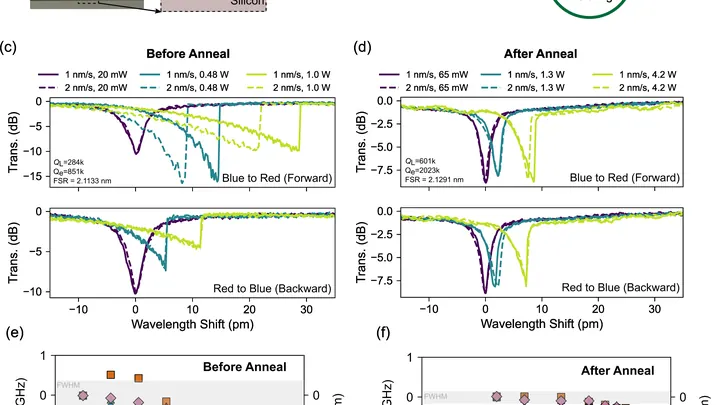
Light in a tiny ring is like water in a closed channel: if you push the flow too hard, the walls start to shake and the channel changes shape. In optical microrings, the water is played by a laser beam, and the walls are a crystalline track thinner than a hair.
Magnetic materials can store oscillatory energy, like a tuning fork that keeps ringing after being struck. When such a material is placed in a microwave cavity, its oscillations (magnons) start interacting with light (photons).
An ordinary chemical reaction is like a ball rolling down a hill: it has one natural path. But if you place molecules in a tiny mirrored box, an optical microresonator, the light inside starts to interfere with the ball's motion. It can nudge it, hold it back, or even split its trajectory.
In a new study, physicists traced exactly how this happens.
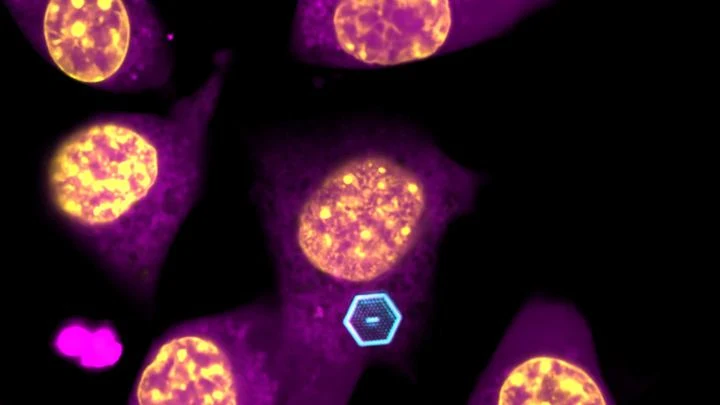
You can trap light in a cage smaller than a speck of dust. Photonic crystals are lattices that stop light from scattering and force it to run in circles. Previously, such structures were grown on a bulky substrate, making them too large for living cells.
For the quantum internet, we need to learn how to hold light — much like mail is sorted at intermediate nodes. The technology is based on a thin crystal plate doped with europium ions, a rare-earth element that, incidentally, is responsible for the red glow of smartphone screens.
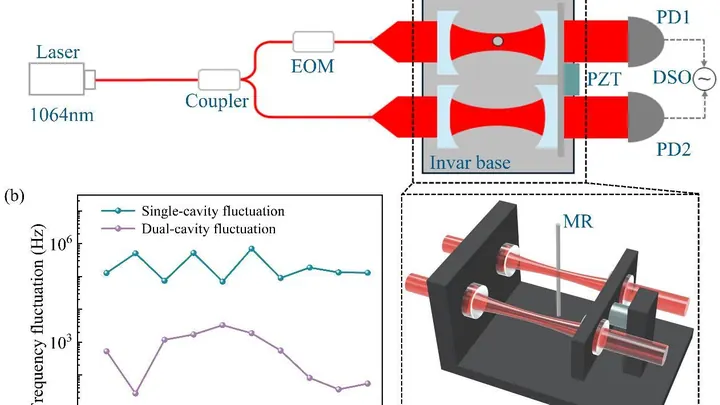
Tuning a string: higher harmonics help hold the pitch without drowning out the fundamental note. In an optical microcavity, a tiny resonator made of two mirrors, light bounces between the reflective surfaces, and any jitter in the spacing knocks it off resonance.