Light Splits Evenly: Geometry Instead of Mirrors express
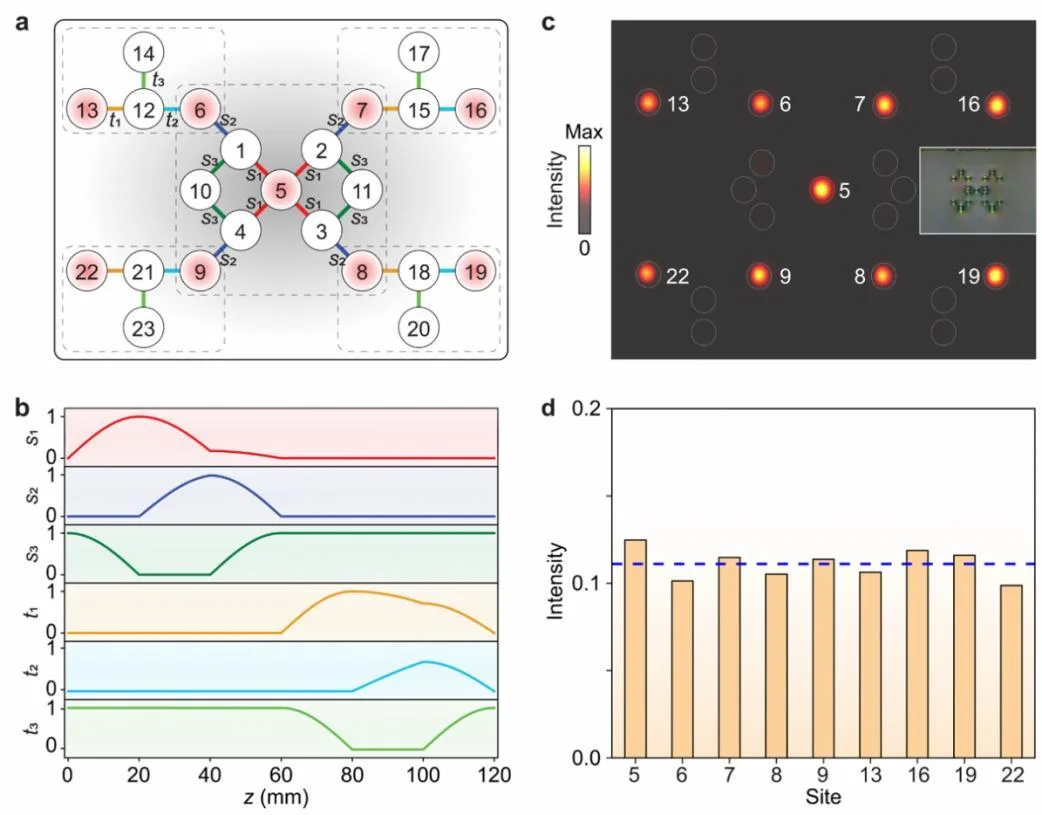
Light from a single bulb usually spreads in all directions, and catching it in equal portions across several channels is quite a puzzle. In the new work, light is split into nine identical beams without a single lens or mirror. Instead, there's a glass plate with etched waveguide paths, along which light naturally flows in the desired way.
The secret is that light in such waveguides behaves not like a stream of particles but like a wave, and this wave has its own 'geometry'—a special property that depends on the shape of the path. By changing the shape of the paths, you can make the light split into strictly equal parts. It's as if a river, meeting a fork of nine identical channels, would naturally spread into them perfectly evenly.
Such precision is needed when signals from different beams must coincide down to the tiniest fractions of a wave. Today, complex control systems are used for this, but here geometry alone does the trick. This opens the way to miniature optical chips where light processes information like electrons in ordinary processors — only faster and without overheating.
The glass microchip used to split light is smaller than a fingernail, yet it replaces an entire optical table with mirrors and lenses.
In the series 'The Expanse', light signals between ships and stations are transmitted through fiber optics — similar chips could make such communication more compact and reliable.