object

photon sphere

A spherical region around a black hole where gravity bends light into circular orbits.
73 related articles

Description

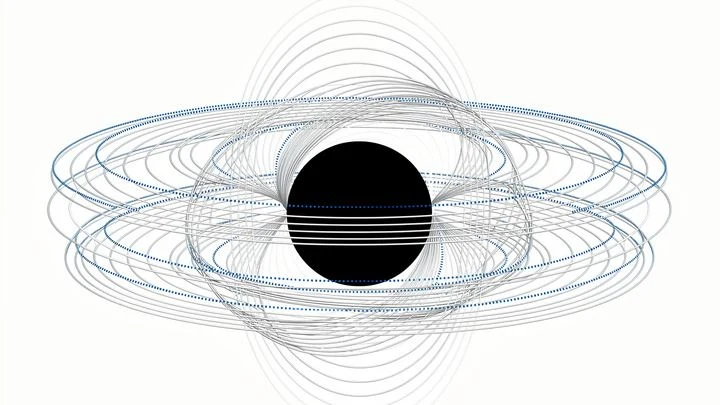
The photon sphere is a spherical boundary around a black hole where gravity is so strong that light must travel in a circular orbit. At this radius, photons can orbit the black hole indefinitely, neither falling in nor escaping. The photon sphere is a key feature in understanding black hole shadows and gravitational lensing, as it defines the region where light paths become highly curved.

History

The concept of a photon sphere was first derived by David Finkelstein in 1958, building on earlier work on Schwarzschild geometry. It became more widely known through the work of James Bardeen and others in the 1970s on black hole astrophysics.

How it works

For a non-rotating (Schwarzschild) black hole, the photon sphere lies at 1.5 times the Schwarzschild radius. Light passing near this region is deflected so strongly that it can loop around the black hole multiple times before escaping or being captured. The innermost stable circular orbit for photons is exactly at this radius, and any perturbation causes the photon to either plunge into the black hole or spiral outward. For rotating (Kerr) black holes, the photon sphere is distorted into a more complex shape, with different radii for prograde and retrograde orbits.

In practice

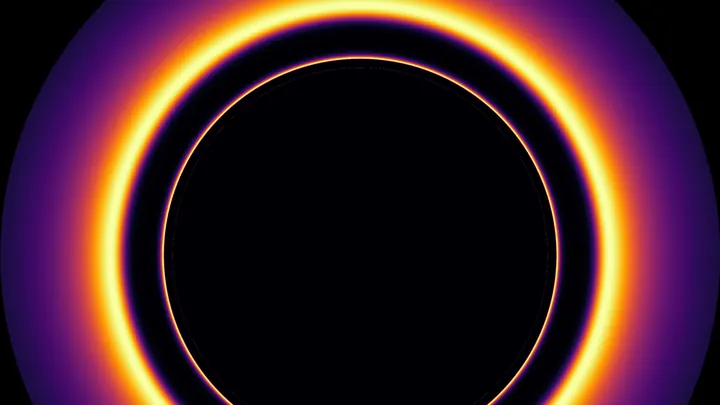
The photon sphere is crucial for interpreting images of black holes, such as those taken by the Event Horizon Telescope. The bright ring seen in these images is the photon ring, which is the projection of the photon sphere onto the observer's sky.

Fun fact

If you were standing on the photon sphere, you could see the back of your own head, because light from your head would travel all the way around the black hole and come back to your eyes.


Concept graph →

Related articles · 73

HEP Theory2026-08-102 minarXiv:2608.09797express
Black Hole Rings Like a Hot Bell
Drop a pebble into a pond, and ripples spread across the water. Something similar happens when a black hole merges with another: it emits gravitational waves that resemble the fading ring of a bell.
General Relativity2026-08-101 minarXiv:2608.11264express
Where Stars End and the Invisible Begins
A galaxy is like a city: bright lights and dense buildings at the center, sparse lights and emptiness toward the outskirts. But if you watch how gas rotates in a galaxy's disk, you see that its speed barely drops at the edges. As if invisible neighborhoods keep the motion going. Astronomers have found a way to map this invisible city.
General Relativity2026-08-052 minarXiv:2608.05270express
A Bright Spot in a Black Hole's Shadow
A black hole's shadow isn't just a black circle. Usually, we see a dark void surrounded by a glowing ring of hot gas. But if a black hole wasn't born from a dying star but has existed forever, its shadow might hide a surprise. An eternal black hole is a solution to Einstein's equations with no past and no collapse.
High Energy2026-07-312 minarXiv:2607.29121express
A Black Hole's Shadow with a Secret from Other Dimensions
A cosmic object spins, but its shadow isn't round. Astrophysicists examined a black hole in an unusual version of gravity — the so-called brane world (where our universe is a three-dimensional surface in a space of higher dimensions).
General Relativity2026-07-312 minarXiv:2608.00238express
Light Trapped by a Black Hole with Hair
Light from afar bends around a black hole like a cyclist taking a sharp turn. Get closer, and it starts looping around an invisible sphere of photons. Every black hole has such a sphere, but usually it's wobbly: the slightest nudge sends light flying away or falling in.
Math Physics2026-07-261 minarXiv:2607.23873express
Balls on a Curved Stage
In a vast hall, billiard balls are scattered about. At first they lie sparsely, each on its own. Then someone adds more, and suddenly the balls compress into dense clusters. This is a phase transition — the moment when matter abruptly changes its state. Physicists have long described such a picture with the hard-sphere model: particles are identical balls that cannot overlap.
General Relativity2026-07-231 minarXiv:2607.20945express
A White Hole in the Lens: What the Telescope Will See
A black hole is a place from which nothing can escape. But some theories allow that deep inside, at the quantum level, it might bounce and turn into its opposite — a white hole, which only spews out matter and light. A group of physicists built a computer model of such a transformation.
General Relativity2026-07-192 minarXiv:2607.17367express
Dark Matter Tunes Black Holes Like Quantum Instruments
At the center of many galaxies lurks a black hole, wrapped in an invisible cloud — the halo of dark matter. This is not just a featureless mass: its density changes from the edge to the center, and the degree of this "compression" is called compactness.
General Relativity2026-07-181 minarXiv:2607.16842express
How a Spinning Black Hole Bends Light in a New Way
A light ray passing by a massive body gets deflected: this is the effect of gravitational lensing, familiar from images of distant galaxies. The astrophysicists started with a rotating black hole (Kerr spacetime) and added a tiny correction to how light itself propagates.
Shadow Symphony: How Data Became a Portrait of a Black Hole
In 2019, the world saw the first image of a black hole's shadow — an orange doughnut on a black background, becoming a symbol of scientific progress. But this image wasn't captured by a camera: it was born from mathematical alchemy, where data from eight radio telescopes, which gathered only crumbs of signal, merged into a single picture.
A Top on the Abyss's Edge: How Polarized Light Betrays Black Hole Spin
At the hearts of many galaxies, cosmic tops of incredible power spin — supermassive black holes. Their nature was first described by Schwarzschild right after Einstein gifted the world with general relativity.
The Neutrino Aria of Black Holes: Listening in on Silent Dark Matter
Dark matter remains the inaudible bass line of the cosmic symphony — it emits no light, but its gravitational pull shapes galaxies. Vera Rubin first caught this rhythm in the 1970s by observing the rotation of stars.
General Relativity2026-07-121 minarXiv:2607.10533express
Spindle Black Hole: The Shadow Changes Shape
At the center of attention is a black hole of unusual shape. Its geometry resembles a spindle: a slight elongation is added to the usual rotation. The parameter B measures this deformation. The spindle deformation is not just a mathematical toy.
The Liquid Mirror of the Horizon: How a Partonic Ocean Gives Black Holes an Electric Soul
For a long time, the event horizon behaved like a cosmic dictator: everything that crossed its boundary vanished irretrievably from our Universe. But quantum mechanics, like a dissident's voice, whispered: information cannot simply disappear.
General Relativity2026-07-122 minarXiv:2607.10658express
A Black Hole in Polarized Glasses
A black hole is not just a dark silhouette against the stars. Its shadow is surrounded by a thin glowing ring of photons that loop around the event horizon before escaping to an observer.
General Relativity2026-07-122 minarXiv:2607.10713express
Black Holes Without Singularities: Almost Indistinguishable
An ordinary black hole hides a singularity at its center — a point where density and curvature become infinite and the laws of physics break down. The authors of the new work built a model of a rotating black hole that, instead of a singularity, contains a calm "core" resembling ordinary flat space.
Galaxies2026-07-083 minarXiv:2607.06902
Black Holes Spin Every Which Way, Ignoring Their Galaxies
For decades astrophysicists painted a neat picture: a galaxy, like a giant carousel, spins in a unified rhythm, and the supermassive black hole at its center inherits that dance.
General Relativity2026-07-082 minarXiv:2607.07955express
Cosmic Mirage: How Smearing Mass Changes a Black Hole's Shadow
At the center of an ordinary black hole, according to classical ideas, lurks a singularity — a point of infinite density where the laws of physics break down. But some theories, inspired by the duality idea from string theory, propose replacing the point with a tiny 'smudged' region.
HEP Theory2026-06-291 minarXiv:2606.30794express
A Black Hole in a Fluffy Fur Coat
An ordinary black hole is surrounded by a thin photon sphere — a place where light can loop around before falling in or escaping. In the new work, this region has puffed up into a whole layer packed with massless particles that zip around at nearly the speed of light and don't press against the walls.
General Relativity2026-06-291 minarXiv:2606.30865express
Black Holes Grow a Fur Coat on the Fly
Two black holes race past each other like Formula 1 cars on opposite lanes. In standard general relativity, they remain 'bald'—no extra fields appear around them. But if you add a scalar field to the equations (something like an invisible fog permeating space), the rules change.
General Relativity2026-06-282 minarXiv:2606.29418express
A Cosmic Lens at the Very Edge of a Black Hole
A cosmic ray approaches a black hole almost tangentially. Instead of falling straight in, it lingers on an unstable orbit, like an acrobat balancing on a tightrope over an abyss. After a few loops, the light finally escapes toward a distant observer. Such rays produce multiple images of the same source, known as higher-order images.
General Relativity2026-06-261 minarXiv:2606.27958express
Black Hole Grows a Cloud Without Outflow
A black hole with a magnetic field resembles a whirlpool in a river, where water doesn't flow into the vortex but swirls in place. Usually, the hole's rotation picks up waves and amplifies them: this is called superradiance. But add a magnetic field, and everything changes.
Cosmology2026-06-231 minarXiv:2606.25031express
Dark Spikes Around Black Holes
At the center of a galaxy, gravity condenses dark matter into a dense 'spike.' Such a dark spike resembles a funnel of invisible particles around a massive body. But if both the center and the particles are primordial black holes, the picture breaks down.
General Relativity2026-06-151 minarXiv:2606.17284express
The Shadow of a Charged Black Hole
A black hole is a place where gravity is so strong that even light cannot escape. But around it there is a glowing ring of gas, and in the center a dark void known as the shadow. The size of this shadow depends on how spacetime is curved.
General Relativity2026-06-142 minarXiv:2606.15727express
A Black Hole's Shadow as a Mirror of Unknown Gravity
A black hole is not just a dark spot in the sky. Its shadow falls on the glowing backdrop of infalling matter and carries the imprint of spacetime geometry itself. If gravity works even slightly differently than we think, the shadow will give it away. In a new study, physicists traced light rays around a rotating black hole in so-called Rastall gravity.
HEP Phenomenology2026-06-112 minarXiv:2606.13788express
Invisible Black Holes Leave a Mark in Gamma-Ray Light
A swarm of tiny ice balls is scattered across a warm room. Some melt faster, others slower, but when only wet spots remain, they all vanish in the same way: the last drop evaporates according to the same law. This is roughly how primordial black holes behave — hypothetical objects born in the first moments after the big bang.
High Energy2026-06-101 minarXiv:2606.12518express
Black Hole Spin Paints a Polarization Pattern
A spinning top whirling so fast that it forces light around it into spirals: that's a fitting image for what happens near a black hole's horizon. Hot plasma falls in and emits radio waves. Their polarization (the plane in which the wave oscillates) becomes an arrow pointing in the direction of energy flow.
General Relativity2026-06-102 minarXiv:2606.12698express
A Black Hole of Loops and Shadows
Drop a pebble into a pond, and ripples spread across the water. A black hole 'sounds' much the same when matter falls into it or when its spacetime gets a gentle jolt. These fading oscillations are called quasinormal modes, like the tolling of a bell that gradually fades away.
General Relativity2026-06-091 minarXiv:2606.10792express
A Black Hole from Nothing
Emptiness can surprise you. In general relativity, there is a solution where space itself gives birth to a black hole — literally from a point. It all starts at the moment when the event horizon (the surface from which not even light can escape) appears with zero radius and immediately begins to grow.
General Relativity2026-05-301 minarXiv:2606.00456express
Black Hole Shadows: Geometry in the Service of Gravity
Light passing by a black hole swirls like water down a bathtub drain. The most intriguing part is the thin ring where rays can orbit forever, neither falling in nor escaping. This is the photon sphere — an invisible boundary that paints the hole's shadow on the sky.
HEP Theory2026-05-282 minarXiv:2605.29923express
How a Black Hole's Photon Ring Reveals Its Chaos
A light beam approaches a black hole not head-on, but at a glancing angle. If the angle is just right, the light neither falls in nor escapes: it starts looping around, like a figure skater circling the rim of a funnel. This narrow track is the photon ring. It acts like a lens, repeatedly reflecting the image of everything that falls into the hole.
General Relativity2026-05-271 minarXiv:2605.28376express
Shadow of a Shaggy Beast: How Scalar Hair Shatters a Black Hole’s Image
A black hole isn’t a perfectly smooth ball. Einstein’s theory allows invisible 'hair' — clumps of scalar field — to swarm around it, warping spacetime. The shadow — the dark region from which light can’t escape — was predicted by Penrose in the 1960s.
HEP Theory2026-05-262 minarXiv:2605.26829express
How a Black Hole Breaks the Rules of Chaos
Drop a handful of sand into calm water — the ripples spread and fade. Drop it into a running blender — the vortices mix everything in an instant. Physics has a similar rule: chaos cannot grow faster than a certain rate.
General Relativity2026-05-261 minarXiv:2605.27242express
Light Delay Near Black Holes Will Uncover the Mystery of Dark Matter
The gravity of a black hole creates a curvature of spacetime, acting like a lens: light from a distant galaxy splits in two, stretching into arcs. Dark matter around the hole barely changes the picture, as if a transparent curtain was added to a window pane.
General Relativity2026-05-232 minarXiv:2605.24369express
The Shadow of a Black Hole: How Bent Light Paints a Portrait of the Invisible
Around an invisible fire, glowing gas swirls. The fire itself is hidden, but its outline can be guessed from the way the flames dance. That's roughly how astronomers 'see' black holes — not the object itself, but the superheated matter that, before plunging into the abyss, accelerates to enormous speeds and shines.
General Relativity2026-05-231 minarXiv:2605.28871express
Black Hole Shadows Put Quantum Gravity to the Test
The shadow of a black hole is not just a silhouette. It's the edge of the abyss, where space and time are twisted so tightly that even light is forced to swirl like a wood chip in a whirlpool. This 'cosmic whirlpool' arises from the monstrous mass warping spacetime.
General Relativity2026-05-211 minarXiv:2605.22696express
Black Hole Pinball: How Spin Creates Dark Matter
Light passing by a black hole falls into a gravitational trap: its trajectory curves and the particle bounces along a nearly closed orbit, like a pinball.
General Relativity2026-05-142 minarXiv:2605.15330express
A Black Hole in a Dark Matter Cap
A whirlpool in a river sucks everything in. Now imagine adding an invisible jelly to the water that thickens near the vortex and suddenly vanishes at its edge: that's roughly what a black hole looks like in a new mathematical model.
HEP Theory2026-05-141 minarXiv:2605.26124express
How Brane Tension Changes Black Holes
Our Universe behaves like a stretched elastic sheet: massive bodies dent it, creating spacetime curvature — gravity. In brane-world theory, a hidden dimension is added, and this sheet becomes just a surface in a higher-dimensional space. The brane tension determines how much the sheet dents: the weaker the tension, the weaker the gravity.
Polarization Echo: Light Catches the Gravitational Ringing of a Black Hole
When two black holes merge, they shake the very fabric of spacetime. The newborn giant doesn't settle instantly (it rings like a cosmic bell, emitting a characteristic pattern of damped gravitational waves) the so-called ringdown.