Mirror symmetry, or parity symmetry, is the property of a physical system to remain unchanged when spatial coordinates are inverted — as if reflected in a mirror. In particle physics, this means that the laws governing a process should be identical to those governing its mirror image. For decades, physicists assumed this symmetry was fundamental, but experiments in the 1950s showed that the weak nuclear force violates it, meaning some processes occur preferentially in one 'handedness' over the other.
History
The concept was formalized in quantum mechanics in the 1920s–1930s, with Eugene Wigner providing a rigorous treatment. The violation of parity in weak interactions was proposed by Chen-Ning Yang and Tsung-Dao Lee in 1956 and confirmed experimentally by Chien-Shiung Wu in 1957.
How it works
In mathematical terms, paritytransformation flips the sign of all spatial coordinates (x, y, z) → (−x, −y, −z). A system has mirror symmetry if its Hamiltonian (energy operator) commutes with the parity operator. When this symmetry is exact, every physical state has a mirror counterpart with identical energy and behavior. In practice, testing parity involves comparing rates of processes with their mirror images, often using polarized particles or chiral molecules.
In practice
Parity violation is exploited in neutrino detection and in studying the chiral structure of fundamental interactions, as well as in medical imaging techniques like PET scans that rely on weak interaction processes.
Fun fact
The universe itself may have a slight left-handed bias, as evidenced by the fact that all observed neutrinos are left-handed and antineutrinos right-handed.
A tightly stretched membrane, squeezed into a narrow case, decides on its own where to burst. So does a cell: when it is cramped, the point of division shifts from the middle, and the two halves come out unequal. Previously, it was thought that such asymmetry is predetermined by chemical labels, but the new work shows that mechanics alone is enough.
An ordinary mirror swaps left and right. Many laws of physics don't notice the swap: they are mirror-symmetric. But some phenomena, like the weak interaction, break this symmetry. Until now, it was thought that gravity and light each break mirror symmetry in their own independent way.
A rotating black hole is no calm whirlpool. Space around it shudders and rings at the slightest disturbance, like a guitar string after a pluck. These oscillations are described by the Teukolsky equation — a complex mathematical construct that physicists have studied for half a century.
Recently, a strange symmetry was noticed in this equation.
An old house. The facade is freshly painted, the stairs don't creak. A pretty picture. But try to move in heavy furniture, and the floorboards give way. The beauty of the facade says nothing about the strength of the floors.
It's much the same with black holes without singularities.
A magnetic mirror is a tube open at both ends. The magnetic field inside is arranged so that hot plasma doesn't leak out: at the ends, the field lines bunch up like a cork in a bottle. Plasma particles flying toward the exit are repelled by these "corks" and bounce back. But some still escape: that's the classic "loss cone" argument.
The early Universe was not just a hot soup of particles. In the first fractions of a second, mirror symmetry could have been broken: the world and its reflection would not be quite identical. If so, the large-scale cosmic web of galaxies would retain a barely noticeable 'curl'—as if all matter were slightly twisted in one direction.
The race for fusion energy is like trying to bottle a lightning bolt. For decades, physicists have struggled to recreate on Earth the processes that power the Sun. The main challenge is getting light nuclei to fuse despite their mutual repulsion, while extracting more energy than was spent heating and confining the plasma.
Place two identical alarm clocks on a table and set them off at the same time. If one is on a slippery surface and starts to slowly slide, its timing will be thrown off, and within a minute they'll ring out of sync. That's roughly how the new method proposed by astrophysicists for supermassive black holes works.
Light usually behaves like a pedestrian on a two-way street: the path from a streetlamp to a camera matches the reverse path. But near a rotating black hole with broken spatial symmetry, this street becomes one-way. Swap the light source and observer, and the hole's shadow changes shape: from an oval resembling a rugby ball, it turns into a teardrop.
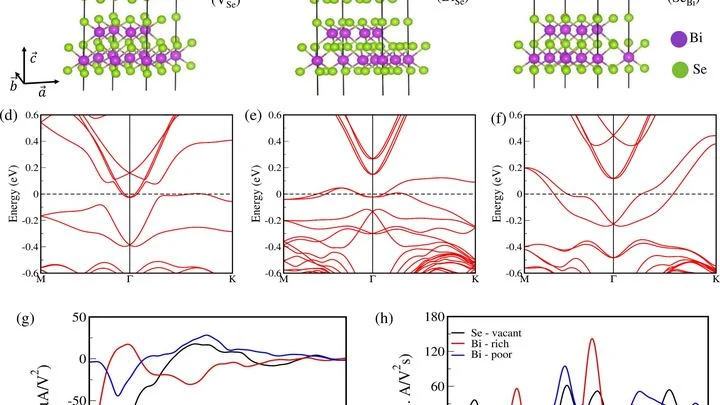
The crystal bismuth selenide (Bi₂Se₃) is symmetric by itself, like a neatly stacked sandwich: flip it over, and nothing changes. But twist one layer slightly relative to the other, and the symmetry breaks. The material begins to 'feel' which side the light comes from and responds with an electric current.
In the quantum world, there are rules that seem to be broken. One of them is the conservation law: if in classical physics symmetry guarantees the conservation of charge, then in the quantum description this guarantee can disappear. This phenomenon is called a quantum anomaly.
The universe wasn't born alone — alongside it came a mirror twin where everything is reversed: left and right are swapped and time flows from future to past. After the Big Bang, the world, according to Alan Guth's idea of superfast inflation, should have contained equal amounts of matter and antimatter.
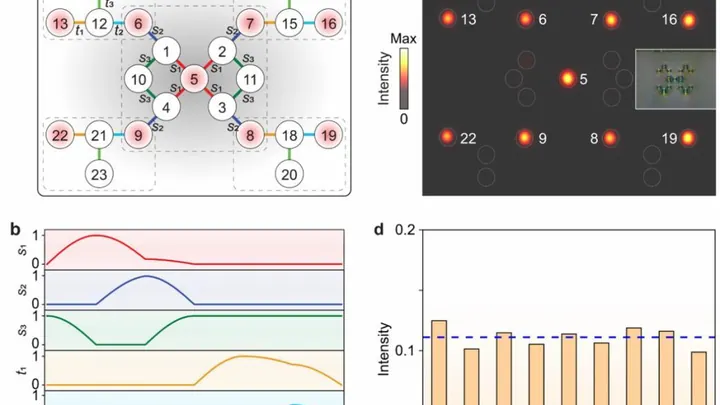
Light from a single bulb usually spreads in all directions, and catching it in equal portions across several channels is quite a puzzle. In the new work, light is split into nine identical beams without a single lens or mirror. Instead, there's a glass plate with etched waveguide paths, along which light naturally flows in the desired way.
Two beams of light, red and blue, enter a tiny ring made of silicon nitride. The ring is smaller than the thickness of a human hair. At the input, both beams are equally bright. But inside the ring, one of them suddenly starts to outshine the other, like two equally matched people in a debate where one unexpectedly gains the upper hand.
In an accelerator, two Higgs particles collide. For a fleeting moment, their fates intertwine, then separate, carrying away information about the encounter.
Two vessels of water at different temperatures are separated by a thin partition. As long as the partition is intact, each vessel lives its own life: in one, the water is hot; in the other, it's icy. But once the partition is removed, the temperatures begin to equalize, and eventually both vessels reach the same state.