Coherent spectroscopy is a family of techniques that use light with a well-defined phase relationship — coherent light, typically from lasers — to probe the quantum states of matter. Unlike conventional spectroscopy, which simply measures how much light is absorbed or emitted at each frequency, coherent spectroscopy exploits the wave nature of light and matter to extract information about quantum superpositions, energy-level structures, and dynamical processes. It is the foundation of many modern quantum technologies, from atomic clocks to quantum computing.
History
The field emerged in the 1960s and 1970s with the development of lasers and the theoretical work on coherent transients by Richard Brewer and others. The technique of photon echoes, a cornerstone of coherent spectroscopy, was first predicted by Erwin Hahn in 1950 and demonstrated in optics by I. D. Abella, N. A. Kurnit, and S. R. Hartmann in 1966.
How it works
The key idea is that a coherent light pulse can prepare a quantum system in a superposition of states. A second pulse, delayed in time, can then interfere with the first, creating an echo or a beat signal that reveals the system's coherence properties. By varying the time delay and frequency of the pulses, researchers can map out the energy landscape of the system with high precision, even in the presence of noise or disorder.
In practice
Coherent spectroscopy is used in atomic clocks, quantum memory devices, and in the characterization of semiconductor nanostructures and molecular dynamics.
Fun fact
The photon echo, a key phenomenon in coherent spectroscopy, is the optical analogue of the spin echo used in MRI machines.
Surf doesn't roll onto the shore as an even front. It comes in tongues of foam that merge and split apart. Magnetic fields inside materials behave much the same way: they breathe in waves, and until now nobody had seen them whole.
In a hall with a thousand spectators, applause blends into a general noise, but if someone falls out of rhythm — a ripple runs through the crowd. The quantum world works similarly: atoms in a trap can behave as a single whole, or they can fall apart into independent individuals.
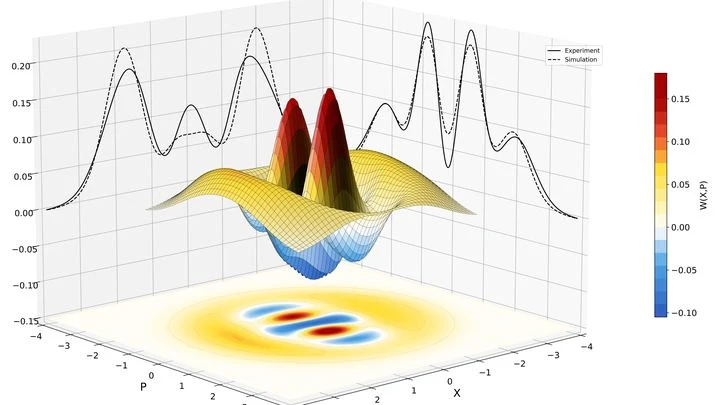
A delicate watermark on wet paper, and a fogged-up glass before your eyes. That's roughly what reading quantum states of light looks like: fragile photon patterns get distorted by losses, and detectors catch only a small fraction of the signal.
Each positron annihilation is like the birth of a pair of dancers, connected by an invisible thread of polarization. Two gamma quanta fly apart, but their states remain entangled: measuring one instantly determines the other — as if one partner senses every movement of the other, no matter the distance.
Light from an ordinary bulb seems utterly chaotic: its waves oscillate out of sync, like a crowd where everyone walks in their own direction. Such light is called incoherent. For a long time, it was believed that elegant topological structures (knots, rings, links) could only be created in coherent laser light, where all waves march in step.
A quantum computer measures a molecule's energy much like an old tape measure that only has markings every meter. If the actual length of a table is 2.37 meters, the tape shows “two and a bit,” and you can't do better. Physicists call this resolution: the step of the grid, finer than which you cannot go.
The authors of the new work turn this flaw into an advantage.
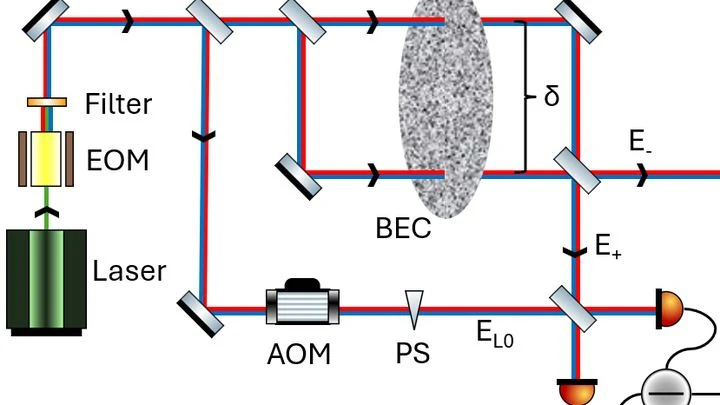
Physicists have proposed an experiment: a laser beam acts as a quantum detector and splits into two beam-ears. Each ear is directed through a tiny cloud of ultracold atoms — in this state, atoms merge into a single wave.
Light can be more than just a beam: it can be a precision ruler. If you take very short pulses, shorter than a fly's wingbeat, and fire them one after another, you get an optical comb: a set of colors spaced at exactly equal intervals, like the teeth of a comb. This rainbow lets you measure distances, time, and the composition of materials with unimaginable accuracy.
Ever since Paul Dirac theoretically predicted antimatter, physicists have been hunting for the tiniest differences between particles and their antiparticles.
A squad of soldiers marches across a parade ground. As long as everyone keeps in step, the movement remains sharp and coordinated. But if someone falls out of line, the order is lost. In the microworld, electrons play the role of such a squad: when their oscillations are synchronized, the substance emits a narrow, sharp line.
An ordinary laser emits narrow lines, like a string that sounds only one note. For spectroscopy, this is inconvenient: if a substance absorbs light between the lines, you might miss it.
Atoms in a beam travel at different speeds, like runners on a track. A regular laser pulse only pushes those moving at one speed, but the new one acts like a coach giving commands to the whole group at once. This approach involves more atoms in the measurement.
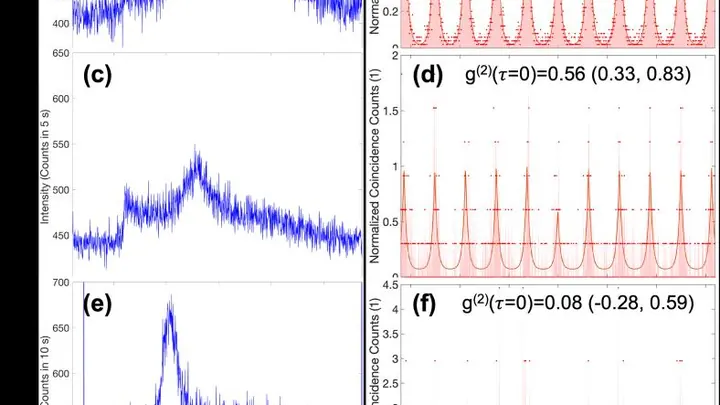
A quantum dot is like a tiny lamp that turns on and off at the command of a laser, emitting exactly one photon at a time. But this light has a quirk: the photons don't interact with each other; they fly independently, like random drops from a faucet.
In a dark room, an atom and light are locked together in a mirrored box. The box is so small that the atom cannot simply release light: they constantly exchange energy, like two dancers who never let go of each other's hands.
Two clocks in different rooms need to tick in unison. Usually, this is done by sending bright pulses or pairs of photons that arrive one right after the other. But the signal can be so weak that photons barely make it through. In this work, clocks were synchronized with light a billion times dimmer than usual.
A regular laser is like a choir where everyone sings their own part — the sound is loud, but with inevitable roughness. In the new quantum laser, the singers hear each other and harmonize their voices.
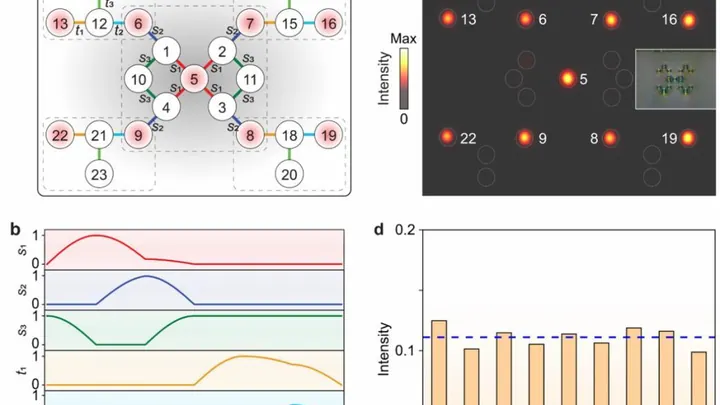
Light from a single bulb usually spreads in all directions, and catching it in equal portions across several channels is quite a puzzle. In the new work, light is split into nine identical beams without a single lens or mirror. Instead, there's a glass plate with etched waveguide paths, along which light naturally flows in the desired way.
The light from a single molecule is like a lone voice in a vast choir. To hear it, you need not a microphone but a delicate instrument that catches each photon and notes its arrival time.
An ordinary laser amplifies light into a bright beam. Run the process in reverse, and you get an anti-laser — a device that sucks in light without a trace. But such a machine is finicky: even a slight disorder can ruin the absorption.
Physicists have found a way to make the anti-laser invulnerable.
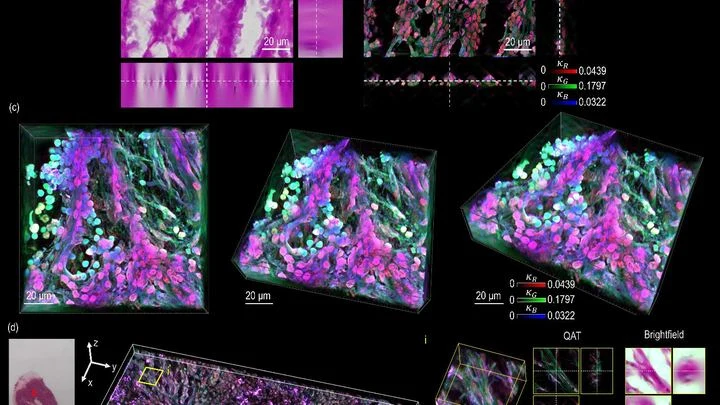
Light passing through a stained cell loses some of its strength, like a flashlight beam cutting through a glass of tea. The denser the color, the more light is absorbed. But until now, a microscope could only show a flat shadow of this process, not its volume.
Physicists built a chain of Rydberg atoms — atoms with electrons in enormous orbits, comparable to planetary paths. These giant atoms feel their neighbors intensely, turning the chain into a quantum analog of a string.
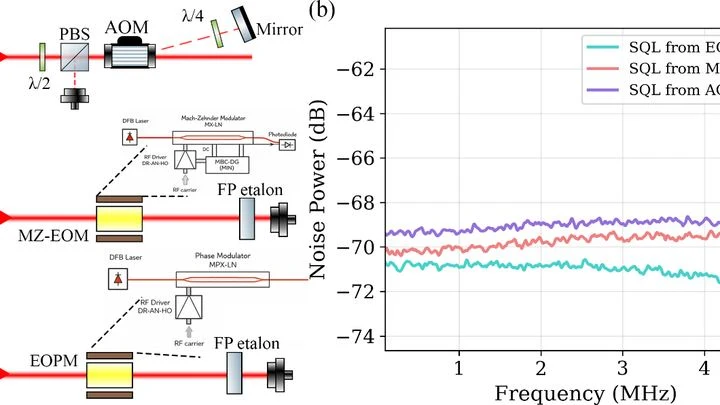
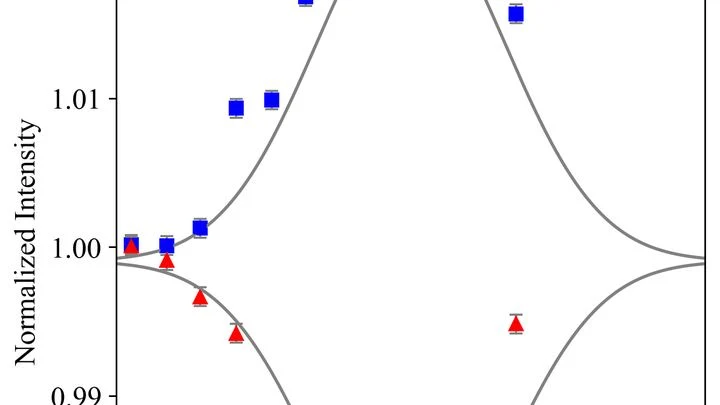
Ordinary light is a stream of photons flying every which way: sometimes more, sometimes fewer, and in that chaos, measurement precision gets lost. Physicists have learned to "tame" this stream by creating squeezed light — where the noise in one characteristic drops below the vacuum level.
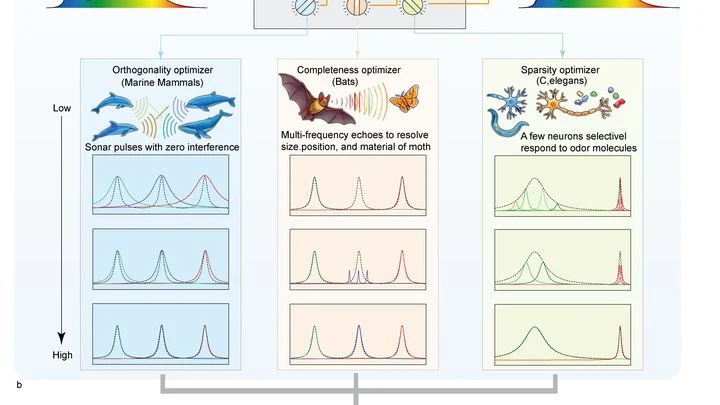
A conventional spectrometer is like a comb that untangles light and sorts it by wavelength. But a comb is rigid: one type of light needs one comb, another needs a different one. The new device works differently. It asks light a series of questions, changing its shape each time to glean more meaning from the answers.
Schrödinger's cat usually hides in thought experiments — alive and dead at the same time. This time, it was caught in the lab: a light pulse was made to be in two opposite states at once, like a coin hovering in the air, heads and tails at the same time.
A laser pointer shines a neat spot: all its light waves march in step, like soldiers on parade. Such light is called coherent. But nature and technology also feature another kind of light—'messy' light, where waves are out of sync, like a crowd at a market. It's called partially coherent.
In a dark room, two flashlights shine on a wall. Usually, their beams simply add up, and the spot becomes brighter. But if the flashlights emit light in special packets, photons, then under certain conditions they can behave differently. Instead of independently hitting different spots, two photons 'agree' and only come out together, as a pair, from a single output.
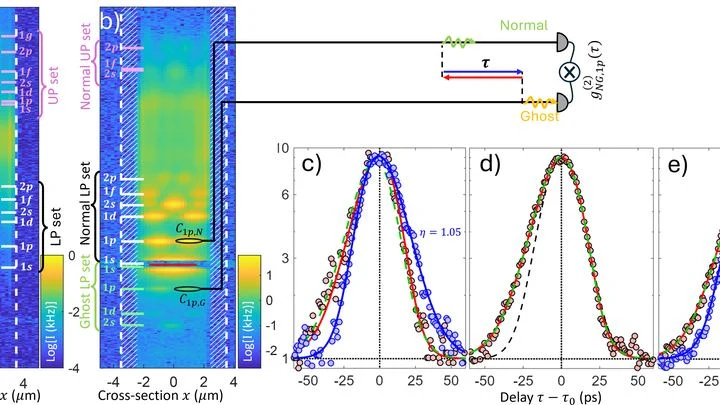
Inside a tiny mirrored cavity, smaller than the thickness of a hair, light is trapped and bounces off the walls many times. If you place a material that can absorb and emit light inside, the light particles (photons) start to 'dress' in excitations of the material — this is how polariton modes are born.
Dark matter makes up 85% of the matter in the Universe, yet remains invisible. It only reveals itself through gravity. We can catch it by its cosmic 'hum' — a faint vibration that permeates space. A single detector is powerless here: the signal is too quiet.
Physicists turn many sensors into a quantum ensemble.
Plants employ an army of perfect couriers to deliver energy. Each photon of sunlight is absorbed, and its energy is instantly, with almost no loss, transferred to reaction centers where nutrient synthesis occurs.
A turnstile lets you through only forward, and not a step back. Physicists have implemented a similar principle on a tiny semiconductor chip for single photons — particles of light.
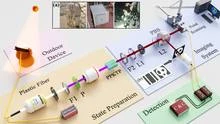
Sunlight collected by a Fresnel lens and passed through 20 meters of plastic fiber had a power of just 3 microwatts, a million times less than a typical laser pointer. That was enough to generate photon pairs correlated in position inside a nonlinear crystal. One photon from each pair passed through the object, the second was scanned by a detector, and coincidences built up the image.
Five superconducting qubits on a chip: the stage for a performance of quantum chaos. Four qubits form the system, and the fifth acts as the environment, introducing dissipation. After a short evolution, the environment is discarded, leaving the system with an open quantum map, an operator that transforms the system's state.
A ruler made of light: that's one way to describe a new method for measuring tiny time delays. In 1987, Chong Ki Hong, Zhe-Yu Ou, and Leonard Mandel noticed that when two indistinguishable photons hit a beam splitter simultaneously, they always exit together from the same port.
Detecting a single quantum emitter is like tuning a piano on a factory floor full of screaming machines: the pure tone drowns in noise. But the tuner doesn’t try to outshout the racket — he picks up a tuning fork and listens for beatings. That’s how even a barely audible echo becomes clear.