Galaxy Colors Trace the Universe's Pattern express
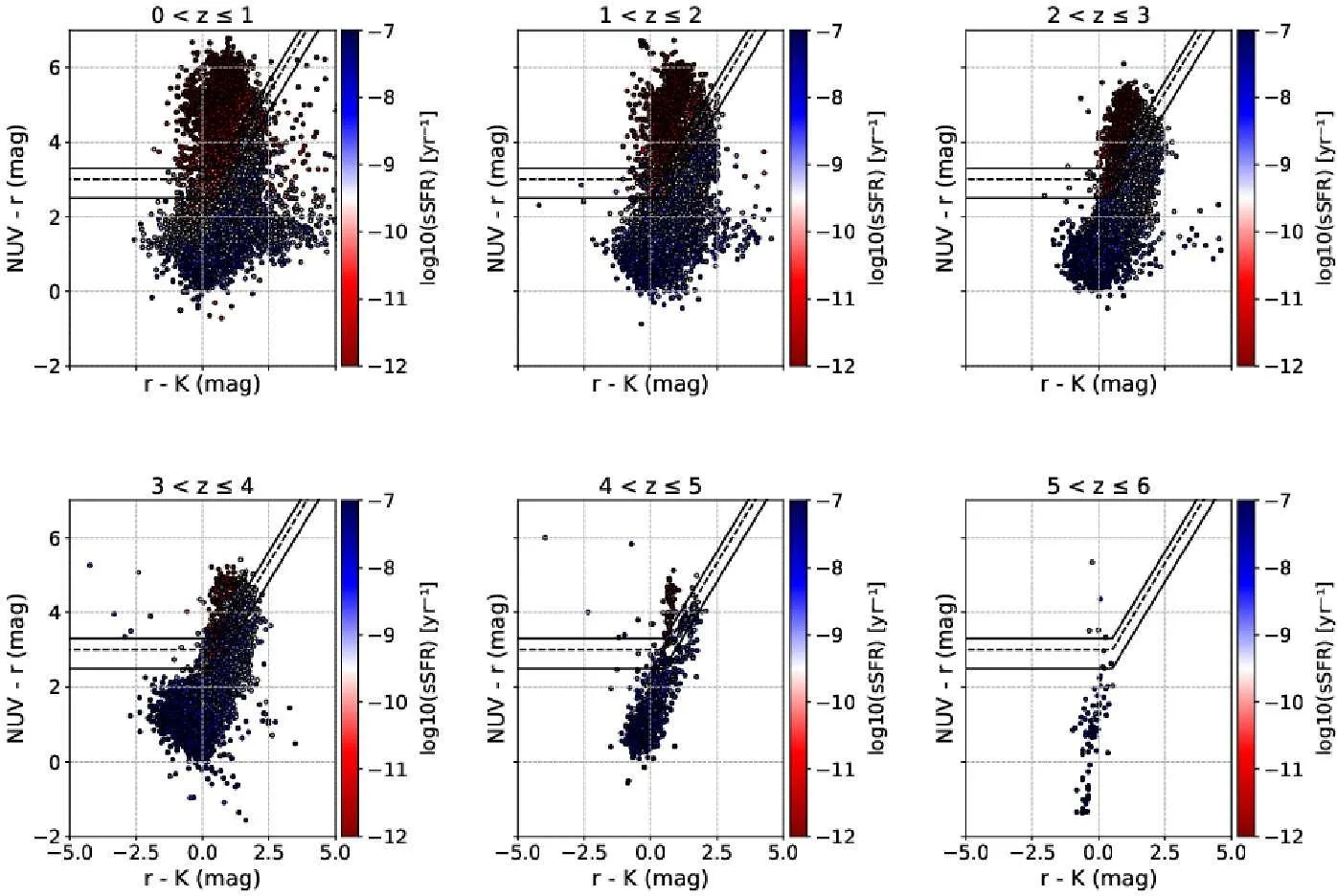
If you spill a handful of colorful beads on the floor, they will land differently: some will clump together, others will scatter into corners. Roughly the same way, galaxies of different colors (blue, green, and red) are scattered across the universe. Scientists decided to measure how 'clumpy' their distribution is using a number called the fractal dimension. It indicates how densely objects fill space: a smooth sheet has dimension 2, a crumpled one slightly less, and scattered points even less.
Astronomers took a catalog of 618,952 galaxies observed up to redshift z=4 (meaning we see them as they were when the universe was less than one and a half billion years old). For each galaxy, the color is known: blue ones are young, with active star formation; red ones are old, where new stars are barely born; green ones are intermediate. It turned out that for nearby galaxies (z<1), the fractal dimension is highest for blue galaxies (up to 2.03), lower for red ones, and lowest for green ones (1.40). That is, blue galaxies are distributed more uniformly, like flour scattered on a table, while green ones are more clumpy, like raisins in a muffin.
But the most interesting part happens at large distances. For galaxies with redshift between 1 and 4, the picture changes: now blue galaxies still have the highest dimension, but green ones become higher than red ones. At the same time, all values drop sharply — to 0.03–0.44. This means that in the young universe, all galaxies, regardless of color, were distributed much more 'clumpily' than now. The cosmic web, a network of dark matter and gas, was denser then and pulled galaxies more strongly into knots and filaments.
So, a galaxy's color acts as a marker of its place in the cosmic web. Blue galaxies are more often found in less dense regions, red ones in dense clusters, and green ones on the outskirts. Over time, this picture changes: galaxies age, redden, and move to denser neighborhoods. The fractal dimension turns out to be a sensitive tool that lets us see this evolution from just the colors and coordinates of galaxies.
The fractal dimension of galaxy distribution in the nearby universe is close to 2 but never reaches 2—meaning galaxies never fill space uniformly; there are always clumps and voids.