The density contrast is a dimensionless number that measures how much denser or sparser a region of the universe is compared to the cosmic average. It is defined as the difference between the local density and the mean density, divided by the mean density. A positive value means the region is overdense, a negative value means it is underdense, and zero means it is exactly average. This quantity is central to cosmology because it quantifies the seeds of structure: tiny initial fluctuations in the density contrast, imprinted shortly after the Big Bang, grew over billions of years under gravity to form galaxies, clusters, and the vast cosmic web.
History
The concept was formalized in the 1940s by Yakov Zeldovich and others, building on earlier work by James Jeans and Georges Lemaître. The modern framework of linear perturbation theory was developed in the 1960s and 1970s, with key contributions from James Peebles and others.
How it works
In the early universe, quantum fluctuations were stretched to cosmic scales during inflation, creating small variations in density. Regions with a slightly positive density contrast exert a stronger gravitational pull, attracting more matter and increasing their contrast further. This runaway growth is counteracted by pressure in the hot plasma, but after recombination (when the universe cooled enough for atoms to form), pressure support dropped and overdense regions collapsed. The evolution of the density contrast is described by linear perturbation theory for small values, and by nonlinear simulations for large values, which is how cosmologists connect initial conditions to the observed distribution of galaxies.
The density contrast of the cosmic microwave background is only about one part in 100,000, yet those tiny fluctuations are the seeds of every galaxy we see today.
A drop of ink spreads in a glass of water: its edges move faster than its center, and the drop's shape changes. Likewise, a clump of dark matter collapsing under its own gravity expands unevenly, with different shells flying apart at different speeds. Previously, astrophysicists could accurately describe only the simplest case, a uniform sphere with a sharp boundary, which has a single expansion rate.
The standard cosmological model ΛCDM (which includes dark energy and cold dark matter) is the score of a cosmic symphony. It describes how space expanded after the big bang. How dark matter clumped together. How galaxies ignited. For a long time, everything played flawlessly.
Gravity is a remarkably weak force. A small magnet holds a paperclip against the pull of an entire planet. Physicists have long sought the reason for this weakness, and one guess leads us into hidden dimensions. Perhaps gravity 'leaks' into them, losing strength in our three-dimensional world.
A cold, black mirror — that's what the sea of dark energy, the invisible substance driving the expansion of the universe, looked like for billions of years. But the DESI spectrograph has caught a faint ripple.
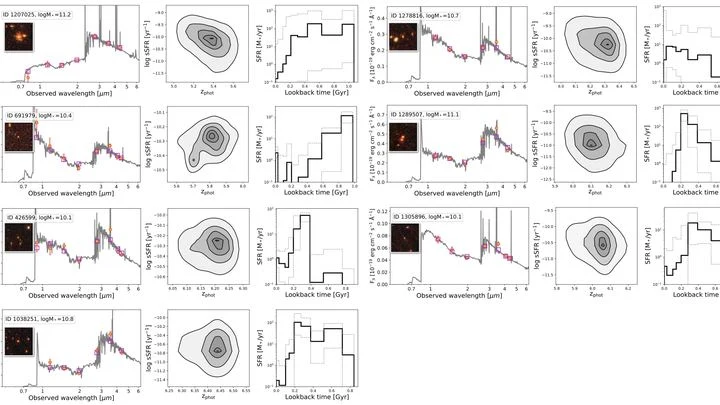
Among the precious scatterings of the early Universe captured by James Webb, there are objects that resemble ruby beads scattered on black velvet. These are the 'little red dots' (LRDs) — compact sources with steep red spectra, inside which lurk supermassive black holes up to a hundred million solar masses.
A compressed spring can sit for years without moving. It seems frozen forever, but inside the metal, atoms slowly rearrange, and one day the spring clicks, settling into a new, more relaxed position.
A distant galaxy always looks redder than it really is. That's the work of cosmic dust — tiny solid particles that scatter blue light more than red, like haze at sunset. Astronomers measured this effect for tens of thousands of galaxies using two powerful instruments.
Imagine inflating a balloon. It expands quickly at first, then slows down, and then suddenly speeds up again, as if someone gave the pump another squeeze. That's what seems to be happening to our universe.
The universe abhors monotony. A century ago, Edwin Hubble and Georges Lemaître gave us an elegant picture: an expanding cosmos, smooth as the surface of an inflated balloon.
The universe keeps a tally of every newborn star. Over 13.8 billion years, galaxies have ignited so many stars that their 'census' can reveal the nature of the cosmos itself, just as tree rings reveal past climates.
In the first few hundred million years after the Big Bang, the cosmos was like a noisy teen club: galaxies flared up, collided, and churned out stars by the hundreds.
If space is a canvas, then brushstrokes cannot be infinitely thin. There's a tiniest segment, shorter than which there's no point in measuring. This quantum 'graininess' alters the geometry itself: the motion of galaxies and the growth of large-scale structures bear its mark.
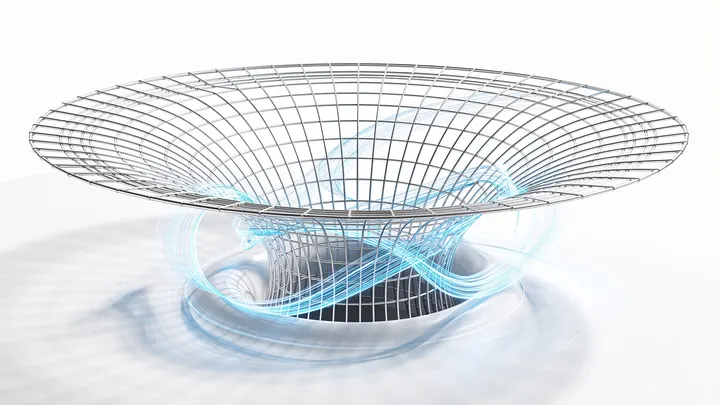
Schrödinger's cat, according to quantum rules, can be both alive and dead at once. But a table can't pull that off. When a massive object tries to be in two places, its mass curves spacetime so drastically that instead of two points, a single deep depression forms, and the object rolls into it.
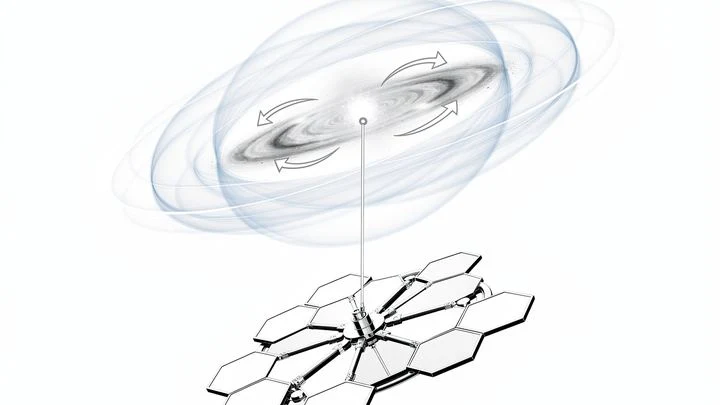
At the center of our Galaxy lies a supermassive black hole, with stars orbiting around it. Their motion resembles a cosmic dance: some race along elongated orbits, others follow nearly circular paths. If invisible dark matter exists near the black hole, it slightly distorts these orbits, like an unseen hand nudging a star off course.
In one hospital ward it's +40°C, in another +10°C, and on average it's +25°C. If temperature affected something nonlinearly (say, the rate of bacterial growth) the average would give a wrong prediction. The same problem arises when cosmologists describe a universe where galaxies are packed into clusters and voids yawn between them.
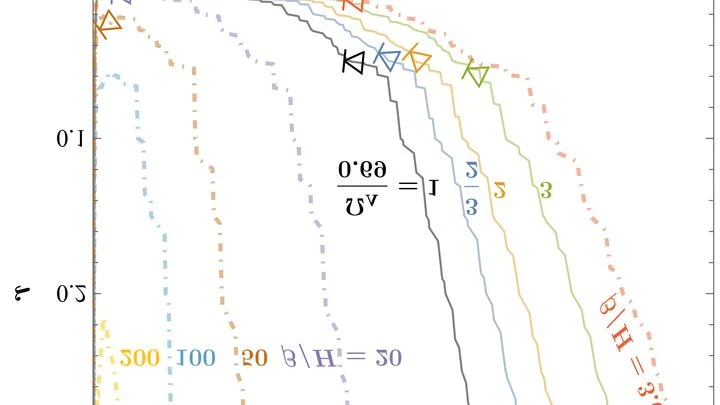
If you spill a handful of colorful beads on the floor, they will land differently: some will clump together, others will scatter into corners. Roughly the same way, galaxies of different colors (blue, green, and red) are scattered across the universe. Scientists decided to measure how 'clumpy' their distribution is using a number called the fractal dimension.
In the dark clouds of interstellar gas where stars are born, matter gathers into dense knots — future cradles of stars. Astronomers measure distances between these knots from sky photographs, but a photograph is flat while the cloud is volumetric. Converting from plane to volume is not as simple as it seems.