High-redshiftgalaxies are galaxies observed at very large cosmological distances, meaning we see them as they were when the universe was young. Because light takes time to travel, looking farther out in space is equivalent to looking further back in time. These galaxies often appear as small, red dots in deep-sky surveys, and their light has been stretched (redshifted) by the expansion of the universe, shifting their emission into the infrared. They are crucial for understanding how the first structures formed and evolved, and they often challenge our models of early galaxy formation.
History
The first high-redshiftgalaxies were discovered in the late 1990s with the Hubble Deep Field, and the field advanced rapidly with the installation of infrared cameras on Hubble and later with the launch of JWST in 2021, which pushed the redshift frontier to z~13 and beyond.
How it works
Astronomers identify high-redshiftgalaxies by measuring their redshift — the amount by which their spectral lines are shifted toward longer wavelengths. This is typically done through photometry (comparing brightness in different filters) or spectroscopy (resolving individual lines). The most distant galaxies are found in deep-field images taken by telescopes like Hubble and JWST, and their properties — such as star formation rate, stellar mass, and morphology — are inferred from their spectral energy distributions. Recent work has shown that some seemingly 'impossible' massive galaxies at high redshift may be misidentified due to measurement errors, while others are genuinely new types of galaxies, like the 'little red dots' that are not dustyquasars but a distinct population.
The most distant galaxy ever confirmed, JADES-GS-z14-0, is seen just 290 million years after the Big Bang, when the universe was only 2% of its current age.
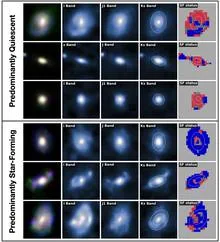
A ground-based image of a distant galaxy looks like a view through frosted glass: the atmosphere smears details, hiding the internal structure. Astronomers have long wanted to know where exactly star formation shuts off in galaxies, but ground-based telescopes could not resolve the subtle color gradients.
An old city gains new suburbs. In the center, narrow streets where life has nearly stopped, while on the outskirts construction is booming. That is what a spiral galaxy looks like when its core stars have long aged and new stars are still being born in the outer disk.
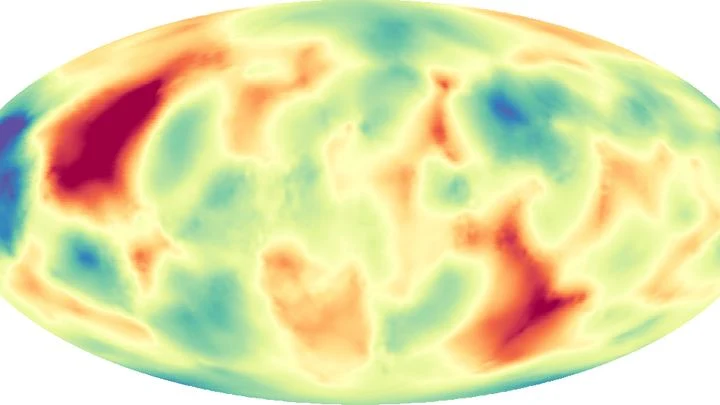
The night sky looks smooth, but it's actually clumpy — vast communities of galaxies that bend light from distant objects like lenses. When a short, powerful radio burst goes off somewhere in the universe, its path to an Earth telescope can pass near such a clump.
In the heart of an old city stands a clock tower whose hands have never been adjusted since it was built. By how far it runs slow, you can calculate how much time has stretched since then. In space, the role of such towers is played by relic galaxies — dense stellar systems that formed in the first few billion years and have since neither merged with neighbors nor given birth to new stars.
Six runners sprint down the track, and officials time their speed without noticing a tailwind. The wind blows at their backs, and the stopwatches show a better result than the truth. Roughly this is how six megamasers — natural cosmic lasers in distant galaxies — misled astronomers measuring the expansion rate of the universe.
The universe is like a vast invisible scaffold. We don't see it directly, but we know it's there: galaxies and clusters hold together thanks to it. This scaffold is dark matter. The most popular version says it is "cold," made of heavy, slow-moving particles.
In the galaxy NGC 1052 DF2, stars move at only 8 kilometers per second, as if there were no invisible mass around. For comparison: in our Milky Way, outlying stars accelerate to 200 kilometers per second, held by a massive dark matter halo.
The JWST spectrograph caught a barely perceptible dip in the spectrum of a distant galaxy — two lines, like shadows cast by cold gas. These are the sodium lines, the very yellow light of streetlamps. Here, at the edge of the visible Universe, they betray the slow exhalation of a galaxy returning matter to space.
In the early universe, just a few hundred million years after the Big Bang, astronomers see strange objects — little red dots. They are compact, red, and in their spectra, broad Balmer lines scream the presence of supermassive black holes. But how did the hole manage to accumulate millions of solar masses in such a short time?
The hunter of ancient light, the James Webb Telescope, aimed its mirrors at a tiny patch of sky and caught a strange beacon. The object, with the working name beacon_1420-$$5253_{4770}$$, flashed and faded. At first, it was logged as a candidate for the most distant galaxy, as if we were seeing it just 300 million years after the big bang.
Two cities endure a series of fires. In one, the wind carries ash far beyond the outskirts, leaving the sky clear. In the other, ash settles as a dense veil, painting sunsets crimson. Roughly the same thing, just on a galactic scale, happens with supernova explosions, the final flares of massive stars.
It takes the stellar pair J05+50 nearly two months to complete one orbit around their common center. From Earth, it appears as a faint point in the constellation Hercules — 4625 parsecs away. Photometry of the binary star only captures a steady flicker of brightness, like the pulse of a giant heart.
The optical sky background is a cosmic palimpsest, where light from billions of unresolved galaxies is layered, each layer corresponding to a different epoch. Until now we could only distinguish the brightest "letters"—individual stars and nearby galaxies.
In 2016, astronomers saw something incredible: a distant star, named Icarus, flared up for several weeks, crossing the abyss of space. Gravitational lensing, an effect predicted by Einstein, had kicked in: a massive object bends spacetime and focuses light like a giant magnifying glass.
In a giant cosmic cradle, the Tarantula Nebula, astronomers took a close look at 122 massive stars, each at least 30 times heavier than the Sun. They measured the nitrogen abundance in their atmospheres, and the picture turned out to be unexpected.
In the young Universe, about ten billion years ago, galaxies resembled endless fields after a thunderstorm: everywhere, giant — thousands of light-years across — clumps of star formation were boiling up, where young stars were born with unbridled energy. Today, these patches are an almost vanished species: in nearby galaxies, raucous hotbeds are rare.
When we peer deep into space, we see the past. Edwin Hubble’s law turns redshift into a time machine: light from galaxy UDS 12999 traveled to us for 7.6 billion years — more than half the age of the Universe.
When JWST peered into the young universe at redshifts of 6–10, it revealed a scattering of mysterious 'little red dots' (LRDs). These objects combined features of galaxies and active nuclei, but their spectra refused to fit into familiar patterns.
Every fast radio burst is like a resounding strike of a bell in the void. And in its fading ring, the entire structure of space is encoded: over billions of light-years, the radio pulse is slightly delayed by every free electron it meets.
Imagine a spotlight: if you look at it from the side, it glows dim red, but if you stare straight into it, it blinds you with white-blue light. That, according to new data, is exactly what the mysterious 'little red dots' in the early universe look like. They are giant black holes, objects with gravity so strong that even light cannot escape, turned edge-on to us.
When a distant galaxy sends us light, it dims with distance, and from that dimming, we can tell how far away it is. Gravitational waves work in much the same way: the farther their source, the weaker the ripple in space that detectors on Earth pick up.
The Universe grows like a metropolis: galaxies skyscrapers are erected on an invisible scaffold of dark matter: its gravity pulling in construction material. Meanwhile, dark energy makes the city itself continuously expand.
Elliptical galaxies are quiet stellar metropolises in retirement. By all rights, their light should be calm, reddish, like a sunset. But their spectra scream otherwise: in the far ultraviolet, these old-timers blaze like holiday lights. For three decades, astronomers have puzzled over this 'ultraviolet upturn' (UV upturn).
The Universe resembles a dense forest: up close, individual galaxy-trees are visible, gathered into groves, but from a distance everything merges into a solid green canopy. The boundary beyond which the cosmos becomes homogeneous is called the angular scale of homogeneity: it's the size of a patch of sky from which galaxies are distributed evenly.
When the James Webb Space Telescope turned its gaze deep into time, astronomers expected to see familiar galaxies. Instead, the images were dotted with a scattering of bright, incredibly compact red dots.
The James Webb space telescope peered into an era when the Universe was less than a billion years old and discovered hundreds of strange objects there. Tiny yet dazzlingly bright, they glowed a deep red — like burning coals scattered across the black velvet of space.
The first two billion years after the Big Bang were an era when the universe resembled a boiling construction pit. Dark matter clumped the gas together, igniting the first stars. It seemed there simply wasn't enough time to assemble massive elliptical galaxies—'dormant' stellar metropolises — from this raw material.
Images from the James Webb Space Telescope have revealed unexpectedly intense light from the first galaxies — colossal star systems that formed shortly after the Big Bang. Imagine a toaster browning a slice of bread in a minute, while an oven takes an hour to bake a loaf — the result is essentially the same.
Among the precious scatterings of the early Universe captured by James Webb, there are objects that resemble ruby beads scattered on black velvet. These are the 'little red dots' (LRDs) — compact sources with steep red spectra, inside which lurk supermassive black holes up to a hundred million solar masses.
The James Webb Space Telescope has spotted astonishing objects in the depths of space — tiny red dots that shine so brightly it's as if a spotlight were hidden inside a small bulb. These dots are not stars or galaxies in the usual sense, but rather 'cocoons' around supermassive black holes greedily gulping down surrounding gas.
An artist paints a portrait stroke by stroke, and then someone offers them a flash camera — one click, and it's done. That's roughly the shift from multi-step models to one-step models in generating images of galaxies.
Typical neural networks for image synthesis work like a watercolorist: they apply a layer, blur it, add details.
Two stars circle each other like dancers in a slow waltz. This dance is not eternal: the partners gradually draw closer until they collide and merge into a single entity. At that very moment, a red nova is born — a flash that lights up the sky for a few weeks, then slowly fades, enveloped in a dense cloud of dust.
The JWST telescope has spotted a multitude of bright galaxies in the young universe. Their ultraviolet light was barely absorbed by cosmic dust — defying previous expectations.
Edwin Hubble and Georges Lemaître discovered the expansion of the Universe nearly a century ago. One way to test it is the surface brightness test: in an expanding cosmos, the light of a distant galaxy should fade like a pattern on a stretching film.
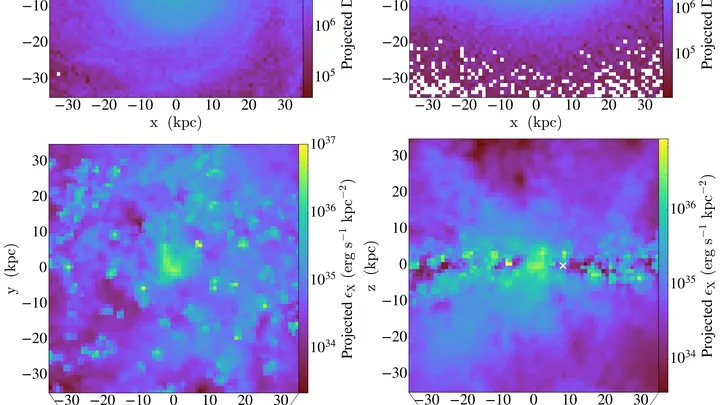
Around our Galaxy, like an invisible crown, stretches a tenuous cloud of gas heated to millions of degrees. It is called the galactic halo. Seeing this glow directly is difficult: it emits soft X-rays that are absorbed by Earth's atmosphere.
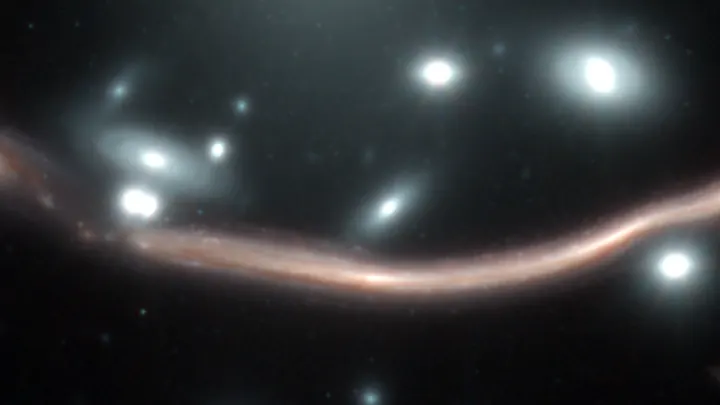
Light from the distant Dragon Galaxy has been traveling toward us for more than seven billion years. On its way, it passes by a huge galaxy cluster whose gravity bends the path of light like a lens. As a result, the galaxy appears brighter and larger than it really is, just as a magnifying glass enlarges fine print.
There is something wildly generous about a garden where the first flowers don't just bloom but immediately scatter their seeds far beyond the fence. Something similar was happening in the young universe.
In the vast cosmic web, the James Webb Space Telescope spotted something unusual — tiny but bright red sparks that astronomers have nicknamed 'little red dots.' They shine as if an invisible fire is raging inside: their spectrum looks like a letter V, and the hydrogen lines are broadened, as if someone smeared paint across a canvas.
On a playground, a merry-go-round has just been set spinning. In the first moments, kids are still crowding, grabbing the rails, and the overall picture is chaos. But a couple of seconds later, centrifugal force lines them up in a circle, giving the motion a clear shape.