A megaparsec is a unit of distance used in astronomy, equal to one million parsecs, or roughly 3.26 million light-years. It is the standard yardstick for measuring the vast gaps between galaxies and galaxy clusters. For context, our Milky Way galaxy is about 0.03 megaparsecs across, while the nearest large galaxy, Andromeda, lies about 0.77 megaparsecs away.
History
The parsec was introduced in 1913 by the British astronomer Herbert Hall Turner, who coined the term as a contraction of 'parallax of one second of arc.' The megaparsec became widely used in the 1920s and 1930s as Edwin Hubble and others began measuring distances to galaxies.
How it works
The parsec is defined geometrically: it is the distance at which one astronomical unit (the Earth-Sun distance) subtends an angle of one arcsecond. A megaparsec simply multiplies that by a million. Astronomers use it because it keeps numbers manageable when describing cosmic scales, and it is the unit in which the Hubble constant — the rate of cosmic expansion — is expressed.
In practice
Megaparsecs are used to measure distances to galaxies and quasars, and to calibrate the expansion rate of the universe, which is crucial for cosmological models.
Fun fact
The observable universe is about 46 billion light-years in radius, which is roughly 14,000 megaparsecs — a number that seems impossibly large, yet it is the standard scale of modern cosmology.
Systems:SIOne megaparsec is equal to 3.0856775814913673e22 meters, defined as 10^6 parsecs.
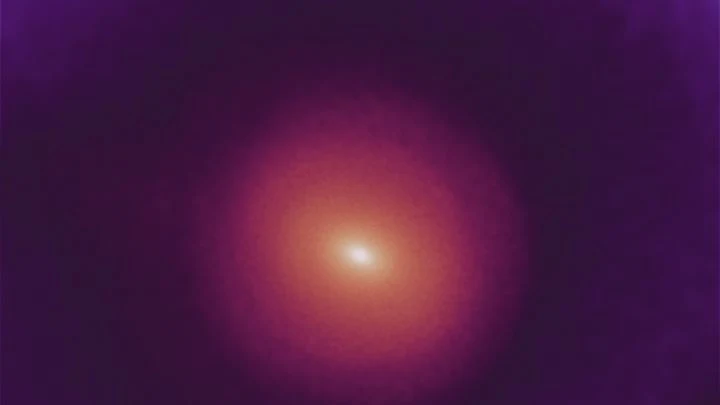
The galaxy cluster RXC J0528.9−3927 is like a city shrouded in fog: at its center, a radio halo shines brightly, but farther out, beyond the usual boundaries, astronomers have spotted a barely visible glow. It stretches for two million light-years — three times farther than the halo itself.
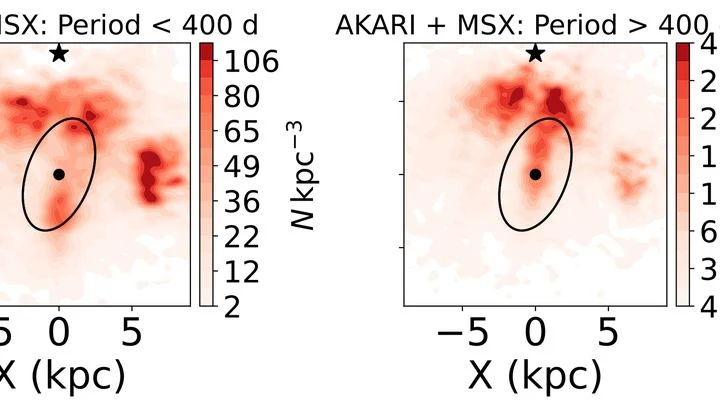
Red giants in the center of the Milky Way resemble distant lighthouses that brighten and dim. Their light pierces through dense dust, but standard distance-measuring methods fail here: the stars are too bright and unstable, and dust distorts the picture.
Astronomers found a workaround.
Six runners sprint down the track, and officials time their speed without noticing a tailwind. The wind blows at their backs, and the stopwatches show a better result than the truth. Roughly this is how six megamasers — natural cosmic lasers in distant galaxies — misled astronomers measuring the expansion rate of the universe.
The cosmic dawn is hidden behind a dense veil of time. To see beyond it, you need to catch the radio signal from clouds of neutral hydrogen — the so-called global 21 cm signal. But it is so faint that the receiver's own noise drowns it out.
Light needs space. A camera lens sits several centimeters from the sensor so the rays have room to focus. Now, that gap has been squeezed to the thickness of a sheet of paper, and light still behaves as if it had traveled its rightful centimeters. That's what 'spaceplates' do: flat elements that mimic free-space propagation.
Imagine a dark room with dust floating in the air. A bright flashlight goes off, and the dust particles light up, revealing their positions. Astronomers have applied a similar trick to our Galaxy. The flashlights were gamma-ray bursts, the most powerful explosions in distant galaxies, and the dust particles were interstellar clouds.
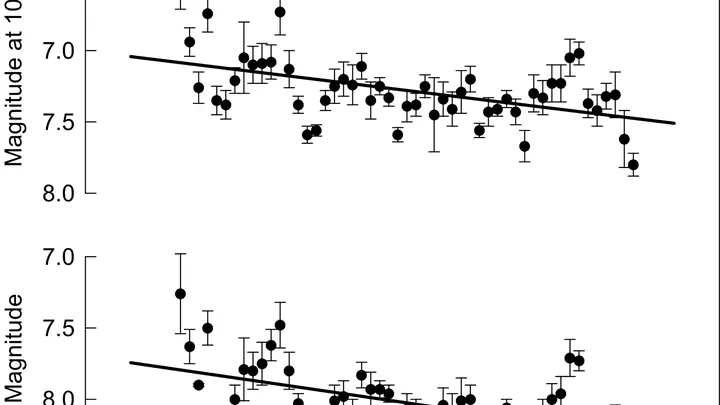
For five consecutive years, the automated MMT9 observatory measured the brightness of Starlink and OneWeb satellites using photometry (precise light measurement). The results were surprising: VisorSats, equipped with visors to reduce glare, became brighter by 0.6 magnitudes, while OneWeb, on the contrary, dimmed by 0.4.
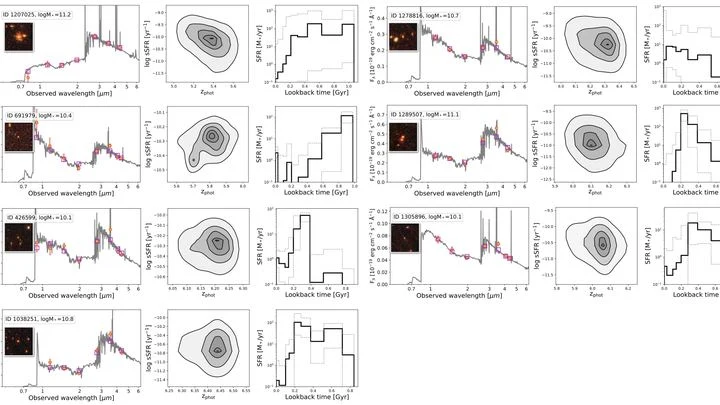
In the first few hundred million years after the Big Bang, the cosmos was like a noisy teen club: galaxies flared up, collided, and churned out stars by the hundreds.
The night sky looks still, but many stars tremble like a drum after a strike. For seven straight years, the TESS satellite stared at the same patches of sky and caught this trembling in 19,151 red giants — old, bloated stars. Previously, far fewer of these 'singing' giants were known, and now the list has grown by 80%.
The Milky Way and the Andromeda Galaxy are like two vast flocks of birds drawing together in the celestial expanse. New data from the Gaia telescope shows: Andromeda barely deviates sideways. The chance of their merger is a whopping 90%. Even the gentlest crosswind could steer their paths apart, but calculations say: it’s almost nonexistent.
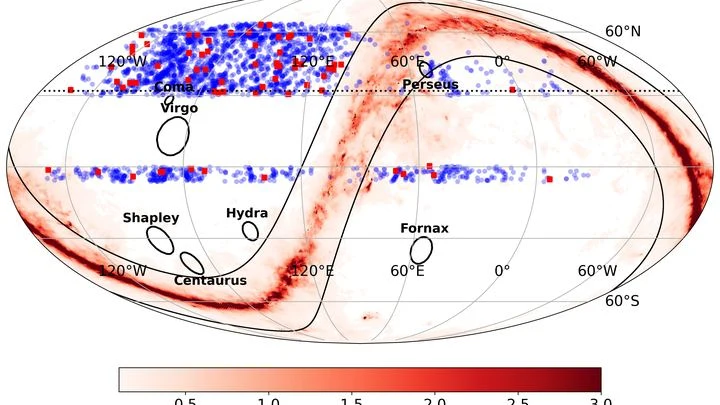
A pebble dropped in a pond creates curved ripples, but from far away they appear as straight lines. Gamma-ray flashes from an evaporating black hole behave the same: a distant burst sends flat waves, while a nearby one arrives curved.
Rhythmic flashes of a lighthouse in thick fog: that's what searching for pulsars looks like. The lighthouse spins, and its beam periodically sweeps across the telescope. But the fog smears the light, making the period seem slightly different. If the same lighthouse was observed twice, you can compare: the periods should nearly match, and the smearing should be similar.
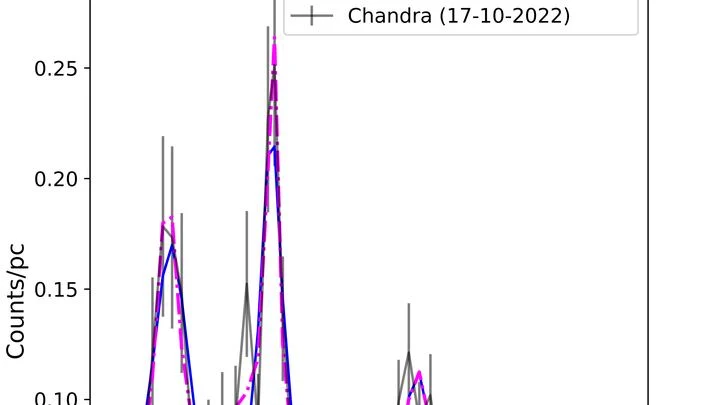
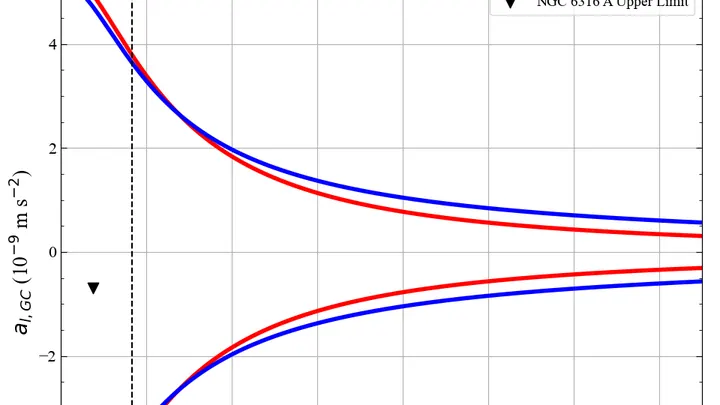
In a dense ball of hundreds of thousands of stars, what astronomers call a globular cluster, radio telescopes have picked up a faint but very steady rhythm. Every 2.45 milliseconds, that's 408 ticks per second, a radio pulse arrives.
Galaxies, like giant whirlpools, sometimes collide and merge. In this chaos, gas compresses, new stars flare up, and a bright radio beacon is born at the very center. Its light — not visible to the eye, but radio waves — pierces through dust and gas like a siren through fog.
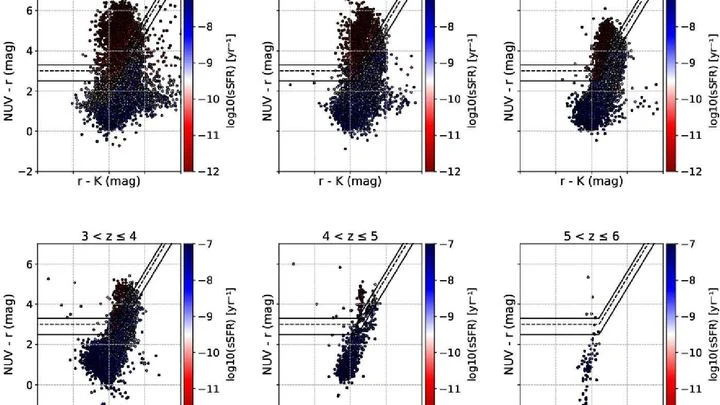
If you spill a handful of colorful beads on the floor, they will land differently: some will clump together, others will scatter into corners. Roughly the same way, galaxies of different colors (blue, green, and red) are scattered across the universe. Scientists decided to measure how 'clumpy' their distribution is using a number called the fractal dimension.
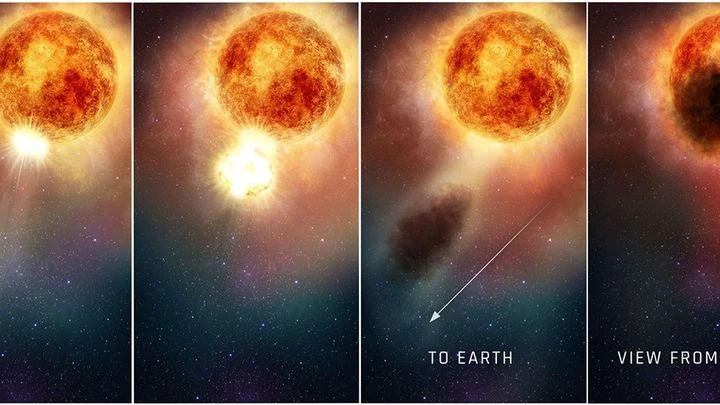
In 2019, Betelgeuse suddenly dimmed, sparking rumors of an imminent explosion. But clouds of cosmic dust turned out to be the culprit. Now, the Gemini North telescope has discerned a minuscule companion star in its dazzling glare, just as calculations had predicted.
NGC 3627, a spiral beauty in the constellation Leo, harbors a trail that fits no standard scenario. A narrow band of cold gas, a molecular trail, stretches more than 8 kiloparsecs (thousands of parsecs, each about 3260 light-years) with a width of about 200 parsecs. That is like a thread as long as a football field and as thick as a pencil.
At a distance of 8.58 megaparsecs, the spiral galaxy M51 spins its arms, while the VLA radio telescope in its most extended configuration observes it with a resolution of 0.16×0.14 arcseconds. That is like spotting a coin on the surface of the Moon from Earth.
The Solar System takes 210 million years to complete one orbit around the center of the Milky Way. The last time we were on this same side of the Galaxy, early dinosaurs were roaming the Earth. That number, 243.72 km/s, has now been refined thanks to rare stars that streak through the Galaxy like cannonballs.