The galacticplane is the flattened disk-like region where most of a spiral galaxy's stars, gas, and dust reside. It defines the main structural axis of disk galaxies like the Milky Way, and its orientation is tied to the galaxy's rotation. Observations of the galactic plane reveal the distribution of matter and the processes of star formation.
History
The concept dates back to the 18th century when William Herschel mapped the Milky Way and noted its flattened distribution of stars, though the modern understanding of disk galaxies emerged in the 20th century.
How it works
The plane forms because the galaxy's angular momentum causes material to collapse into a rotating disk. Gravity pulls matter toward the center, but centrifugal force resists collapse along the rotation axis, leaving a thin, flat structure. Stars and gas orbit within this plane, and the plane's thickness varies with the age and temperature of its components.
A river drawn on a map is always a single line. But stand on the bank, and you will see that within the channel there are faster currents, eddies, and branches that merge and split. The cosmic web is like that river, but made of dark matter, and until recently astronomers drew it as a single line.
The night sky looks like a random scattering of stars. But zoom out to enormous distances, and the chaos disappears. Galaxies gather into long filaments and flat walls, with colossal voids gaping between them — cosmic voids. This structure is called the cosmic web.
A weather forecaster draws a thick black line across Europe: north of it, frost; south, a thaw. That boundary, the zero isotherm, won't tell you the temperature in Stockholm or Rome, but it honestly marks where winter ends. In recent cosmology, a map has emerged where a similar frontier can be drawn.
For decades astrophysicists painted a neat picture: a galaxy, like a giant carousel, spins in a unified rhythm, and the supermassive black hole at its center inherits that dance.
The cosmological principle – the notion that the Universe is homogeneous and isotropic on large scales – has guarded our understanding of the world since the time of Edwin Hubble and Georges Lemaître, whose ideas formed the basis of the Big Bang model.
Lenticular galaxies are the cosmic quiet types: they have a disk but no bright spiral arms. For a long time, their origin remained a mystery. A team of scientists ran the Hydrangea computer simulation and traced the fate of each galaxy from its youth to the present day.
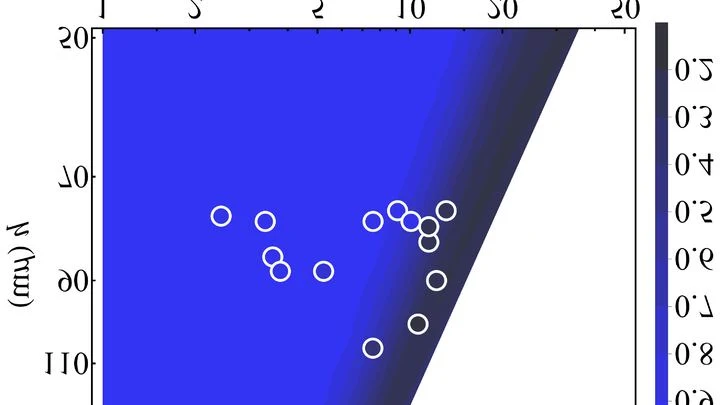
On the mass–size diagram, these galaxies line up in a V shape.
In astrophysics, some numbers seem random yet recur with the persistence of a spell. One such number is the ratio of X-ray brightness to H-alpha hydrogen emission in turbulent gas tails. From galactic winds to ‘jellyfish’ slicing through clusters, this ratio steadily holds at around three.
The night sky sometimes throws up riddles that take your breath away. One of them is a ring of galaxies stretching across a third of the horizon. Astronomers have named it the “Giant Ring on the Sky”: a cluster of galaxies stretched into a thin filament and closed into a circle about 400 megaparsecs in diameter.
In a large gas cloud where stars are born, the magnetic field lines are roughly aligned in one direction, like the fibers in a piece of felt. But look inside, into the dense clumps that will eventually become stars, and the picture changes: there the lines are twisted every which way, like a ball of yarn after a kitten has played with it.
Around young stars, disks of gas and dust swirl — the building blocks for future planets. Inside these disks, dust grains don't just fly randomly: they align along invisible lines of gas flow. Recently, astronomers noticed that dust grains in such disks behave like badminton shuttlecocks — always turning their long side into the wind.
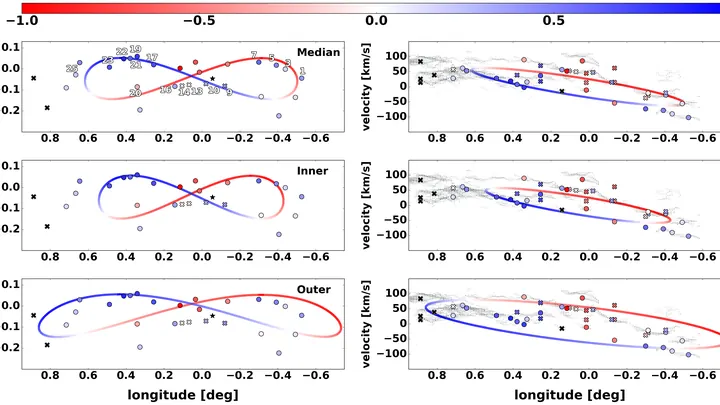
In the very center of the Milky Way, hidden behind a thick veil of dust, lies a giant accumulation of gas — the Central Molecular Zone. You can't see it with the naked eye: dust absorbs visible light, much like dense fog hides the lights of a city.
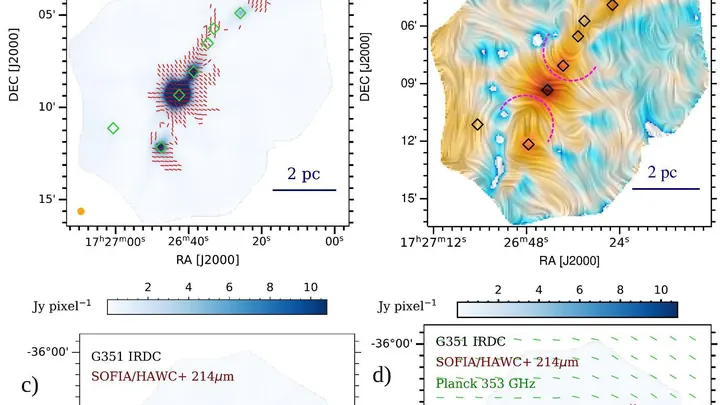
In the dark cloud G351, where new stars are about to emerge from gas and dust, the magnetic field has bent into an hourglass shape. Such a shape is a sign that the field is not just watching star birth from the sidelines but is actively taking part.
Scientists used the SOFIA telescope, mounted on an airplane, to see the dust in the cloud.
In a thin film of water squeezed between two glass plates, bacteria live. Oxygen reaches them only through one wall, like air entering a room through a single window. When bacteria are few, they pay no attention to this: some stick to one wall, some to the other, and the picture is symmetric. But once they multiply, everything changes.
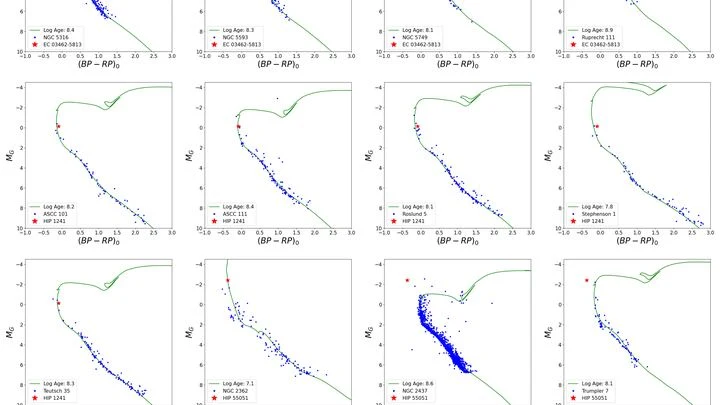
Blue giant stars are usually born in tight stellar nurseries — open clusters within the thin disk of our Galaxy. But sometimes such stars are found high above the disk, as if thrown out of their home. How did they get there?
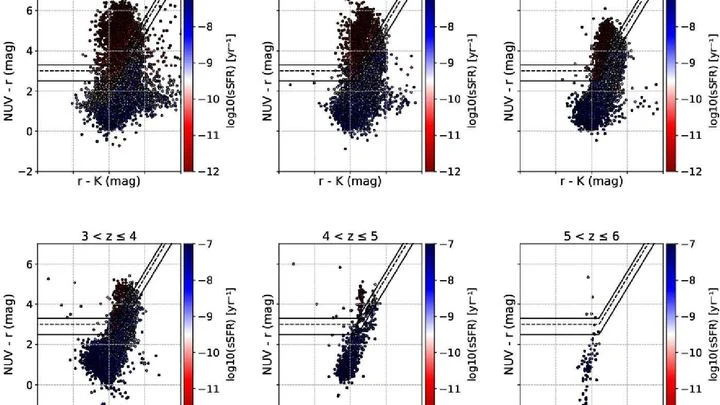
If you spill a handful of colorful beads on the floor, they will land differently: some will clump together, others will scatter into corners. Roughly the same way, galaxies of different colors (blue, green, and red) are scattered across the universe. Scientists decided to measure how 'clumpy' their distribution is using a number called the fractal dimension.
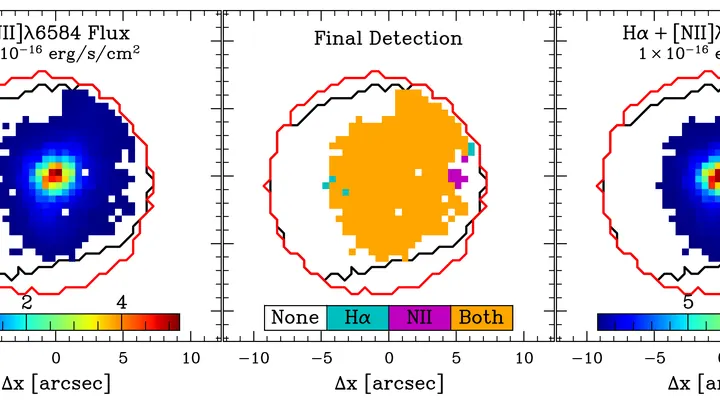
A galaxy cluster is like a busy intersection where galaxy-cars race through a headwind of hot gas. This wind, called ram pressure, strips galaxies of their cold gas — the fuel for star formation. Astronomers from the SAMI survey traced how this happens in hundreds of galaxies across eight nearby clusters.
In the 2010s, astronomers noticed something remarkable: supermassive black holes at the centers of galaxies, despite vast differences in size and brightness, fall onto a single straight line when you plot their millimeter emission against X-ray emission and mass.
Dust in space is not just grime: it's the raw material for future stars and planets. But how it is distributed in our galaxy has long been a puzzle: dust is hard to measure directly, and it blocks the light of distant stars. Now astronomers have peered through this veil using data on five million stars: their brightness, color, and precise positions in the sky.
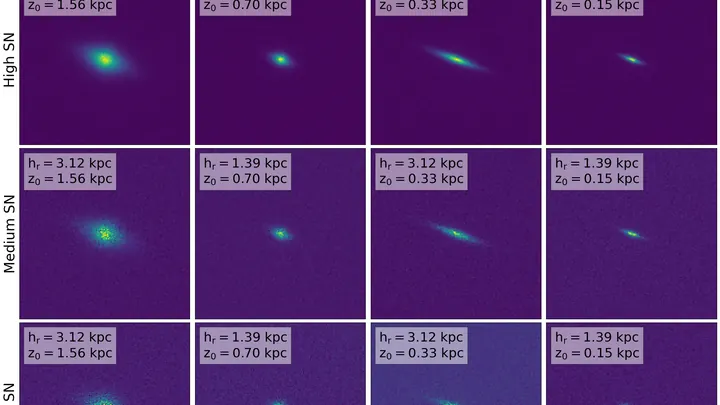
The James Webb Space Telescope peered 11 billion years back in time and spotted galaxies turned edge-on toward us. To measure their thickness, scientists devised a clever method: they calculated it the same way you'd measure the thickness of a slightly tilted pancake, not a perfectly flat one. Previous estimates were imprecise because they assumed an ideal angle.
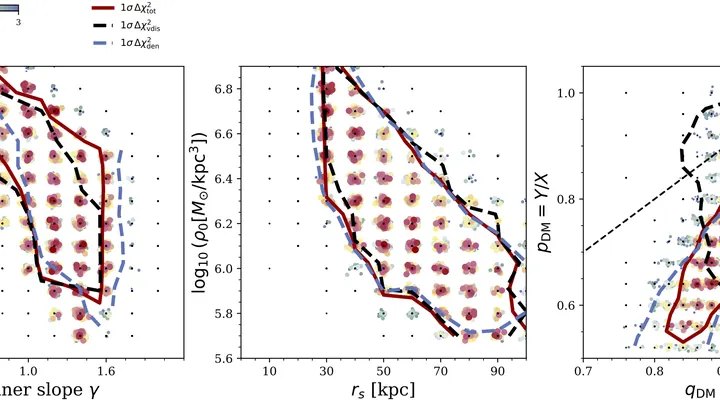
The Milky Way's stellar disk is like a glowing pinwheel, and тёмное вещество is an invisible cloud around it. For the first time, its shape has been precisely measured. Astronomers tracked the motions of millions of stars and built a 3D map of the тёмное гало out to 160,000 light-years.
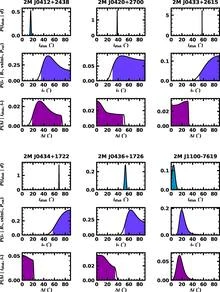
A spinning top tilted over a table, with a dusty pancake swirling around it. That is what a young stellar system looks like when the star's spin axis and the plane of its protoplanetary disk do not align. Until recently, astronomers did not know how common such a configuration is in nature.