How tumor cells wander through the brain's maze express
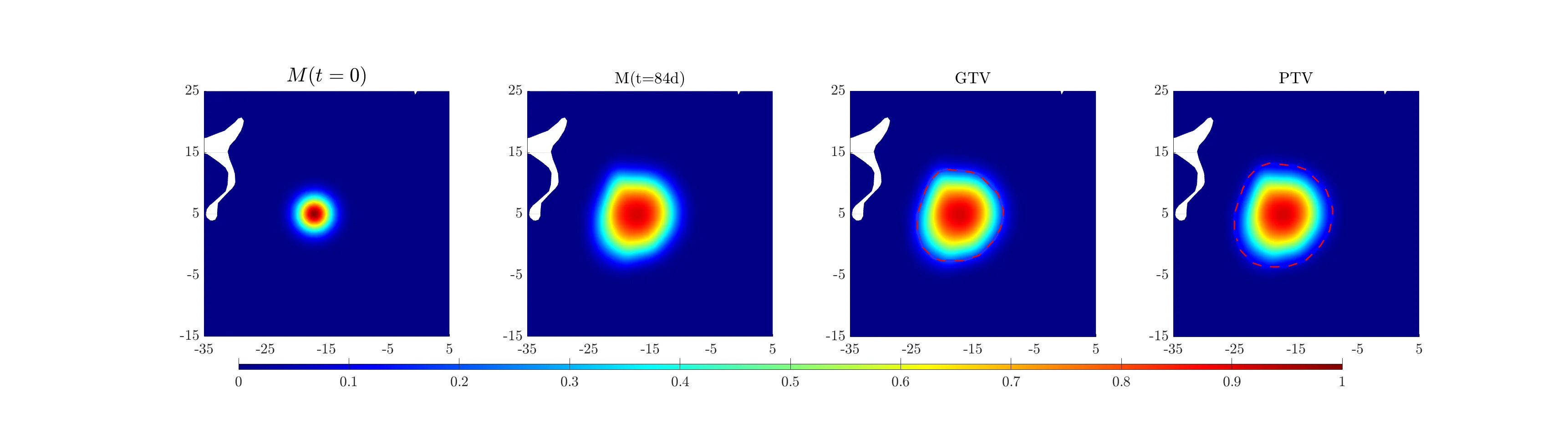
A brain tumor is like a traveler trudging through a dense forest: trees and bushes are the different types of brain tissue, some easier to traverse than others. Glioma cells don't move in a straight line; they constantly loop around, bumping into obstacles and going around them. Stochasticity here is not an annoying nuisance but the very essence of the process: each cell chooses its path based on a multitude of small events — encounters with other cells, chemical signals, and available space.
The authors of the new study assembled this wandering picture into a mathematical model. They started by describing the movement of individual cells, then derived equations showing how cell density changes across the brain. The model incorporates tissue heterogeneity: white matter, gray matter, blood vessels — all affect the speed and direction of migration. They also included an "anti-crowding" mechanism that prevents cells from packing too tightly in one place, forcing them to seek free space.
The main question the model answers is how different treatment regimens affect tumor spread. The scientists ran numerical experiments simulating radiation therapy and chemotherapy. They evaluated outcomes not only by standard medical criteria (e.g., changes in tumor size) but also by newer, subtler metrics — for instance, how uniformly the tumor regresses and whether any foci remain that could later cause recurrence.
The results show that even seemingly identical treatment protocols can lead to different outcomes due to random variations in cell behavior. The model allows one to "play out" different scenarios in advance and choose the one most likely to contain tumor growth. This is a step toward personalized therapy: a doctor could tailor treatment based on a specific patient's characteristics rather than averaged statistics.
Glioma cells can move at speeds up to several micrometers per minute — roughly like the minute hand on a clock if its tip crawled across the dial.
In Michael Crichton's novel The Andromeda Strain, scientists battle a rapidly mutating microorganism, a similar race against randomness occurs in treating glioma.