The Sun's Pulse in Interstellar Silence express
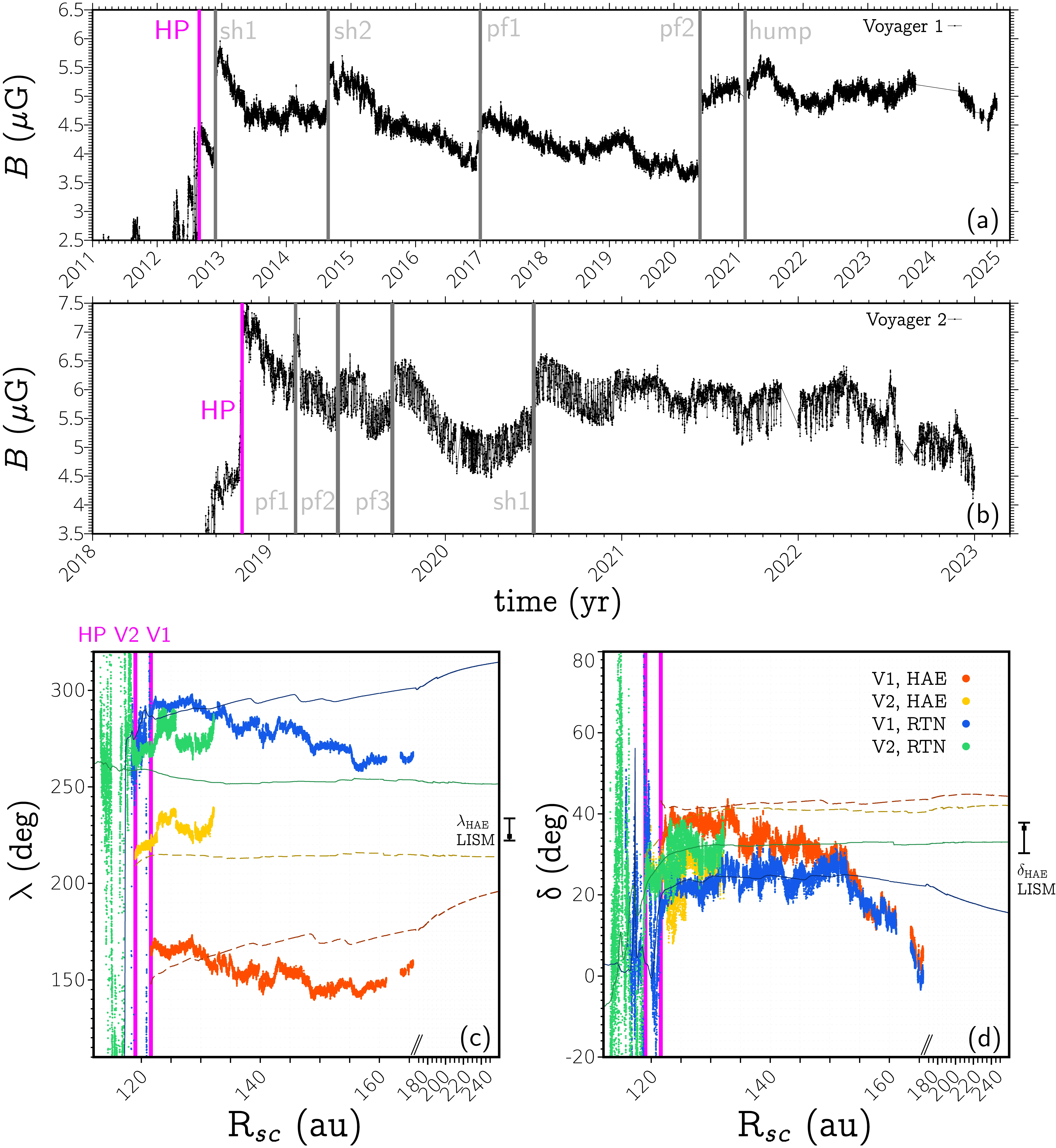
Two aging spacecraft, launched back in 1977, are flying through interstellar space — the region where the Sun's influence fades. The Sun doesn't just shine; it continuously blows a stream of charged particles that forms a giant bubble around our system — the heliosphere. Beyond its boundary, at about 150 astronomical units (one AU is the distance from Earth to the Sun), Voyager 1 felt a strange jolt. In 2020, its instruments recorded a sharp rise in the magnetic field, followed by a long "hump" and an enhanced field lasting months.
Scientists built a computer model that mimics the solar wind's behavior and its collision with the interstellar medium. It turned out that the jolt was a compression wave born from the Sun itself. Our star lives on an 11-year cycle: it calms down, then stirs with sunspots and flares. As activity ramps up, the solar wind becomes denser and faster, and this wave, like a slow drumbeat, travels all the way to the heliosphere's edge. When it hits, it compresses the interstellar gas and magnetic field — exactly what Voyager 1 felt.
Analysis of turbulence, small chaotic fluctuations in the field, showed that they fade with distance. Up to 165 astronomical units, pulsations with periods shorter than 10 days are still noticeable, but very short bursts (under an hour) nearly vanished after 2022. This doesn't mean the medium changed; it's just that the wave weakened, like ripples on a pond after a stone is thrown. Voyager 2, traveling in a different direction, is predicted to encounter several such waves by 2026, and then a powerful shock from the next solar cycle around 2030. The New Horizons spacecraft, now catching up, will cross the Sun's termination shock in 2031 at about 80 astronomical units.
Voyager 1 is currently more than 24 billion kilometers from Earth — a radio signal from it takes nearly a day to reach us.
In the film 'Star Trek: The Motion Picture', the Voyager probe becomes sentient and returns to Earth — real probes, for now, only send us signals from the dark.