Helicity is a measure of the twist or handedness of magnetic field lines, quantifying the extent to which the field wraps around itself. In magnetohydrodynamics, it plays a crucial role in turbulence dynamics, influencing energy transfer between scales and the generation of large-scale magnetic fields. Helicity is conserved in ideal conditions, making it a key invariant that shapes the evolution of cosmic plasmas, from solar flares to interstellar clouds.
History
The concept of magnetic helicity was introduced by Lodewijk Woltjer in 1958, who showed it is conserved in ideal magnetohydrodynamics. Its role in turbulence was later developed by Uriel Frisch and collaborators in the 1970s.
How it works
Mathematically, magnetic helicity is defined as the volume integral of the dot product of the vector potential and the magnetic field. It measures the linkage and knottedness of magnetic field lines. In turbulent plasmas, helicity tends to cascade to larger scales (inverse cascade), while energy cascades to smaller scales. This selective decay leads to the formation of coherent, large-scale magnetic structures.
In practice
Helicity is used in solar physics to predict the twist of coronal loops and the likelihood of solar eruptions. It also informs models of the solar dynamo and the generation of galactic magnetic fields.
Fun fact
The Sun's magnetic field has a net helicity that changes sign across the solar equator, a pattern that reflects the underlying dynamo process.
A sunspot, a dark island on the fiery surface, lives its own turbulent life. Beneath it, in invisible depths, giant magnetic loops drift like twisted cables. When such a loop emerges, it can discharge as a flare, and hurl clouds of charged particles into space.
Scientists have long tried to understand what determines the strength and suddenness of these events.
The early Universe was not just a hot soup of particles. In the first fractions of a second, mirror symmetry could have been broken: the world and its reflection would not be quite identical. If so, the large-scale cosmic web of galaxies would retain a barely noticeable 'curl'—as if all matter were slightly twisted in one direction.
Two galaxies (our Milky Way and its satellite, the Large Magellanic Cloud) slowly circle each other. Their gravitational pull stirs the distant outskirts of the Milky Way, like a pebble thrown into a pond makes the water ripple.
Light from a distant blazar, an active galactic nucleus whose jet points our way, travels for billions of years. Along the way, it triggers cascades of charged particles that the intergalactic magnetic field deflects sideways. This creates a blurred gamma-ray glow around the blazar: a secondary halo.
Red giants are swollen, aging stars. Deep inside, an ocean of plasma churns: heat forces its way from the core to the surface, generating waves like a mighty surf. The star's magnetic field acts like an invisible seabed – it steers these waves, changing their height and speed.
Toss a handful of coins on a table: each one lands heads or tails on its own. Now imagine the coins start flipping over, nudging each other. That's roughly how neutrinos behave in a very dense environment.
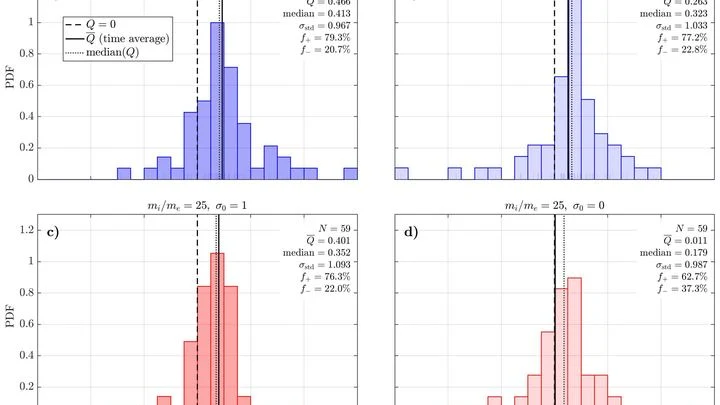
In a pot of boiling soup, churning currents carry heat to the walls, and the soup cools. In a tokamak, a huge magnetic bottle for plasma, the same thing happens: turbulent eddies carry energy outward, hindering the ignition of a fusion reaction. But sometimes the plasma seems to find a way to calm itself.
Deep inside Earth lies a solid iron core about the size of the Moon. It floats in liquid metal and sways slightly, like a pit in a peach when you shake the fruit. Such oscillations are called Slichter modes: the core shifts both along the planet's axis and perpendicular to it.
Three forces act together to damp this motion.
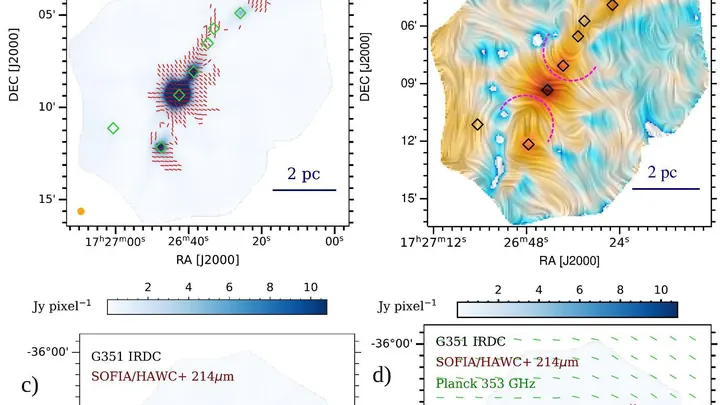
In the dark cloud G351, where new stars are about to emerge from gas and dust, the magnetic field has bent into an hourglass shape. Such a shape is a sign that the field is not just watching star birth from the sidelines but is actively taking part.
Scientists used the SOFIA telescope, mounted on an airplane, to see the dust in the cloud.
A neutron star the size of a city spins faster than a kitchen blender, flinging particles around itself. A glowing cloud forms around it — called a pulsar halo. The shape of this cloud depends on invisible magnetic fields that, like ocean currents, steer the particles.
The Sun is not a calm sphere. Waves constantly ripple through its interior, like a bell after being struck. These oscillations reach the surface and reveal what's happening on the far, invisible side. Astronomers have long been able to 'listen' to this ringing and find large sunspot groups there.
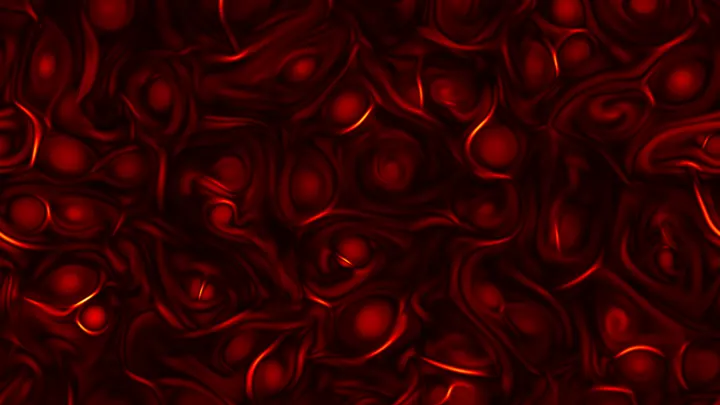
Plasma isn't just hot gas; it's a mix of charged particles that constantly move and generate magnetic fields. When plasma churns, these fields intertwine like spaghetti in a boiling pot. Scientists simulated what happens when the churning subsides and turbulence decays.
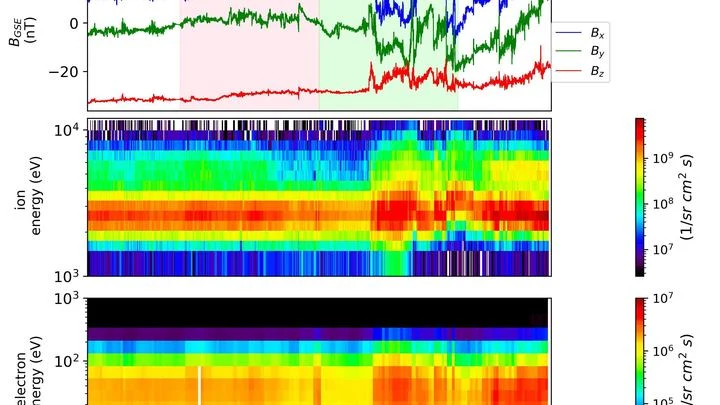
October 10, 2024. The Sun hurled a cloud of magnetized plasma toward Earth, and four spacecraft, stationed at a single point between the Sun and Earth, simultaneously recorded how that cloud churned. The distance between the outermost probes was just 80 Earth radii, about half a million kilometers.
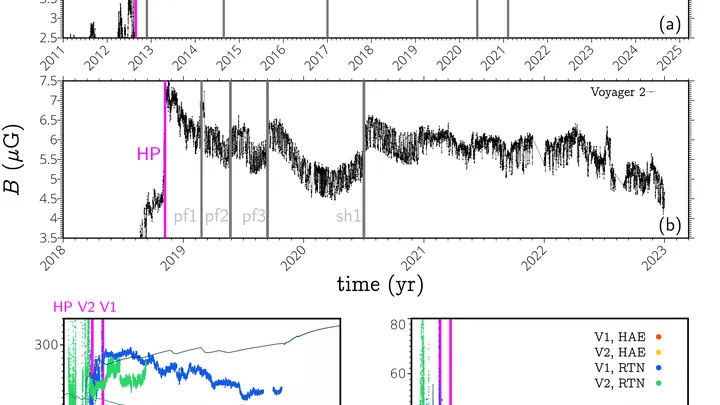
Two aging spacecraft, launched back in 1977, are flying through interstellar space — the region where the Sun's influence fades. The Sun doesn't just shine; it continuously blows a stream of charged particles that forms a giant bubble around our system — the heliosphere.
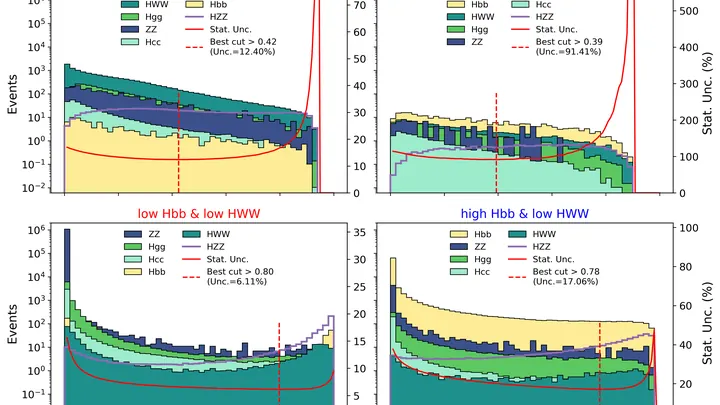
The Higgs boson lives an unimaginably short life — less than a billionth of a second. It cannot be caught directly, so physicists look at what remains after its decay: jets of particles, muons, neutrinos. But some information is lost if you consider only the explicit decay traces rather than the whole event.
In a pot of boiling soup, small bubbles churn, but gradually large-scale flows come to dominate. Something similar happens in cosmic plasma, where magnetic fields behave like tangled threads.
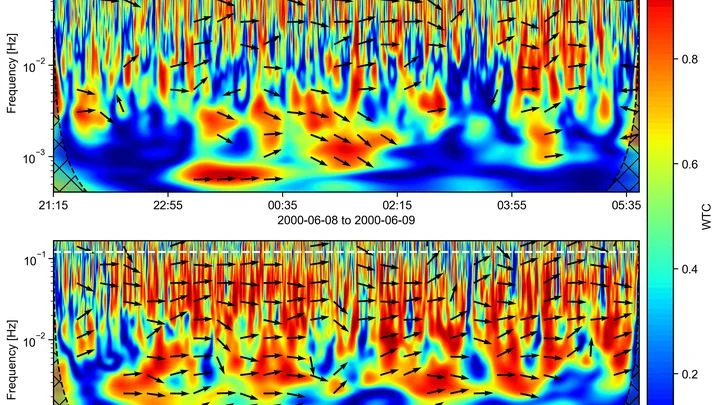
The Sun constantly emits a stream of charged particles, mostly hydrogen — the solar wind. Sometimes the Sun ejects dense blobs of magnetized gas, inside which calm usually reigns. But in 2000, scientists noticed two regions inside one such cloud where the gas was churning.