Millions of Recipes for Better Batteries express
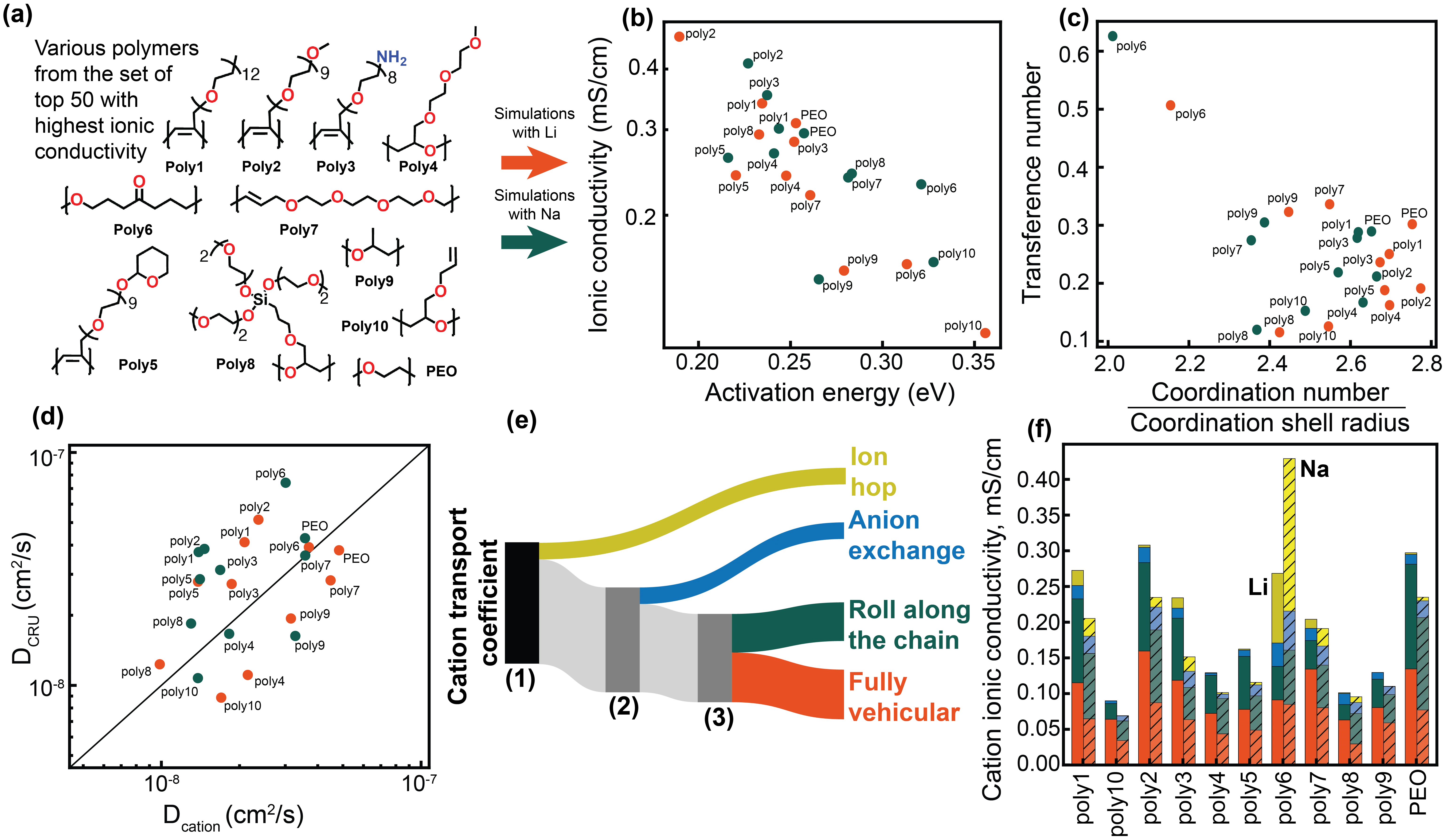
Modern batteries with liquid electrolytes can leak or catch fire. Polymer electrolytes (solid, plastic-like materials) solve that problem, but ions move through them more slowly, so the battery loses power.
Researchers set up a virtual assembly line: a computer program generated new polymer structures the way a chef experiments with new dough recipes. Out of 1.7 million options, the algorithm picked 767 promising ones and calculated how lithium ions move through each. The best samples outperformed the standard polyethylene oxide with lithium salt — the current benchmark.
The method works for sodium batteries too: comparisons showed that sodium ions are larger and move differently, but suitable polymers can still be found. This approach is like searching for a needle in a haystack, but instead of hands you have a supercomputer, and instead of hay, millions of chemical formulas.
Original abstract
as written by the authors arXiv:2602.17595
Polymer electrolytes are critical for safe, high-energy-density solid-state batteries, yet discovering candidates that balance high ionic conductivity with high transference numbers remains a significant challenge. In this work, we develop a high-throughput screening platform that utilizes molecular dynamics simulations to navigate a chemical space of 1.7 million hypothetical polymer electrolyte candidates. Data from previous literature is used to warm-start batch Bayesian optimization for iteratively selecting new polymer electrolytes to evaluate. We iteratively identified, evaluated and analyzed 767 homopolymers as potential candidates. Our results reveal several candidates with transport properties exceeding the benchmark polyethylene oxide (PEO)/LiTFSI system. Crucially, our optimization campaigns for ionic conductivity and Li-diffusivity demonstrate that branched architectures and ketone functional groups significantly enhance ion-hopping mechanisms within the polymer matrix. We provide an in-depth mechanistic comparison of Li vs. Na cation transport and offer our open-source framework to accelerate the discovery of liquid, gel, and multi-cation electrolyte systems.
Polyethylene oxide is the same material used in some laxatives and cosmetics, but with lithium salt it conducts ions.