Neutrons Search for Time-Reversal Symmetry Violation express
Deep inside the accelerator, neutrons are sped up and fly toward a target like a swarm of tiny tops. Each top has an axis of rotation: its spin. If all the tops are spun in the same direction, the beam is called polarized. Such a beam is exactly what's needed to catch the elusive symmetry violation: why our world has almost no antimatter left, even though the Big Bang should have produced equal amounts of matter and antimatter.
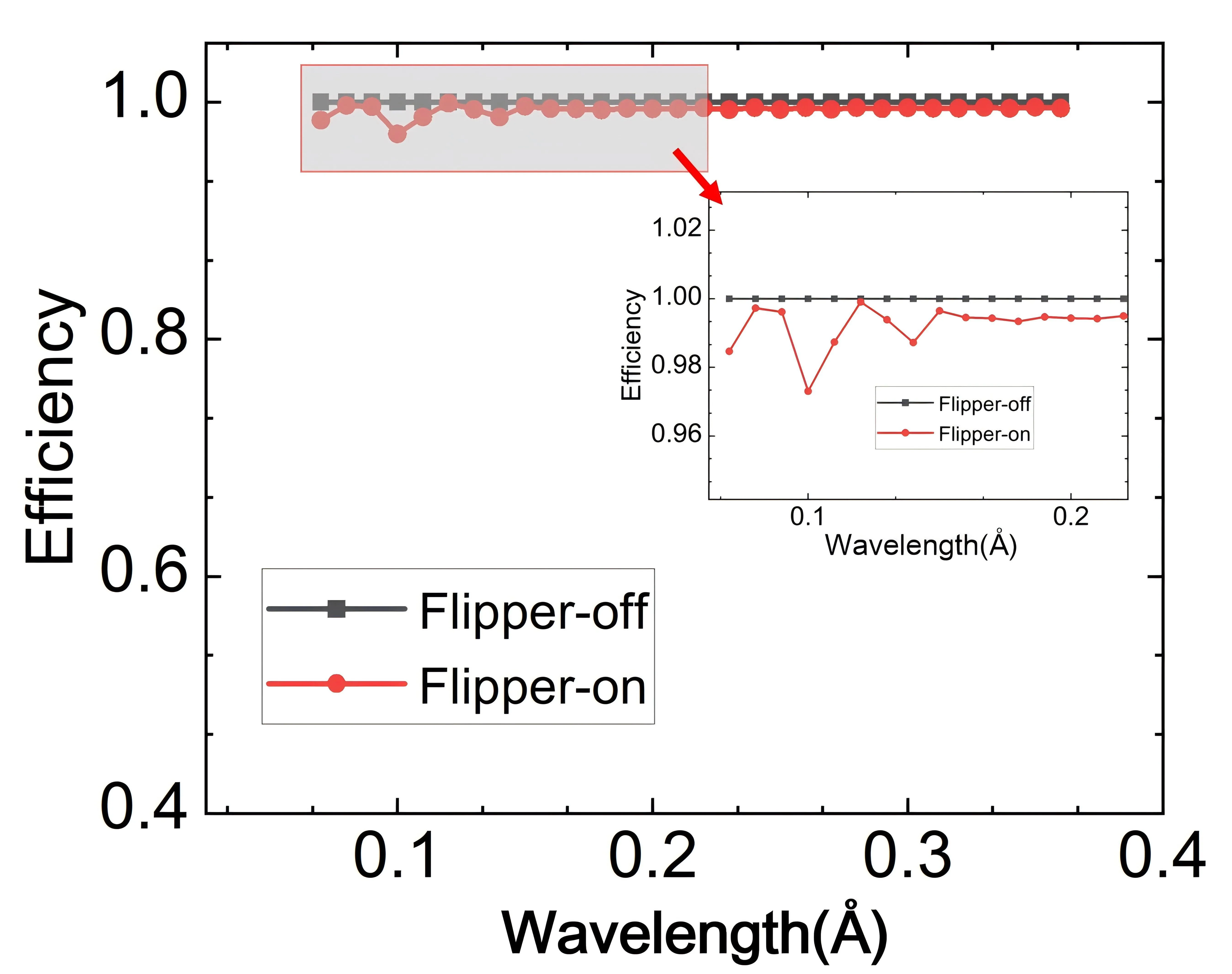
To get polarized neutrons, physicists use helium-3 gas. Atoms of this gas, like a sponge, absorb neutrons with one spin direction and let through those with the other. This produces a beam where the spins are aligned like compass needles in a magnetic field. The beam was directed at a lanthanum-139 nucleus. When a neutron hits a resonance with the nucleus, the absorption probability depends on the relative orientation of the spins. By measuring the difference in neutron counts at two opposite settings, the scientists obtained an asymmetry of about 7.8%.
This result matched previous measurements, meaning the new polarized neutron source works correctly. Now it can be used for more delicate experiments: searching for time-reversal symmetry violation. If such a violation is found, it would explain why matter triumphed over antimatter, and why we exist.
Helium-3, used for polarizing neutrons, is rare on Earth: it is extracted from natural gas and also produced by the decay of tritium. In the future, it is planned to be mined on the Moon, where it has been accumulated by the solar wind.
In Greg Egan's novel 'The Clockwork Rocket', characters travel through a universe where matter and antimatter are separated, and they seek a way to restore symmetry — physicists pondering neutron experiments are thinking about roughly the same puzzle.