Mapping Disease: How to Link Genes and Ailments express
Inside every cell, work is constantly underway: proteins communicate, genes turn on and off, and glitches in this system lead to disease. To find the culprit behind an ailment, scientists used to manually comb through research papers and databases, like a detective interviewing witnesses one by one. But there are so many connections that no one can handle it alone.
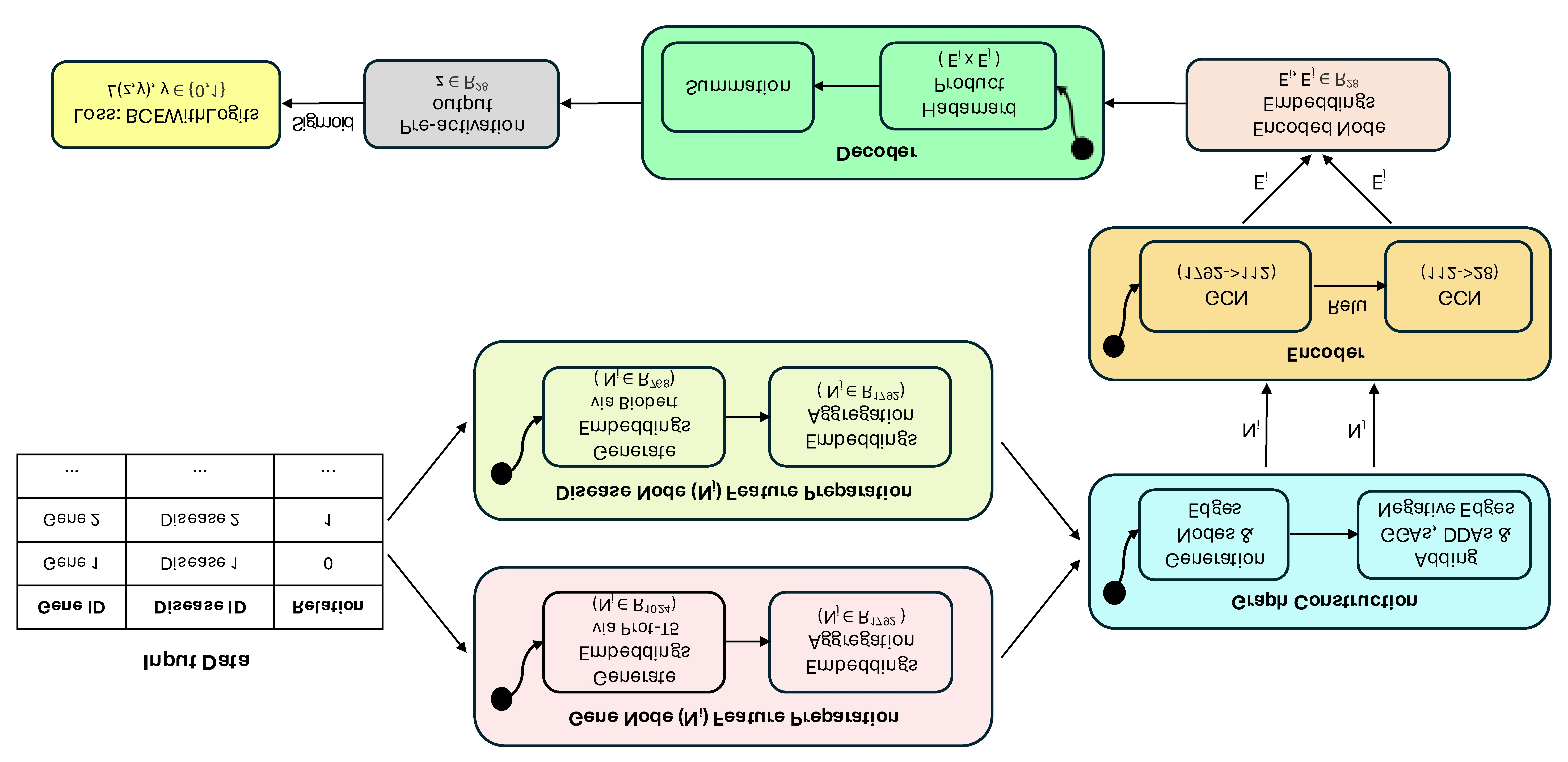
The new model, GLaDiGAtor, works like a smart graph: it builds a map where nodes are genes and diseases, and edges are known interactions. Then it learns from this map, as if from examples, and predicts where missing edges should be. The map also incorporates textual hints: disease descriptions and protein sequences, which the model reads as annotations on the nodes. This allows it to see not only direct connections but also hidden patterns.
This approach speeds up the search for drug-target genes. Instead of months of manual work, just a few hours of computation. And the more data goes into the map, the more accurate the predictions become. Perhaps soon we'll be able to foresee which gene will fail in a given disease and prepare treatment before symptoms appear.
Original abstract
as written by the authors arXiv:2602.18769
Understanding disease-gene associations is essential for unravelling disease mechanisms and advancing diagnostics and therapeutics. Traditional approaches based on manual curation and literature review are labour-intensive and not scalable, prompting the use of machine learning on large biomedical data. In particular, graph neural networks (GNNs) have shown promise for modelling complex biological relationships. To address limitations in existing models, we propose GLaDiGAtor (Graph Learning-bAsed DIsease-Gene AssociaTiOn pRediction), a novel GNN framework with an encoder-decoder architecture for disease-gene association prediction. GLaDiGAtor constructs a heterogeneous biological graph integrating gene-gene, disease-disease, and gene-disease interactions from curated databases, and enriches each node with contextual features from well-known language models (ProtT5 for protein sequences and BioBERT for disease text). In evaluations, our model achieves superior predictive accuracy and generalisation, outperforming 14 existing methods. Literature-supported case studies confirm the biological relevance of high-confidence novel predictions, highlighting GLaDiGAtor's potential to discover candidate disease genes. These results underscore the power of graph convolutional networks in biomedical informatics and may ultimately facilitate drug discovery by revealing new gene-disease links. The source code and processed datasets are publicly available at https://github.com/HUBioDataLab/GLaDiGAtor.
The model uses two languages: one 'reads' protein sequences, the other reads medical texts, and it merges them into a single map.