Seeing the Unseen: The Proton Without Formulas express
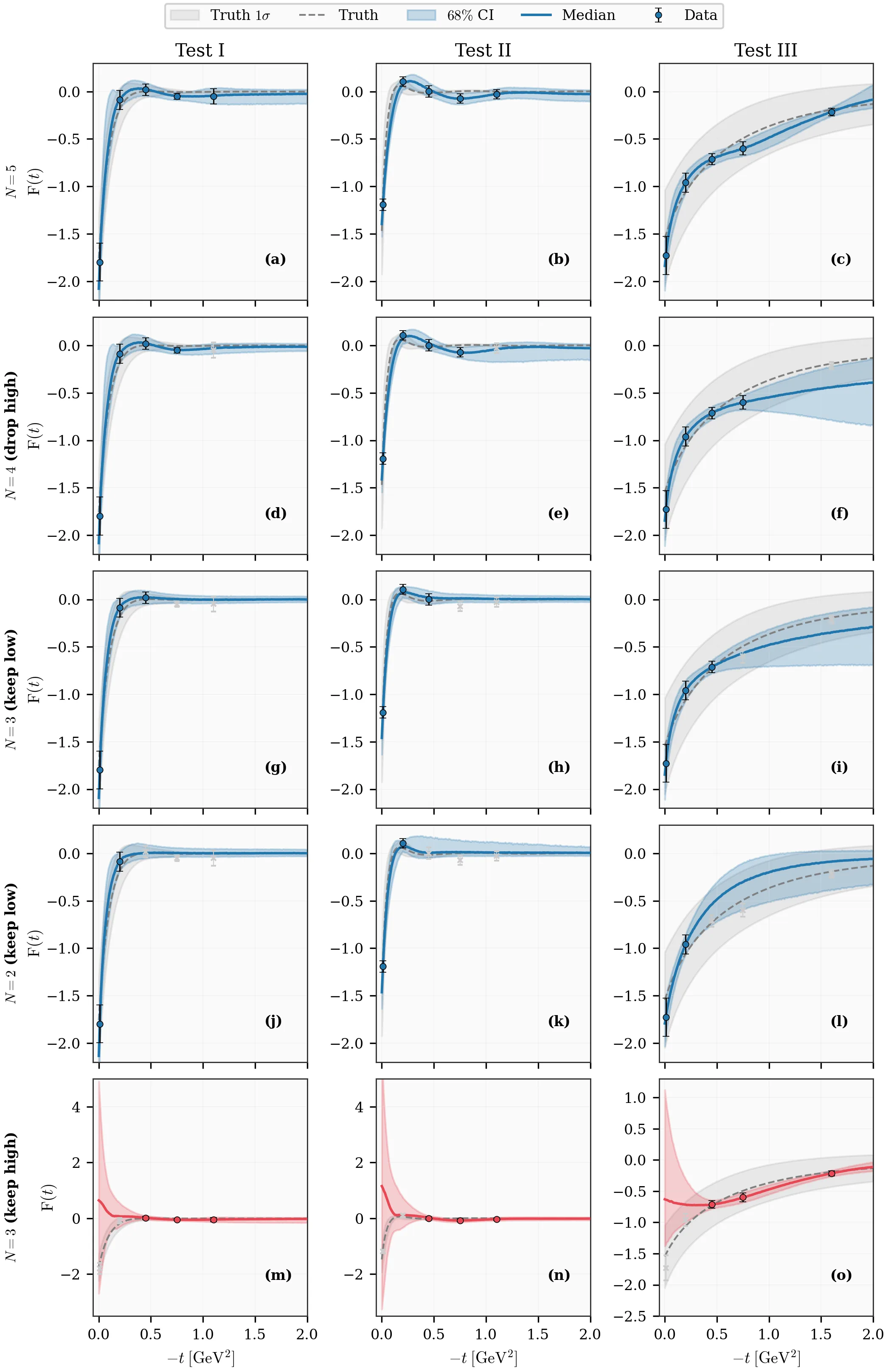
The proton is not a smooth ball but a tangle of quarks and gluons in constant motion, exchanging energy. Finding out exactly how energy, pressure, and spin are distributed inside it is impossible to do directly: measurements yield only sparse, noisy points. It's like trying to guess a face from a few blurry photos taken from different angles.
Scientists applied a method that learns from many examples: first, they generated thousands of plausible curves describing how proton properties change during particle scattering. Then a 'noisy' algorithm gradually turned random lines into credible ones, checking them against real data. In this way, they managed to reconstruct three key characteristics of the proton: its 'gravitational form factors'—across the entire energy range, even when only one or two data points were available.
The reconstructed curves allowed them to extract important numbers — the so-called low-energy constants. Their values helped compute a quantity that shows how the proton 'resists' external pressure. This is a step toward understanding where the proton's mass comes from and how the strong force that binds quarks together works.
The proton is almost 99% energy from quark–gluon interactions, not from the mass of the quarks themselves, as if a person's weight were determined mostly by their internal tension, not their body.
In Liu Cixin's novel 'The Three-Body Problem,' aliens manipulate protons by unfolding them into multidimensional structures — recovering the proton's internal properties could be a first step toward such technologies.