How the Brain Rewires Itself in Alzheimer's Disease express
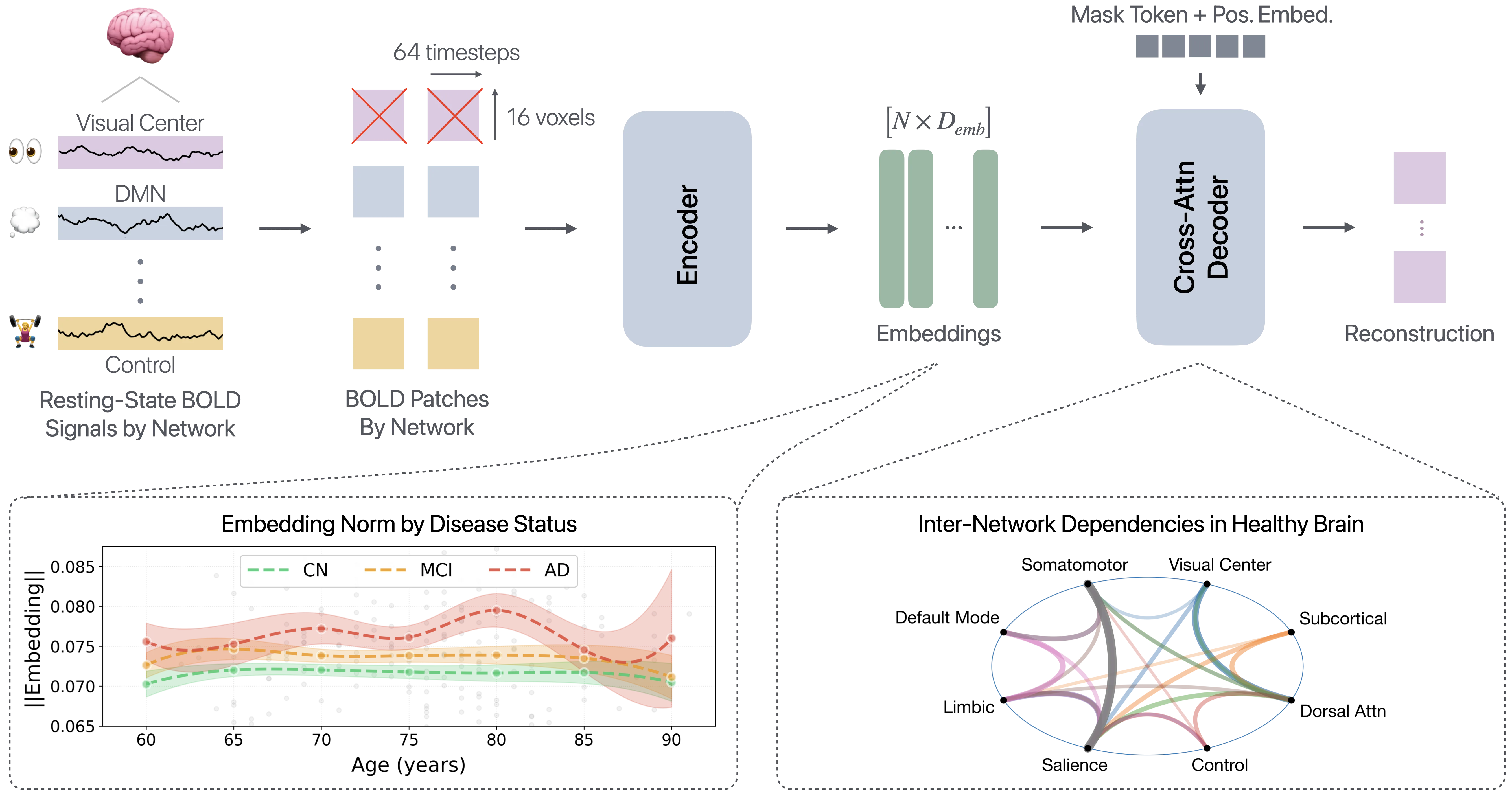
The brain isn't one big computer: it's more like an orchestra, where different groups of musicians play their parts. Neural networks for memory, attention, or emotions are constantly talking to each other. In Alzheimer's disease, this orchestra starts to go off-key: some groups fall silent, others play out of sync. But how do you see that on a brain scan?
Scientists came up with a clever trick. They took thousands of resting-state brain activity recordings — when a person just lies in the scanner, not thinking about anything in particular. Then they 'hid' part of the data, like covering a few notes in one musician's score with your hand. The model learned to guess what was there by looking at the other groups. That's how it learned to understand how much different brain networks depend on each other.
When they applied this model to Alzheimer's patients, they found that connections between networks change. The networks for internal reflection (default mode), emotions (limbic), and attention are especially affected. Moreover, these changes can not only distinguish a patient from a healthy person but also assess how far the disease has progressed. It's like a conductor who, by seeing how musicians stop hearing each other, could predict when the orchestra will completely fall apart.
This approach isn't just another algorithm. It shows which specific connections break first. That means doctors could spot warning signs earlier and possibly intervene before memory starts to fail.
The default mode network is active when you daydream or recall the past. In Alzheimer's disease, it's one of the first to lose connection with other networks.