Magnetic Fingerprint: How to See Quantum Jitter express
A fridge magnet sticks because the tiny atomic arrows inside it are aligned in one direction. But quantum mechanics makes these arrows jitter, so the overall magnetization falls short of the ideal. In a new study, physicists propose to measure this jitter by looking at how neutrons, uncharged particles from the atomic nucleus, bounce off a sample.
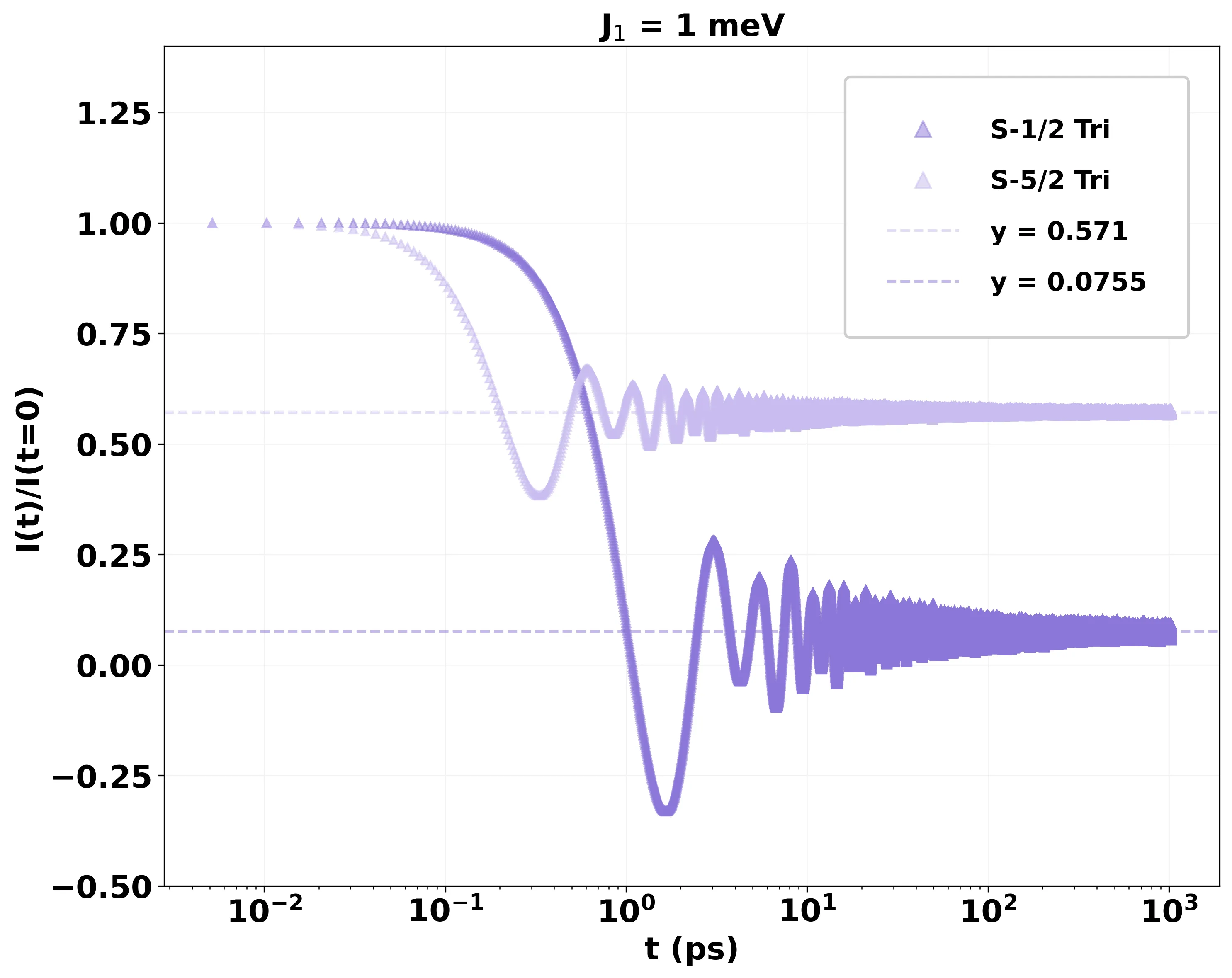
In the experiment, a neutron beam is aimed at a magnetic material. Some neutrons scatter, and the way their polarization changes over time reveals the strength of quantum fluctuations. The longer the polarization persists, the smaller the jitter and the closer the magnet is to perfect order. It is like how the fading echo in the mountains tells you about the roughness of the terrain: a weak echo means strong irregularities.
To test the method, the scientists calculated the behavior of two types of antiferromagnets — materials where neighboring arrows point in opposite directions. The calculations showed that both the quantum reduction of the moment and geometric frustration (when a triangular lattice prevents all arrows from aligning antiparallel) quench the long-lived signal in the same way. This coincidence confirms that measuring neutron polarization directly reflects the level of quantum fluctuations.
The new approach does not require knowledge of the magnetic structure's details and works even with powder samples, where crystallites are oriented randomly. This makes it a convenient tool for studying quantum magnets — materials promising for quantum technologies and spintronics.
Original abstract
as written by the authors arXiv:2603.02431
Starting from the magnetic total-moment sum rule of neutron scattering, we derive an explicit connection between ordered-moment reduction and the long-time limit of the intermediate scattering function. We show that this time-domain formulation establishes a direct and experimentally accessible measure of quantum fluctuation strength through neutron spin-echo spectroscopy, with \[P(t\rightarrow\infty)=\frac{I(Q,t\rightarrow\infty)}{I(Q,t=0)}=\frac{\langle \mu \rangle^{2}}{\langle \mu^{2} \rangle}\] This identity links the long-time polarization to the ratio between ordered and total magnetic moments. Linear spin-wave calculations for square and triangular Heisenberg antiferromagnets demonstrate that both quantum spin reduction and geometric frustration suppress the plateau value in quantitative agreement with moment reduction. The resulting framework establishes a direct and model-independent measure of the level of quantum fluctuations in bulk quantum magnets, particularly for polycrystalline samples.
Neutrons carry no electric charge, so they penetrate deep into matter and only sense the magnetic fields created by electrons.