The g-factor is a dimensionless number that quantifies the strength of a particle's magnetic moment relative to its angular momentum. In essence, it tells you how 'magnetic' a spinningcharged particle is. For a classical charged sphere, the g-factor would be exactly 1, but quantum mechanics introduces corrections. The most famous example is the electron, whose g-factor is approximately 2.002319, a value that deviates slightly from 2 due to quantum field effects. This precise number is one of the most accurately predicted and measured quantities in all of physics.
History
The concept was introduced by Wolfgang Pauli in 1927 to explain the anomalous Zeeman effect, where the splitting of spectral lines in a magnetic field didn't match classical predictions. The precise calculation of the electron's g-factor was a major triumph of quantum electrodynamics in the 1940s.
How it works
The g-factor arises from the relationship between a particle's intrinsic spin and its magnetic moment. For a particle with spin, the magnetic moment is proportional to the spin, and the g-factor is the proportionality constant. In quantum electrodynamics, the deviation of the electron's g-factor from 2 is explained by the particle constantly emitting and reabsorbing virtual photons, which slightly alters its magnetic properties. For composite particles like protons or neutrons, the g-factor is influenced by their internal quark structure, leading to values far from simple integers.
In practice
The g-factor is crucial in electron spin resonance (ESR) spectroscopy, used to identify chemical species and study their local environment, and in the design of quantum bits (qubits) in semiconductor materials like germanium, where magnetic fields manipulate spin states.
Fun fact
The electron's g-factor has been measured to an accuracy of 1 part in 10 trillion, making it one of the most precisely verified predictions in physics.
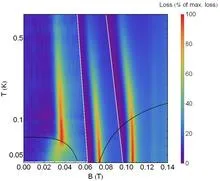
Tuning a radio receiver to a station that changes frequency as you cross a phase boundary: that is how you might picture the challenge facing the researchers. In the metal YbRh2Si2, electrons behave as "heavy" particles: their effective mass is hundreds of times that of a free electron.
Two stars circle each other, gradually drawing closer. Their dance loses energy, and that energy escapes into space — in the form of gravitational waves, and sometimes other fields.
Gravity isn't just the force that keeps us on the floor. On cosmic scales, it conducts galaxies, bends light rays, and decides the fate of everything. A century ago, Einstein described it as the curvature of space and time.
A cosmological map is like a snapshot of ripples on water: from it you can reconstruct what stone was thrown. The stone is the properties of the universe — how much ordinary matter it contains, how much dark matter, how fast it is expanding. The ripples are the pattern of galaxies that telescopes measure.
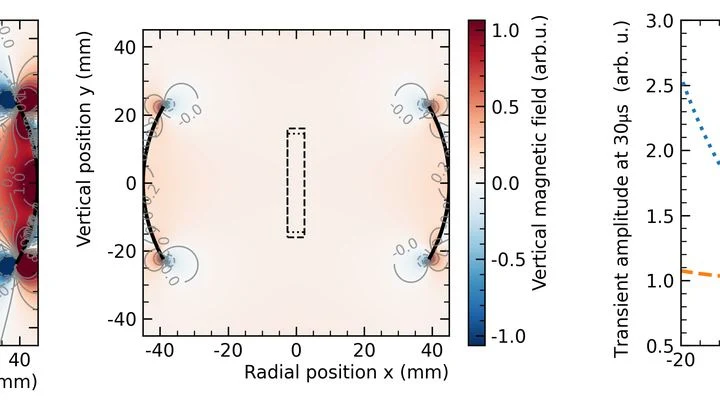
In a giant ring of magnets outside Chicago, muons whirled like figure skaters on an ice rink. But instead of music, there's a magnetic field, and instead of spinning, there's a barely perceptible wobble of the spin. Physicists call this wobble the anomalous magnetic moment.
Electrons and muons are tiny magnets. Their magnetism is slightly more than two (in special units), and this 'excess fraction' (anomalous magnetic moment) arises from constant ripples in the vacuum: particle pairs momentarily pop into existence and vanish.
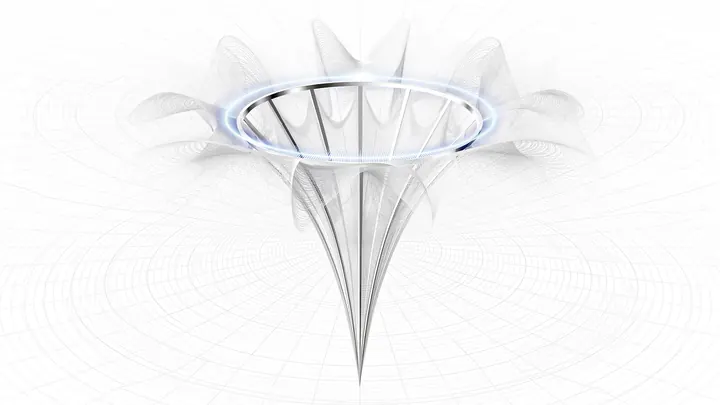
The light cone is a blueprint of causality, laser-cut onto the fabric of the universe. In classical physics, it is as sharp as a scalpel: events inside are linked by invisible threads of influence, while outside lies eternal isolation, sealed by the ultimate speed limit.
Every quantum particle has spin — an intrinsic magnetic property, like a tiny arrow. In an experiment, a beam of such particles passing through a magnet splits in two, like a coin that lands either heads or tails. That’s exactly how particles like a hydrogen atom behave.
The weak equivalence principle, silently tested since the time of Galileo and laid at the foundation of general relativity, states: all bodies fall equally, regardless of their internal composition.
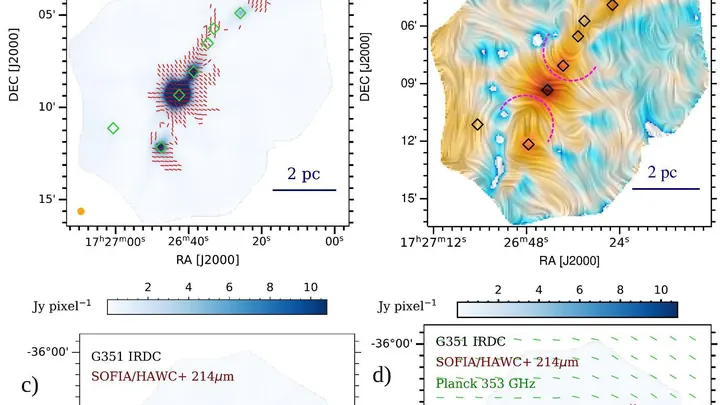
In the dark cloud G351, where new stars are about to emerge from gas and dust, the magnetic field has bent into an hourglass shape. Such a shape is a sign that the field is not just watching star birth from the sidelines but is actively taking part.
Scientists used the SOFIA telescope, mounted on an airplane, to see the dust in the cloud.
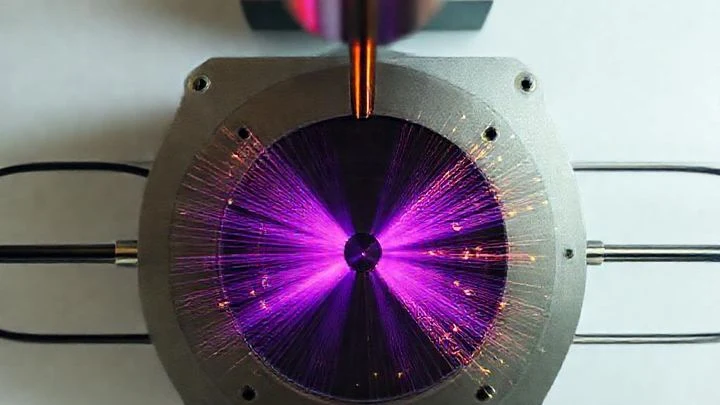
In a solid, atoms vibrate, transmitting sound. Sometimes this wave doesn't run straight but curls into a spiral, like a corkscrew entering a cork. In ordinary crystals, such 'sound vortices' are known, but in magnetic materials they had long eluded detection.
A silicon chip the size of a fingernail holds billions of tiny switches. But a quantum computer needs not switches but individual electrons trapped in microscopic pits. These pits are quantum dots. And here's the catch: two neighboring pits that look identical can hold an electron differently. One is slightly deeper, the other slightly shallower.
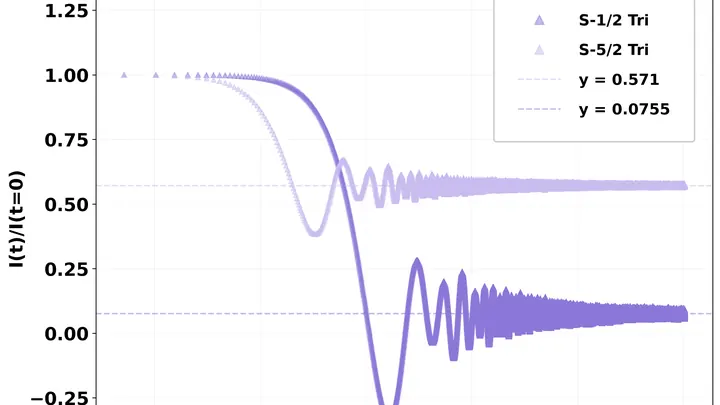
A fridge magnet sticks because the tiny atomic arrows inside it are aligned in one direction. But quantum mechanics makes these arrows jitter, so the overall magnetization falls short of the ideal.
An electron inside a molecule behaves like a tiny magnet, and its 'strength' can be measured with enormous precision. Physicists took the molecular ion HD⁺ — a nucleus made of a proton and a deuteron (heavy hydrogen), with a single electron circling around it — and placed it in a strong magnetic field of 4 teslas (roughly 80,000 times stronger than…
A qubit is like a tenant in a tiny apartment: it usually takes the ground floor to avoid distractions from upstairs neighbors. In germanium quantum dots, where spin qubits live, this tenant is a hole: that is, a missing electron. The hole has a spin that acts like a tiny magnetic needle.
The neutron is a particle with no charge but with internal structure. Like a ball that looks smooth on the outside but has a complex filling inside. Scientists have long wanted to understand how electric and magnetic forces are distributed inside the neutron. To do this, you need to "feel" it — collide it with its antiparticle and see what happens.
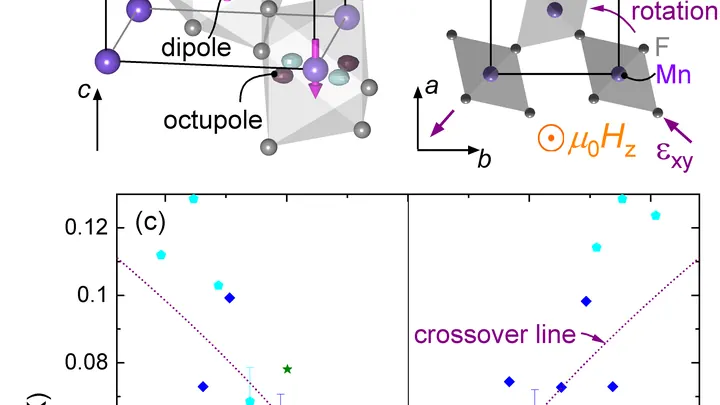
In a manganese fluoride crystal, atoms are lined up like soldiers in formation. But within this formation lies a hidden pattern: the magnetic moments of the atoms point in opposite directions, and the pattern itself changes when the crystal is rotated.
Magnetic resonance is like a tuning fork that rings only at its own note. Each molecule has its own frequency, and from that you can tell what the molecule is and what state it's in. But previously, this tuning fork was listened to through a thick wall: the signal was blurred, and you couldn't make out the exact note.
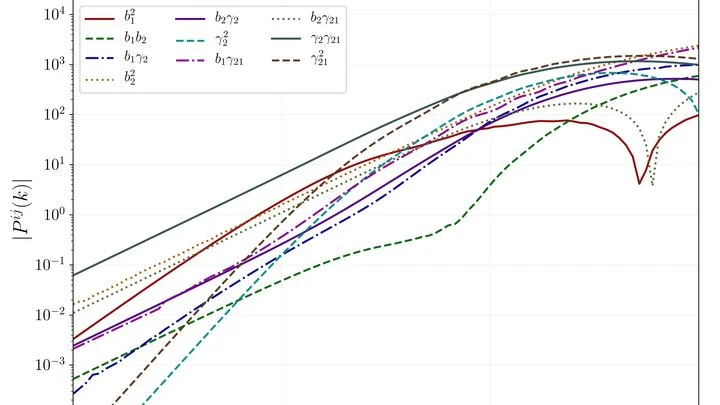
Two great theories describe reality: one — how massive bodies cause curvature of space, the other — the Standard Model — governs elementary particles. Reconciling them remains elusive, like trying to describe an ocean storm in the language of a diamond lattice.
A magnetic field of 8 tesla is 200 times stronger than Earth's field. Under such a field, superconductivity in a thin film of palladium ditelluride not only survives but persists down to 20 millikelvin, which is a hundred times colder than outer space. For comparison, a thick film of the same material has a critical field 80 times smaller.