The muonmagnetic moment is a measure of the intrinsic magnetic strength of the muon, a heavier cousin of the electron. Its precise value is predicted by the Standard Model of particle physics, accounting for quantum loop corrections from virtual particles. Any deviation between theory and experiment could signal new physics beyond the Standard Model, such as undiscovered particles or forces. The muon's larger mass makes it more sensitive to such corrections than the electron, providing a stringent test of our understanding of the quantum vacuum.
History
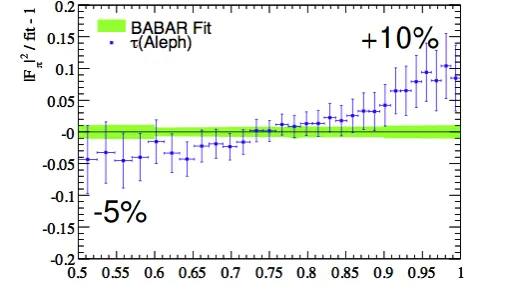
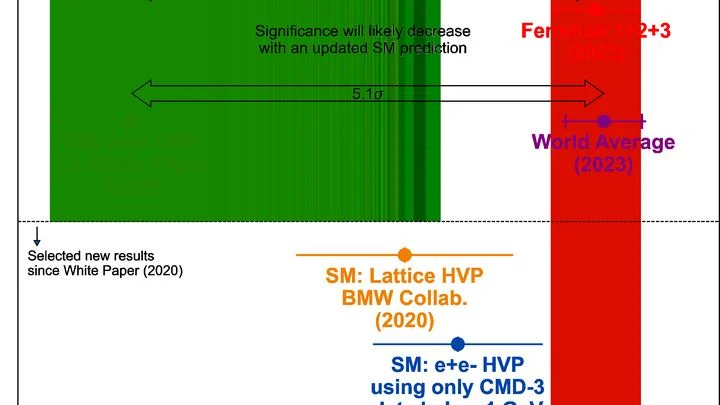
The first precise measurement at Brookhaven National Laboratory (1997–2001) showed a 3.7σ deviation from the Standard Model, sparking intense interest. The FermilabMuon g-2 experiment (2021) confirmed this discrepancy, though the theoretical prediction has since been refined with lattice QCD calculations, reducing the tension.
How it works
The magnetic moment arises from the muon's spin and charge. Quantum fluctuations continuously create and annihilate virtual particles around the muon, slightly altering its effective magnetic strength. These contributions are calculated using perturbative quantum field theory, summing thousands of Feynman diagrams. Experimental measurements use the precession of the muon's spin in a magnetic field, comparing the observed frequency to the theoretical prediction.
In practice
The muonmagnetic moment is a key benchmark for testing the Standard Model and constraining supersymmetric theories. It also informs the design of precision particle accelerators and storage rings.
Fun fact
The muon's magnetic moment is about 200 times more sensitive to new physics than the electron's, making it a powerful probe for undiscovered particles.
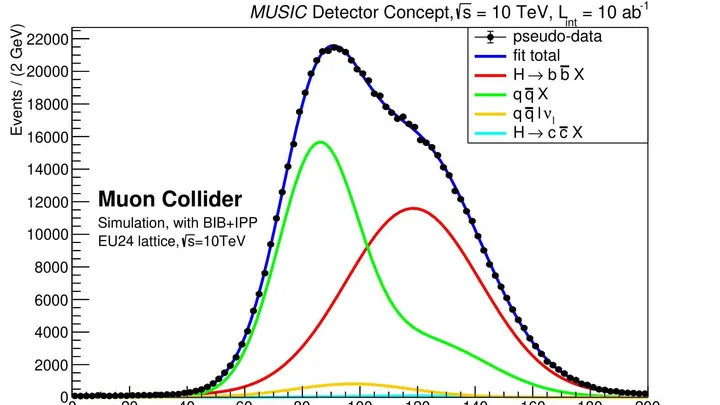
The 21-kilometer ring near Protvino was once planned to accelerate protons. Today, the same tunnel could host a very different machine — a muon collider. The muon is a heavy cousin of the electron, and that's its strength. On a curve, an electron radiates like a searchlight, losing precious energy. A muon radiates a billion times less.
A lead sphere hangs above another lead sphere. According to the usual laws of gravitation, they attract each other exactly along the vertical — along the line connecting their centers.
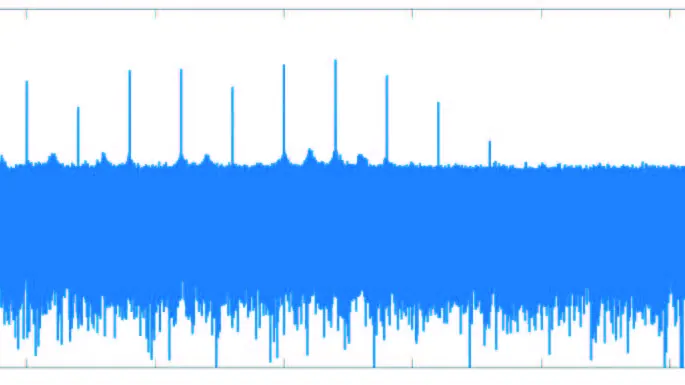
In a giant ring of magnets outside Chicago, muons whirled like figure skaters on an ice rink. But instead of music, there's a magnetic field, and instead of spinning, there's a barely perceptible wobble of the spin. Physicists call this wobble the anomalous magnetic moment.
Atomic nuclei are rarely perfect spheres. More often, they resemble a slightly squashed ball — the electric charge inside is unevenly distributed, and protons may shift a bit, creating a tiny 'pear-shaped' bulge.
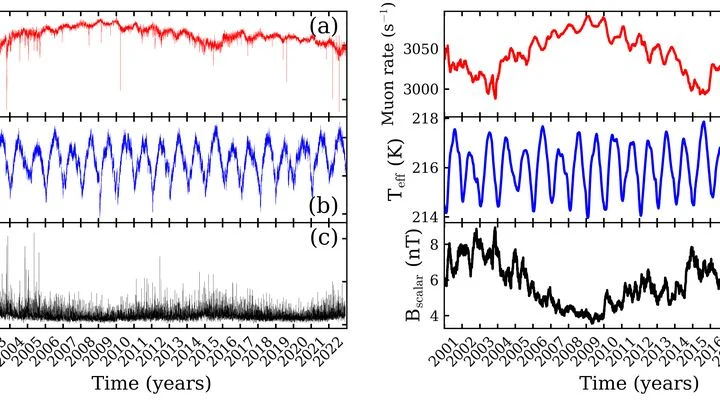
Deep underground, in the thickness of granite, detectors catch rare visitors from space — muons. These particles are born high in the atmosphere when cosmic rays slam into air nuclei. They make it to the underground lab thanks to their enormous speed, close to the speed of light.
Every second, about a hundred invisible particles, muons, pass through your body. They are born high in the sky when cosmic rays collide with air atoms, raining down on Earth. These particles are so penetrating that they can pass through a multi-story building, but they slightly change direction when they encounter dense material, such as lead or uranium.
Electrons and muons are tiny magnets. Their magnetism is slightly more than two (in special units), and this 'excess fraction' (anomalous magnetic moment) arises from constant ripples in the vacuum: particle pairs momentarily pop into existence and vanish.
The Higgs boson is like a conductor that gives mass to all other particles. Without it, electrons would be massless and atoms would fall apart. But how does the conductor interact with itself? That is the key question a future muon collider aims to answer.
To uncover the proton's true size, physicists swapped the electron in a hydrogen atom for its heavy copy — the muon. Acting like a magnifying glass with thousandfold power, the muon gets right up against the nucleus and 'probes' the proton with unprecedented precision.
Protons accelerated to enormous energies slam into a thick metal plate, like bullets into armor. Inside the metal, a J/ψ particle is born for an instant, which immediately decays into two muons — light relatives of the electron. These muons fly out of the target, and detectors catch their tracks.
The scientists compared the number of caught muons with predictions from a computer model.
When a massive star dies and collapses into a supernova, a neutron star is born — a city-sized sphere with the Sun's mass. Its matter is so compressed that a teaspoon weighs more than Mount Everest. Physicists are trying to learn the "recipe" of this matter — the equation of state that explains how matter behaves under extreme pressure.
In an underground ring 27 kilometers in circumference, protons are accelerated to nearly the speed of light and smashed head-on. At the collision point, conditions briefly recreate those of the first trillionth of a second after the birth of the universe.
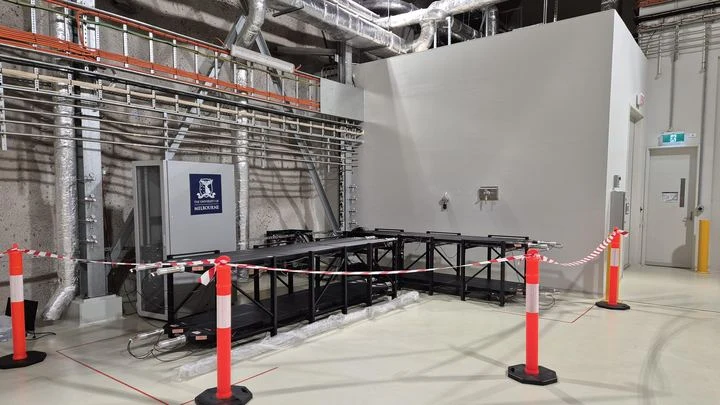
Deep underground, in a former gold mine in Australia, stands a laboratory where silence is broken only by rare flashes of light. These flashes are the traces of cosmic particles that punch through hundreds of meters of rock. Eight plastic panels, resembling large glowing sheets, catch these particles.
A chunk of nuclear fuel inside a reactor is not just a solid. When heated, the uranium atoms in it start to 'wiggle' their magnetic moments, and this motion changes thermal conductivity and other properties.
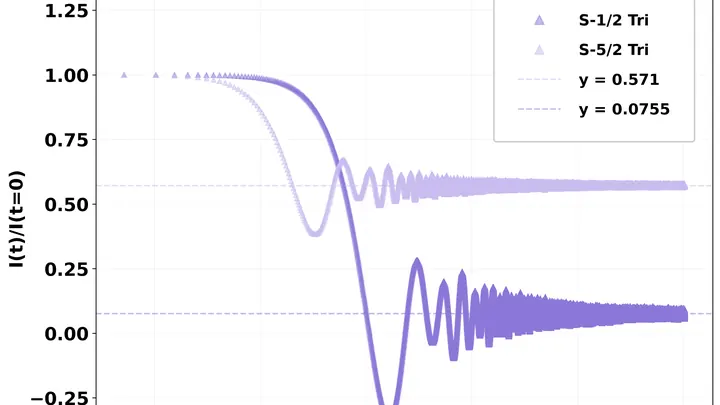
A fridge magnet sticks because the tiny atomic arrows inside it are aligned in one direction. But quantum mechanics makes these arrows jitter, so the overall magnetization falls short of the ideal.
In collisions of heavy nuclei, a fireball of thousands of particles is born. Among them are pions and kaons, two kinds of light particles that look very much alike. To understand what happens in this fireball, physicists need to know exactly how many of each particle flew out.
The nucleus of deuterium, or the deuteron, can be pictured as a microscopic spinning top. If its charge distribution is not perfectly symmetric, then in an external electric field this top experiences a minuscule tilt of its spin axis.
The proton is not a solid ball. Inside, it's a seething mix of quarks and gluons. Gluons are the particles that glue quarks together, much like wood glue binds pieces of wood. The question is: how much of the proton's "weight" comes from this glue? Physicists have calculated this on a computer by discretizing space and time into a fine grid.
Every second, invisible particles from space, cosmic rays, strike Earth's atmosphere. Colliding with air molecules, they produce showers of secondary particles, among which muons are especially abundant. A muon is a heavy cousin of the electron that lives only a couple of microseconds but still manages to reach the ground.
The muon is a heavy cousin of the electron that lives for just two millionths of a second. In a magnetic field, it spins like a top, but slightly faster than formulas predict. Twenty years ago, this 'slightly faster' was noticed at Brookhaven, and physicists have been arguing ever since: either the instruments were wrong, or unknown particles are hiding in the vacuum.
All bodies in vacuum fall with the same acceleration: this principle, formulated by Einstein in general relativity, underpins our understanding of gravity. Yet so far it has been experimentally confirmed only for particles of ordinary matter.
The muon is a tiny spinning top, twirling in the turbulent sea of the vacuum. Its magnetic axis points slightly away from what the Standard Model predicts. The deviation is just a couple of parts per million, but for physicists, it's a full-blown mystery.
The vacuum is not a dead calm.
Two great theories describe reality: one — how massive bodies cause curvature of space, the other — the Standard Model — governs elementary particles. Reconciling them remains elusive, like trying to describe an ocean storm in the language of a diamond lattice.