The Bohr magneton is the natural unit for measuring the magnetic moment of an electron. It quantifies the strength of the electron's intrinsic magnetic dipole, which arises from its spin and orbital motion. This constant is fundamental in understanding magnetism at the atomic scale, from electron spin resonance to the magnetic properties of materials.
History
The concept was introduced by Wolfgang Pauli in 1920, who proposed it as a natural unit for atomicmagnetic moments, building on earlier work by Niels Bohr and others on the magnetic properties of atoms.
How it works
The Bohr magneton is defined as μ_B = eħ/(2m_e), where e is the elementary charge, ħ is the reduced Planck constant, and m_e is the electron mass. It represents the magnetic moment of a single electron with one unit of orbital angular momentum. The electron's spin contributes a magnetic moment of approximately one Bohr magneton (with a small correction due to quantum electrodynamics). In an external magnetic field, the energy of an electron's magnetic moment splits into discrete levels—the Zeeman effect—with energy spacing proportional to the Bohr magneton times the field strength.
In practice
It is used in electron spin resonance (ESR) spectroscopy to identify free radicals and transition metal ions, and in the design of magnetic storage devices and quantum sensors.
Fun fact
The electron's magnetic moment is slightly larger than one Bohr magneton—about 1.001159652—a deviation that was a key test of quantum electrodynamics and led to the most precise prediction in physics.
A sculptor looks at a block of marble and sees the figure within, waiting to be freed from excess material. Instead of adding clay, he removes everything that is not part of the form. The authors of a new study on magnetic resonance took a similar approach: rather than complicating the tissue model by adding ever more details, they stripped away the superfluous to reveal the essence.
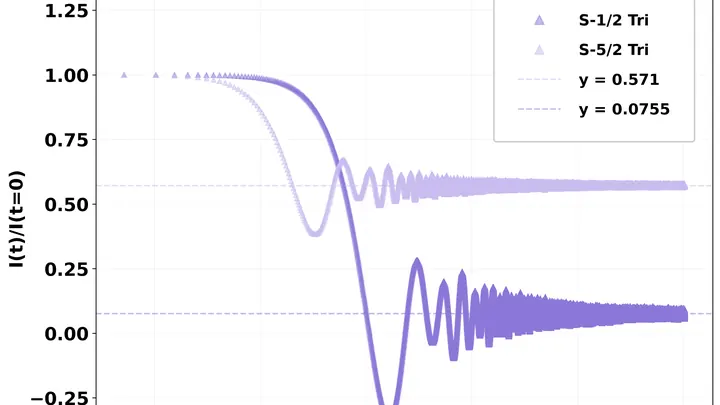
In the layered crystal CrSBr, the magnetic moments of atoms are arranged like notes in a score: within each layer they point in the same direction, but between layers they point in opposite directions. This antiferromagnetic melody plays up to 132 kelvin, beyond which thermal motion destroys the order.
The two states of a strontium atom are like twins running down the same track, but one is slightly higher than the other. Usually, the light used to manipulate atoms pushes one twin harder and the other more weakly. Here, they chose a wavelength of 813 nanometers—'magic'—where both get the same kick.
Among the debris of particle collisions, short-lived 'guests' sometimes appear — hyperons. One of them, Σ0, lives for less than one ten-billionth of a second and decays on the fly. Catching it directly is nearly impossible, but its traces can be spotted: it leaves behind another particle, Λ, and an electron-positron pair.
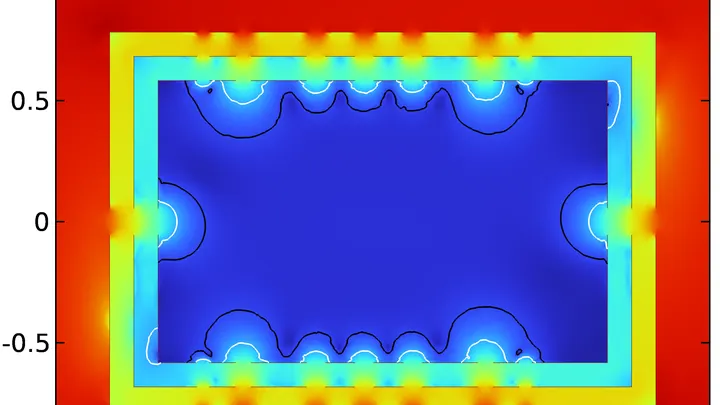
The magnetic field in this setup must be as smooth as glass: the slightest ripple would blur the signal. The engineers built two coils that cancel each other's field externally and packed them in three layers of ferromagnetic plates.
A black hole is not a vacuum cleaner. By itself, it doesn't pull everything in more strongly than an ordinary star of the same mass. But if there's a magnetic field nearby and charged particles flying around, an interesting game begins.
Two stars circle each other, gradually drawing closer. Their dance loses energy, and that energy escapes into space — in the form of gravitational waves, and sometimes other fields.
Radio astronomy began with the mysterious noise caught by the antenna of Karl Jansky and the rhythmic pulses that Jocelyn Bell Burnell playfully called 'little green men'.
If you accelerate an observer to near-light speed, the emptiness around them stops being cold. A thermal glow emerges — an effect predicted in 1976 and named after William Unruh. For earthly accelerations, this glow is vanishingly faint, like a whisper at a rock concert.
The neutron is one of the most neutral particles in nature. But if you add a special parameter to the laws of physics, called the theta term Standard Model, a tiny charge imbalance appears inside the neutron. One edge becomes slightly positive, the other slightly negative.
A guitar string keeps vibrating even after the musician lets it go, and that vibration changes the sound the listener hears. Magnetic moments in a crystal behave much the same way: they align into a strict antiferromagnetic order (neighbors point in opposite directions), but they never completely freeze.
In the vast clouds of rarefied gas that fill the space between stars, something is always churning. Supernova explosions, colliding streams — all of it shakes the plasma. And in this rippling, as it turns out, hides the mechanism that gives birth to magnetic fields.
Plasma is a gas in which electrons are stripped from atoms.
A tiny defect in a boron nitride crystal behaves like a microscopic indicator bulb. Shine light on it, and it glows, with the shade shifting with temperature: the warmer it gets, the redder the glow.
In a giant ring of magnets outside Chicago, muons whirled like figure skaters on an ice rink. But instead of music, there's a magnetic field, and instead of spinning, there's a barely perceptible wobble of the spin. Physicists call this wobble the anomalous magnetic moment.
A translator works in two worlds at once: to an outside observer, they are silent and unobtrusive, but inside their mind, a flurry of activity unfolds along clear lines of meaning. Altermagnets, a recently discovered class of magnetic materials, are much the same.
Many black holes are surrounded by magnetic fields. As it spins, the black hole drags curved spacetime along with it, like a machine's flywheel, and sets the cosmic factory in motion.
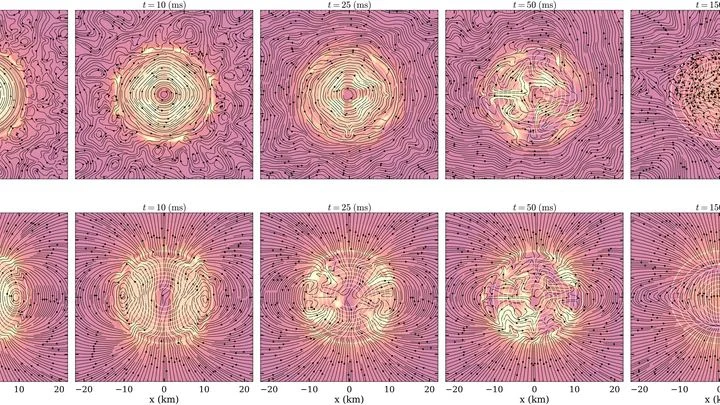
A neutron star is a sphere the size of a city but with the mass of an entire Sun. Its magnetic field can tear atoms apart from thousands of kilometers away. Yet until now, it was a mystery how this field is arranged inside: whether it is twisted into tight ropes or more like neat lines radiating from the poles.
An ordinary magnet always carries two poles — north and south. Split it in half, and each piece immediately grows its own pair. But deep in particle theory lives a strange notion: the monopole — a particle carrying just one magnetic charge, a lone pole without a partner.
A palm hovering over a hot stove feels the heat even when the surrounding air seems cool. Something similar happens to electrons in the Aharonov–Bohm effect: the particle senses an electric voltage even though it enters a region where the field has already been switched off.
A drop of water stretches in a strong electric field. The deuterium nucleus, a bound pair of a proton and a neutron, behaves the same way, except here the field comes from a passing gamma ray, and instead of just stretching, the nucleus can simply fall apart.
When two black holes spiral around each other and merge, they send ripples across the universe — gravitational waves. These waves carry the imprint of exactly how the objects moved before the collision. From the shape of this 'dance,' you can tell how closely the objects resemble perfect black holes.
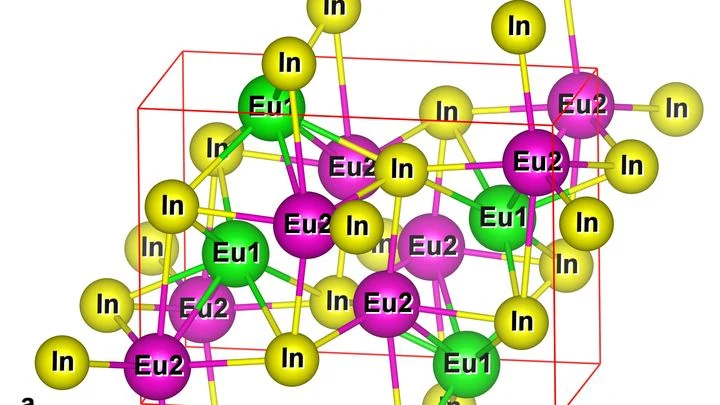
A piece of europium-indium alloy, when cooled in a magnetic field, behaves like water that does not freeze all at once but first in one corner of the glass, then in another.
The magnetic refrigerator of the future won't hum with a compressor. Instead, it will cool your groceries by exploiting a special material that heats up in a magnetic field and cools down when the field is removed. This cycle resembles the compression and expansion of gas in a conventional fridge, but here a magnet does the work of a piston.
You can make a light beam look like a flower with several petals. If you send such a beam through a cloud of cold rubidium atoms and switch on a magnetic field, the petals start to rotate. The angle of rotation is directly linked to the field's strength.
In a crystal made of europium, zinc, and phosphorus, electric current behaves like a car on a bumpy road. Electrons don't run freely but drag magnetic clouds, polarons, behind them.
Neutrinos are tiny particles that zip through Earth, barely noticing it. In the MicroBooNE experiment, they are caught in a tank of liquid argon. When a neutrino strikes an argon nucleus, it produces an electron and protons, like splashes from a stone thrown into water.
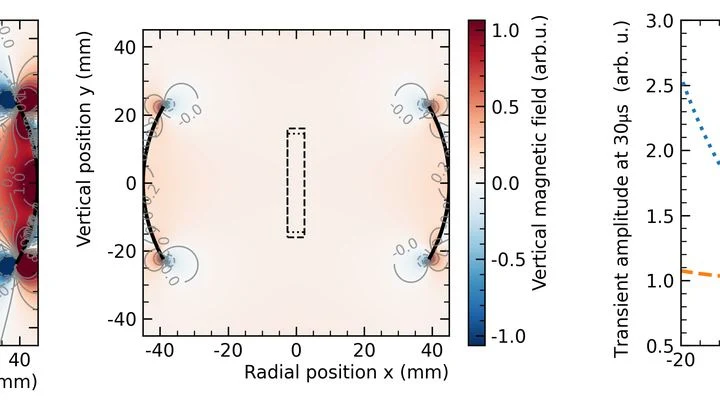
In laboratories where atoms are cooled to near absolute zero, even a tiny change in the magnetic field throws off all the settings. Conventional sensors, Hall plates or coils with ferrite cores, sit a few centimeters away from the vacuum chamber because they themselves create interference.
In a solid, atoms vibrate, transmitting sound. Sometimes this wave doesn't run straight but curls into a spiral, like a corkscrew entering a cork. In ordinary crystals, such 'sound vortices' are known, but in magnetic materials they had long eluded detection.
A fridge magnet sticks because the tiny atomic arrows inside it are aligned in one direction. But quantum mechanics makes these arrows jitter, so the overall magnetization falls short of the ideal.
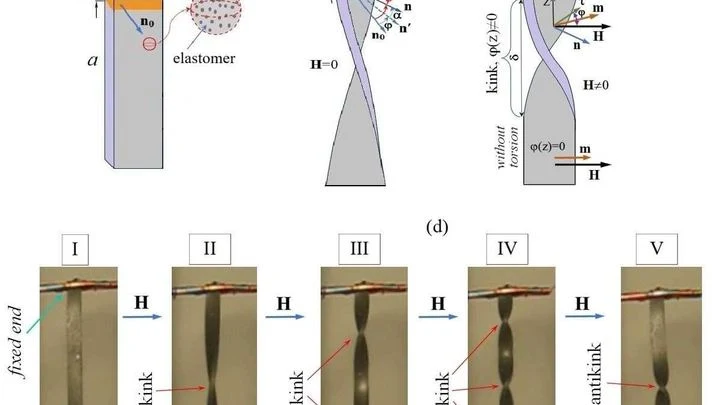
An ordinary rubber strip filled with fine iron filings doesn't just bend in a magnetic field: it ties itself into a stable knot. This effect was predicted and reproduced in experiments by physicists working with magnetoactive elastomers: a silicone base with carbonyl iron particles.
The nucleus of deuterium, or the deuteron, can be pictured as a microscopic spinning top. If its charge distribution is not perfectly symmetric, then in an external electric field this top experiences a minuscule tilt of its spin axis.
The crystal Ca2RuO4 resembles a stack of thin sheets. Inside each sheet, the electron spins are arranged in strict order, like rows of soldiers on a parade ground. The bonds between the sheets are weak, and their sign can be flipped by slightly pulling the crystal apart.
A tuning fork rings dully when it strikes a crack. That principle scales up in this experiment: physicists turned molecules into an ultrasensitive tuning fork to eavesdrop on the electron's asymmetry.
A magnesium oxide crystal is like a row of soldiers: atoms stand in neat lines, and an electron runs along them. But if the electron lingers, the nearest atoms shift slightly from their positions, like neighbors in a rank turning their heads. The electron finds itself in a dip made of displaced atoms and can no longer move freely.
The neutron is a particle with no charge but with internal structure. Like a ball that looks smooth on the outside but has a complex filling inside. Scientists have long wanted to understand how electric and magnetic forces are distributed inside the neutron. To do this, you need to "feel" it — collide it with its antiparticle and see what happens.
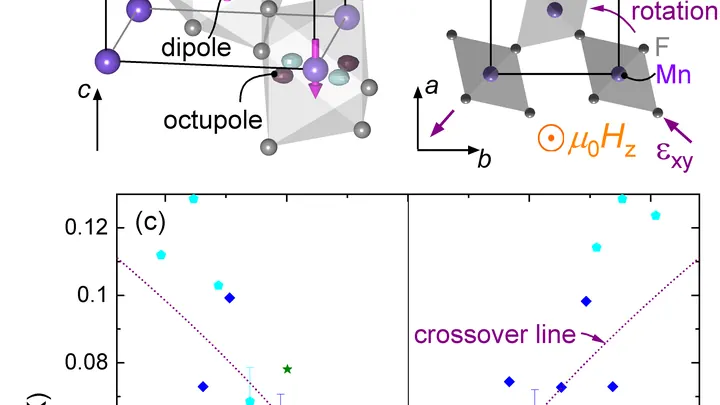
In a manganese fluoride crystal, atoms are lined up like soldiers in formation. But within this formation lies a hidden pattern: the magnetic moments of the atoms point in opposite directions, and the pattern itself changes when the crystal is rotated.
A tiny magnet made of layers of sulfur, chromium, and bromine sits on a microscope stage. Inside it, like unexpected guests, sit erbium atoms — a rare-earth metal. These atoms can glow when hit with a laser, and their light tells us what's happening around them.
An ordinary wave in a magnet is like ripples on water: the shorter the wavelength, the higher the energy. Physicists call such waves magnons. But in a thin film of bismuth yttrium iron garnet, they managed to create waves with the opposite behavior: their energy decreases as the wavelength gets shorter. These are antimagnons.
Magnetic resonance is like a tuning fork that rings only at its own note. Each molecule has its own frequency, and from that you can tell what the molecule is and what state it's in. But previously, this tuning fork was listened to through a thick wall: the signal was blurred, and you couldn't make out the exact note.