Magneticfluctuations are transient, random variations in the local magnetic field strength or direction, or in the orientation of magnetic moments within a material. They are ubiquitous in nature, occurring in everything from the turbulent solar wind to the quantum noise in a magnetic sensor. In condensed matter physics, they play a critical role in determining the properties of magnetic materials, including their phase transitions, transport behavior, and the stability of magnetic states.
History
The concept of magneticfluctuations has been studied since the early 20th century, with foundational work by Pierre Weiss on molecular field theory and later by Lev Landau on fluctuations near critical points. The modern understanding of magnetic fluctuations in metals was developed in the 1960s and 1970s with the theory of spin fluctuations by T. Moriya and others.
How it works
Magneticfluctuations arise from the thermal motion of charge carriers and the collective dynamics of magnetic moments. In a material, the magnetic moments of atoms are constantly jiggling due to thermal energy, and their interactions can create correlated fluctuations that grow near a phase transition. In a plasma like the solar corona, the motion of charged particles generates fluctuating magnetic fields that can propagate as waves. The amplitude and spectrum of these fluctuations depend on the temperature, the strength of the mean field, and the coupling between moments.
In practice
Magneticfluctuations are a key source of noise in magnetic sensors, including those used in hard drives and magnetometers. They also influence the performance of spintronic devices and are studied to understand high-temperature superconductivity.
Fun fact
In the solar corona, magneticfluctuations can drive the heating of the plasma to millions of degrees, a phenomenon known as coronal heating, which is still not fully understood.
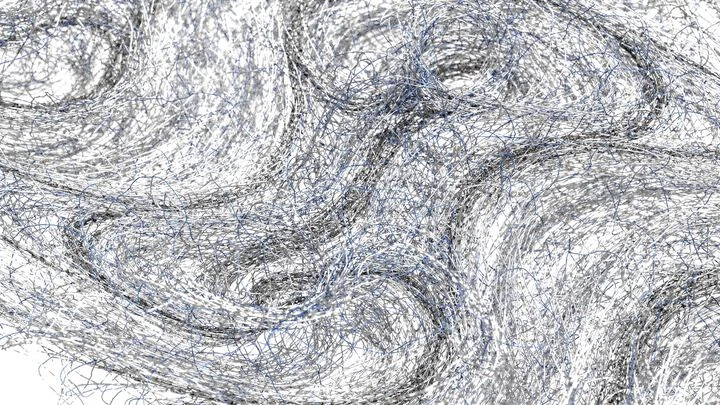
Surf doesn't roll onto the shore as an even front. It comes in tongues of foam that merge and split apart. Magnetic fields inside materials behave much the same way: they breathe in waves, and until now nobody had seen them whole.
Inside a supercomputer, fifteen stable wave clumps — solitons — collide to form a halo of dark matter. These waves obey an equation that Erwin Schrödinger derived for electrons at the beginning of the 20th century, but now they paint a portrait of a giant galactic cocoon.
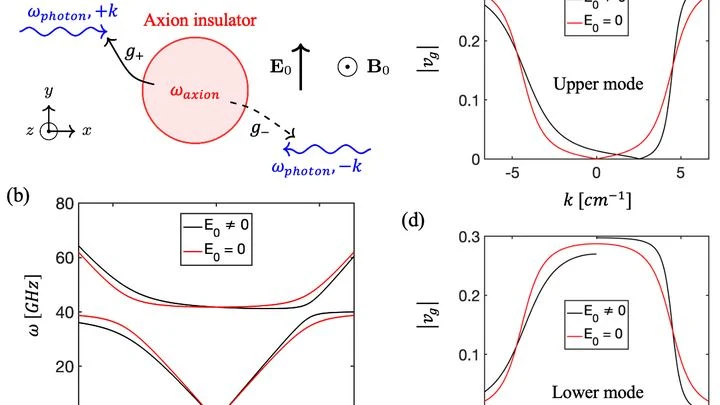
A regular flashlight shines equally forward and backward. But in magnetic crystals, a axion appears — a ghostly excitation, like a wave going around a stadium: atoms pass a magnetic impulse to each other. When light meets an axion, a hybrid forms, whose fate depends on electric and magnetic fields.
Even Jocelyn Bell Burnell, who first detected the strict periodicity of radio signals, noticed that some pulses would suddenly vanish. Today we know: variability is not a whim, but the voice of intricate electrodynamics.
Since their discovery in 2007, fast radio bursts (FRBs) have teased astrophysicists with their elusive nature. These millisecond signals arrive from distant galaxies and carry colossal energy: for an instant, they radiate as much as the Sun does in a month.
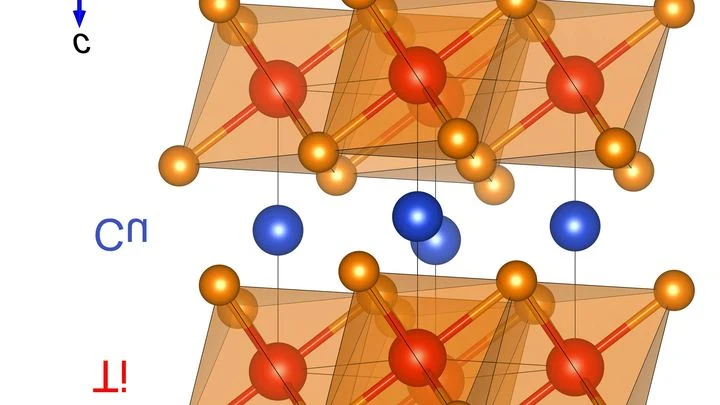
The La3Ni2O7 crystal resembles a layered pie, where the filling of nickel and oxygen atoms alternates with lanthanum layers. At ambient pressure, it does not conduct without resistance, but squeeze it or grow it as a thin film, and high-temperature superconductivity emerges.
A distant lighthouse flashes for an instant brighter than an entire galaxy. This is a fast radio burst — a mysterious signal from deep space. Some repeat, and astronomers have noticed a peculiarity: these bursts show rapid changes in polarization — a property indicating how the radio wave is twisted in space.
A semiconductor film one atom thick is like a tightly stretched membrane. Light makes it flash: luminous points (excitons) are born, which quickly fade. Where the membrane is torn or crumpled, the glow flickers and stutters, like a string with a knot sounding off-key.
Ahead of the bow shock that Earth creates in the solar wind, giant bubbles of rarefied gas sometimes appear. Inside them, particle density drops by factors, and electric fields start to tremble like a plucked string.
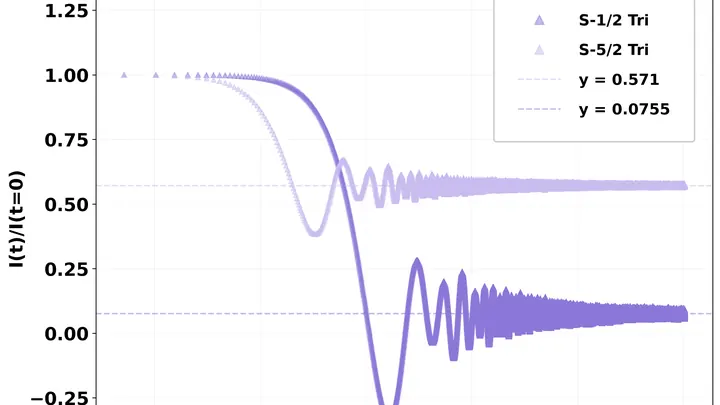
A fridge magnet sticks because the tiny atomic arrows inside it are aligned in one direction. But quantum mechanics makes these arrows jitter, so the overall magnetization falls short of the ideal.
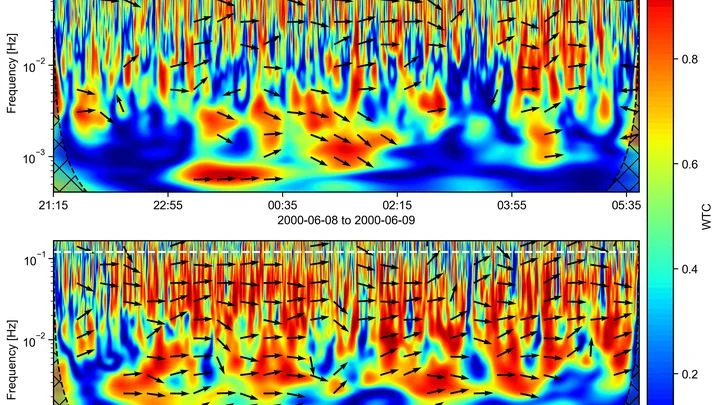
The Sun constantly emits a stream of charged particles, mostly hydrogen — the solar wind. Sometimes the Sun ejects dense blobs of magnetized gas, inside which calm usually reigns. But in 2000, scientists noticed two regions inside one such cloud where the gas was churning.
In the TiSe2 crystal, electrons behave like compass needles that suddenly start pointing in the same direction. This is called a nematic state — by analogy with liquid crystals, where molecules align along a common direction even though the material itself remains liquid.