The Quantum Dance of Protons in Water express
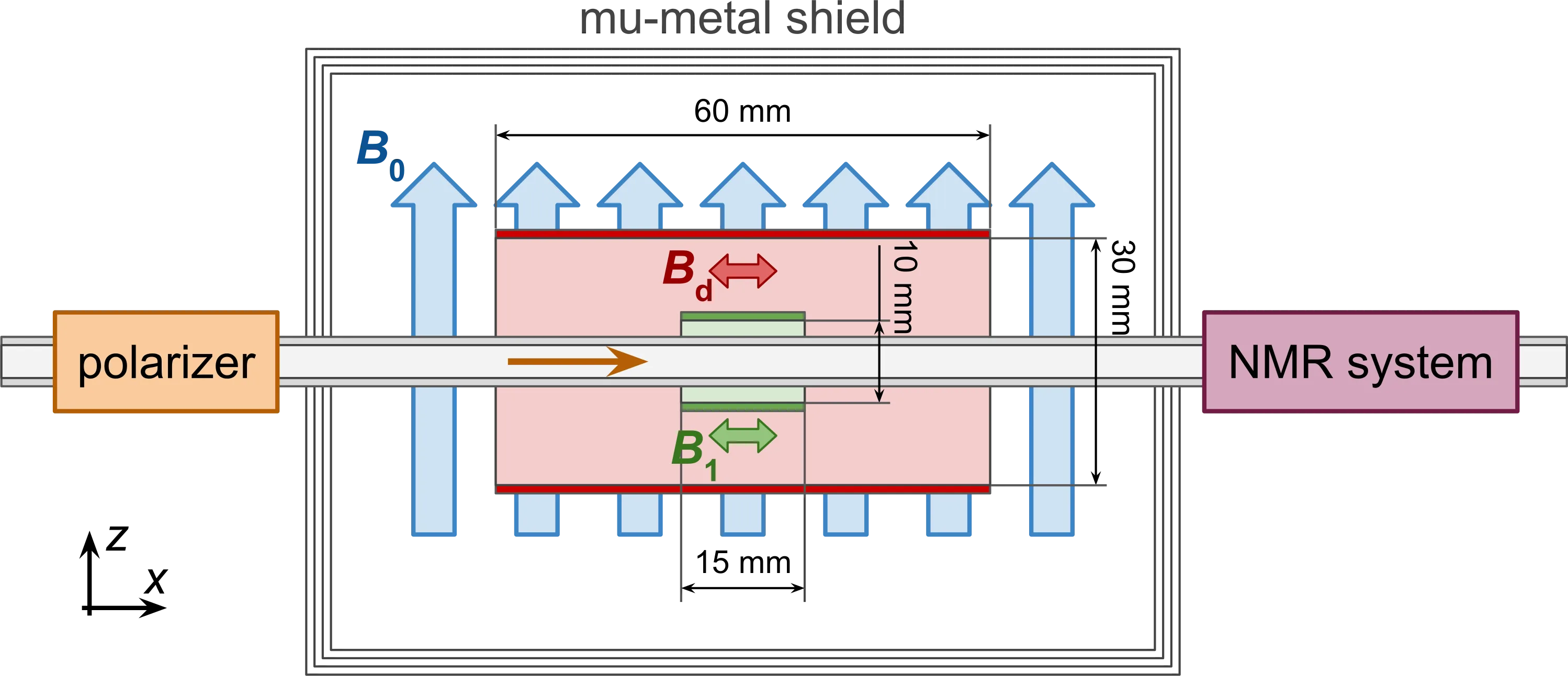
A drop of water on the table looks calm, but inside it, quantum life is bustling. Protons in hydrogen atoms are like tiny spinning tops that constantly rotate. Each has its own direction of spin. In a magnetic field, these tops align, and when the field starts to oscillate, they begin to 'dance.'
Physicists have long known how to control this dance, but usually the field is weak, and the tops simply flip over. Now, a team of scientists turned on a very strong alternating field, and the protons were no longer on their own. They merged with the field into new states, called 'dressed.' It's as if the spinning top and the music it dances to became one.
Such states were predicted by the quantum Rabi model, but for protons in water, they were observed for the first time. Now scientists can more precisely tune nuclear magnetic resonance — a method used in chemistry, medicine, and physics. And perhaps this dance will help create new ultra-precise sensors.
Original abstract
as written by the authors arXiv:2603.14878
The quantum Rabi model provides the framework for describing a two-level system interacting with a strong oscillating field beyond the rotating-wave approximation. We report the first experimental observation of the resulting dressed states of proton spins in water, realized using a Rabi-type setup with a strong off-resonant magnetic dressing field. The measured resonance spectrum exhibits multiple spin-state transitions involving several dressing-field quanta, including higher-order resonances predicted by the quantum Rabi model. The dressed-state energies show excellent agreement with theoretical expectations, extending dressed-state spectroscopy to proton spins and opening new possibilities for precision spin manipulation in nuclear magnetic resonance and related precision measurements.
Protons in water 'feel' Earth's magnetic field, but a typical MRI scanner is thousands of times stronger. In this experiment, the field was even more powerful, like turning on a siren next to a fine-tuning.