Wind from a Black Hole express
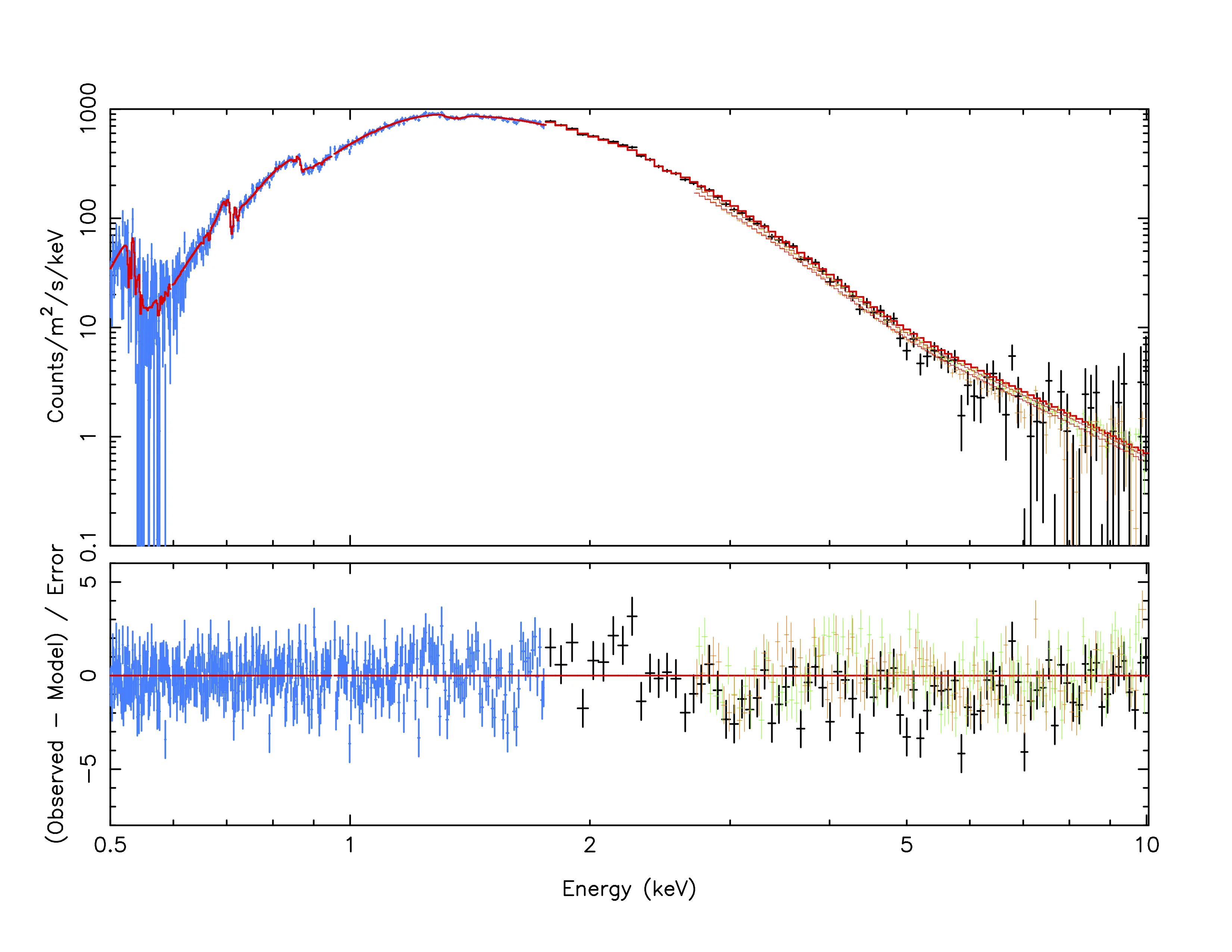
The black hole MAXI J1810-222 behaves like a giant vacuum cleaner with a reverse valve: it pulls in matter, but some of it gets spat back out into space. This "backflow"—a stellar wind — had been spotted by astronomers before, but only as a blurry smudge in X-rays. Now, the RGS spectrometer on the XMM-Newton satellite came to the rescue. It can split X-ray light by wavelength, just as a prism splits sunlight into a rainbow. And in that rainbow, sharp dark lines appeared — the telltale signs of light absorbed by iron atoms in the rushing wind.
The wind's speed turned out to be enormous — about 30,000 kilometers per second. That's a tenth of the speed of light. For comparison, the fastest spacecraft ever built by humanity, the Parker probe, travels 200 times slower. Such speed can't arise from mere gas heating — something extra must be accelerating it. Most likely, magnetic fields twisted around the black hole act like a coiled spring that straightens out and flings matter outward.
The new observations confirmed that the wind is real, not a measurement error. But now it looks less like a narrow jet and more like a broad outflow with fuzzy edges. That means matter isn't being carried away in a single blob but as a whole cloud with varying speeds and temperatures. The researchers hope that the upcoming Japanese X-ray telescope XRISM, with its ultra-sensitive detector Resolve, will reveal this wind in even greater detail, and then it will become clear how black holes pump mass and energy into their galaxies.
Original abstract
as written by the authors arXiv:2603.17609
In previous work, it was reported that the Galactic black hole candidate MAXI J1810-222 exhibited a notable absorption spectral feature at around 1 keV in low-resolution X-ray spectra of CCD-like detectors. The feature was correlated with the spectral state of the source, being stronger in the soft states, as it occurs in the typical Fe K winds of X-ray binaries (XRBs). However, the results hinted towards rather extreme wind velocities of up to ~0.1 c. We therefore requested and obtained an observation with XMM-Newton to take advantage of the 10-fold higher spectral resolution (R ~200-400) provided by the RGS detector in order to resolve the lines and break the degeneracy between different models and interpretations. We applied state-of-the-art models of plasma in photoionisation equilibrium and multiphase interstellar medium. Further comparisons are performed with a re-analysis of NICER and NuSTAR data. The XMM-Newton/RGS spectrum is consistent with the presence of a mildly relativistic wind, confirming the earlier indications obtained with NICER, but places tighter constraints on the outflow properties, with the lines being intrinsically broad. The data would then favour magnetically driven winds, although thermal effects may still contribute to mass loading. NuSTAR and XMM-Newton (EPIC) show a further hotter component indicating a stratified or multiphase outflow. Fe K spectra taken with calorimetric detectors (e.g., Resolve on XRISM) will enable a high-resolution view of the complex extreme outflow in this source and shed new light on outflow processes in XRBs.
The wind from black hole MAXI J1810-222 carries away as much matter in one second as a small asteroid weighs — about a billion tons.
In the series "Stargate Universe," the ship Destiny refuels from stars, but here a black hole itself ejects matter that could serve as fuel for future interstellar probes.