Iron is the strongest metal from which airplanes and towers are built. But it is also inside us: tiny particles of iron in the blood grab oxygen and carry it to every cell, like tiny trucks delivering fuel throughout the body.
History
Iron smelting began in Anatolia around 1500 BC. Meteoritic iron was used as early as the 4th millennium BC. In 1747, Menard de la Grosse discovered iron in blood ash. In 1932, Hans Fischer deciphered the structure of heme. Iron's magnetism was studied by Gilbert (1600), but only Maxwell (1873) gave a rigorous theory of the electromagnetic field, explaining ferromagnetism as the result of microscopic currents.
How it works
Ferromagnetism of iron is due to exchange interaction, aligning the spins of unpaired d-electrons. This creates macroscopic domains that reorient in an external field. According to Maxwell's equations for media with magnetic hysteresis, the hysteresis loop determines the coercive force and remanent magnetization. Upon heating above the Curie point, thermal fluctuations destroy magnetic order (Boltzmann statistics). In biology, oxidation of Fe²⁺ to Fe³⁺ allows cytochromes to transfer electrons in the respiratory chain.
Fun fact
In ancient times, blacksmiths forged weapons from meteoritic iron that fell from the sky. Such iron does not rust and was more valuable than gold! And without impurities, it is viscous like plasticine—the famous Eiffel Tower is made of almost pure iron mined from local deposits.
Every fall, Issaquah Creek in Washington State turns into a maternity ward for thousands of salmon. The fish swim in, spawn, and die, and the water carries away their molecular traces: fragments of DNA, short-lived RNA, chemical marks on the genetic text. From September through November 2024, researchers collected a liter of water every week and ran it through a filter to catch those traces.
The electron beam of a microscope usually flies through emptiness, like a courier on an empty highway. Any air molecule is a bump that makes it bounce and lose direction. So before, to examine a sample, you had to freeze it, dry it, or coat it with metal—and still you could only look in a vacuum.
Imagine three witnesses who saw the same event. Two tell the same story, the third tells a different one. Whom do you believe? This is exactly the situation in astronomy when measuring carbon in the star J0815+4729, an ancient object with a record-low iron abundance (carbon is one of the key elements used to infer the properties of the…
Forty light-years away lives a star that went unnoticed for a long time: TRAPPIST-1 emits two thousand times less light than the Sun. But it turned out to have seven Earth-sized planets, three of which orbit in the zone where water could remain liquid. Yet little was known about the star itself, about its chemical kitchen.
A neutron star is what remains after a massive star explodes. Its matter is compressed so tightly that a teaspoonful would weigh billions of tons. Under such conditions, protons and neutrons can rearrange, and new particles (hyperons, similar to neutrons but containing a 'strange' quark) can appear.
In the layered crystal CrSBr, the magnetic moments of atoms are arranged like notes in a score: within each layer they point in the same direction, but between layers they point in opposite directions. This antiferromagnetic melody plays up to 132 kelvin, beyond which thermal motion destroys the order.
Atomic batteries powered by plutonium decay have been running pacemakers and space probes for over sixty years. But the raw material is scarce: worldwide, only a few kilograms of plutonium-238 are produced each year, barely enough for the most critical missions.
The Sun is a giant cauldron where light struggles through a thick layer of scorching matter. On its way out, photons (light particles) constantly bump into atoms and lose energy. How strongly matter holds back light is called "opacity," and it determines how quickly heat escapes.
Iron is one of the main culprits for opacity in the Sun's interior.
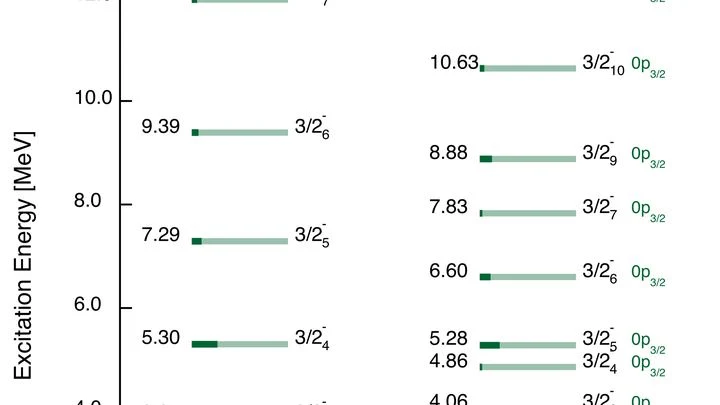
At the center of every atom lies a nucleus — a dense ball of protons and neutrons. These particles don't just crowd together randomly; they fill strict energy levels, much like floors in a skyscraper. When a floor is completely filled, the nucleus becomes especially stable — physicists call this a magic number.
Inside the destroyed Fukushima reactors lie hundreds of tons of melted fuel — a mixture of uranium, zirconium, iron, and fission products. This debris is called fuel debris. It must be extracted, transported, and securely packaged for decades. But how will this volatile mixture behave under heat, compression, or accidental impact?
The carbon nucleus was long imagined as a uniform ball of protons and neutrons, evenly mixed like dough. But physicist George Gamow suspected otherwise: particles inside might group into tiny, sturdy blocks — helium nuclei, or alpha particles.
In the scorching core of a star, two helium nuclei approach each other like two dancers on a crowded stage. Their dance is alpha scattering, the basis of stellar helium burning. How smoothly they twirl determines how quickly the star burns its fuel.
Previously, this dance was described in simplified terms.
Deep underground, iron glows white-hot, and the pressure is so intense that an ordinary instrument would be crushed flat. To peer into this world, physicists built a special microscope based on tiny diamond defects (so-called NV centers).
A pot of porridge boiling over a high flame: bubbles carry grains from the bottom to the surface. A similar mechanism works on a neutron star. As it accumulates hydrogen and helium from a companion star, it occasionally triggers a powerful nuclear explosion — an X-ray burst.
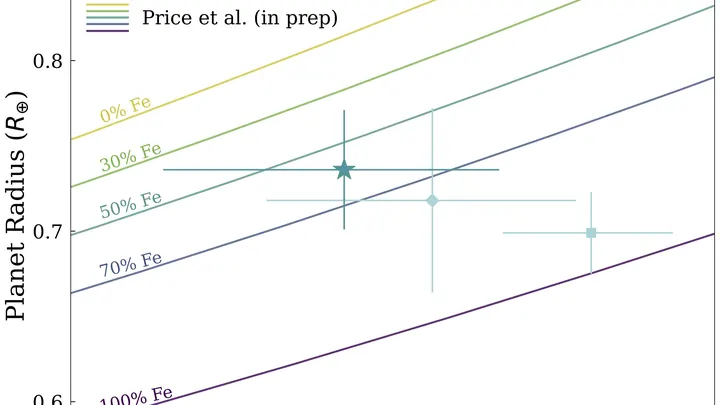
A cosmic sprinter on a short track: that's how you might describe planet GJ 367 b. It whips around its star in just 7.7 hours. This world is slightly smaller than Earth but has a personality: it was once thought to be nearly a solid ball of iron.
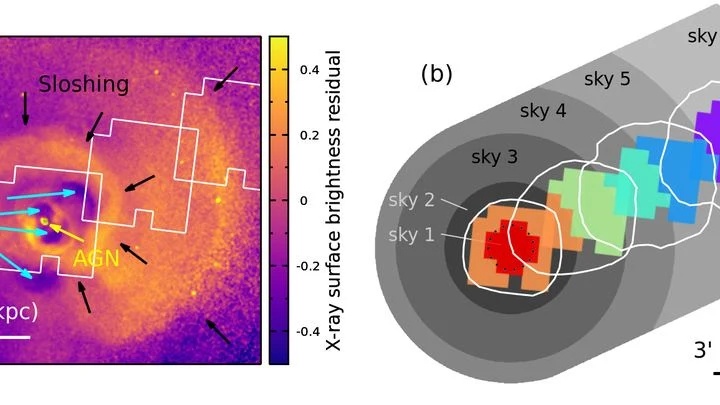
The Perseus galaxy cluster is a giant metropolis of thousands of star islands, bathed in an invisible ocean of scorching gas. Like urban smog, this gas preserves traces of all the chemical factories that have operated in galaxies for billions of years: supernova explosions that scatter freshly forged atoms across the surroundings.
Deep beneath our feet, in the scorching mantle, iron leads a double life. It can be divalent or trivalent, like a coin that lands heads or tails. Which side dominates determines how much oxygen stays in the planet's rocky shell and how much sinks into the core.
The world's most accurate pendulum isn't a steel rod: it's a tiny atomic nucleus. The isotope thorium-229 has a special excited state: to nudge the nucleus into it, you need surprisingly little energy — about what an ultraviolet laser delivers.
An atomic nucleus is like a crowded bus. To free up space, a group of two protons and two neutrons — a helium nucleus, an alpha particle — exits through the front door: this is alpha decay, described by George Gamow as tunneling under an energy barrier.
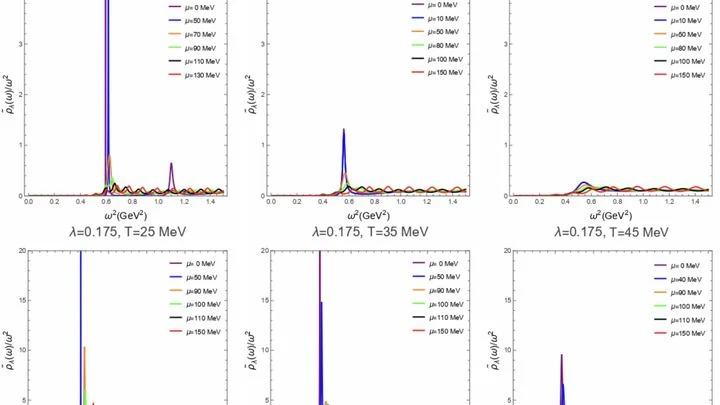
An ice cube in hot tea melts strictly at zero degrees. But what if the ice is made of subatomic particles and the tea is scorching nuclear matter? The authors studied the rho meson, a particle made of a quark and an antiquark that lives for just 4×10⁻²⁴ seconds, and searched for its 'melting temperature'.
A steel cylinder that has held hydrogen for a long time sometimes breaks not along the usual grain boundaries but right through the crystal grains, leaving a strange pattern, as if the crack chose the wrong road. For a long time, people looked at this and wondered: why?
An archaeologist holds in their hands not a clay shard but an actual star — a living snapshot of the era when the universe was just learning to produce anything heavier than lithium. That is exactly the kind of find astronomers describe in a new study. They spotted four dim stars so ancient and pristine in composition that their matter is barely diluted by the 'cosmic dust' of later generations.
Steel is not a monolith but a mosaic of microscopic grains fused together. Their seams, the grain boundaries, are the most vulnerable spots: this is where cracks begin. Impurity atoms, even in negligible amounts, accumulate at these seams like sand between gears, and they can either lubricate the mechanism or jam it completely.
The atomic nucleus is not a solid ball but a dense swarm of tiny particles called quarks, glued together by a special glue (the strong force). In light nuclei, such as calcium, this swarm is simply arranged: the numbers of the two quark types, up and down, are almost equal, like the white and black keys in an octave.
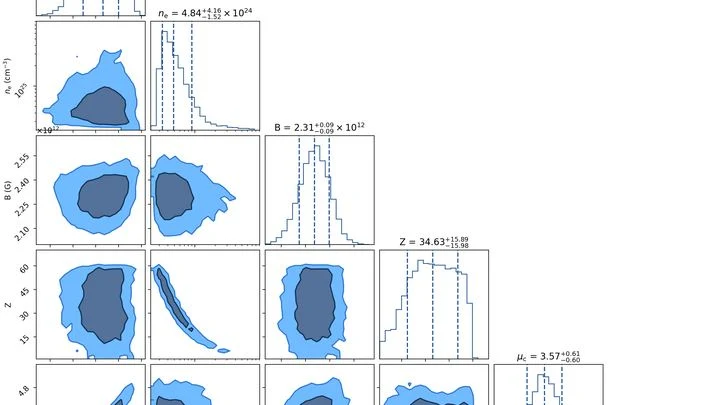
A spinning top whirls so fast it's about to fly apart. Add to it a super-strong magnet — one that, if placed on the Moon, would wipe data from every credit card on Earth. That's a magnetar: an ultra-dense remnant of an exploded star, a lump of matter where a teaspoon weighs as much as a mountain.
The outer crust of a neutron star is like a layered cake, where each layer is a strictly defined filling. It's a crystalline lattice of atomic nuclei immersed in a sea of electrons. The deeper you go, the stronger the pressure, and the heavier the nuclei that can exist there without falling apart.
Imagine a multi-story building where protons and neutrons live on each floor. The floors are energy levels, and usually there's a stairwell of a certain height between the sixth floor and the one above — the so-called gap. In the oxygen-20 nucleus, this gap acts as a barrier that particles find hard to cross.
The crust of a neutron star is not just a solid shell. Under pressures of billions of tons per square centimeter, atoms lose their electrons, and the remaining nuclei arrange into a rigid crystal lattice, reminiscent of a honeycomb, but made of matter a trillion times denser than steel.
There is something wildly generous about a garden where the first flowers don't just bloom but immediately scatter their seeds far beyond the fence. Something similar was happening in the young universe.
The Red Planet is surrounded by the rubble of failed worlds — rocky boulders stuffed with metal. Shipping a kilogram of steel from Earth to Mars costs as much as several cars. It's far cheaper to pick up space junk right in orbit.
Nitrogen, the very gas we breathe, behaves like a finicky metal under a million atmospheres of pressure. In a diamond anvil cell, it is squeezed to 78–98 gigapascals and heated with a laser to 1800–2500 kelvin. Under these conditions, N₂ molecules rearrange into crystals that can store energy more densely than explosives.
Previously it was thought that hydrogen barely mixes with liquid iron at low pressure, so it wasn't expected in the Moon's core. New experiments have flipped that view.
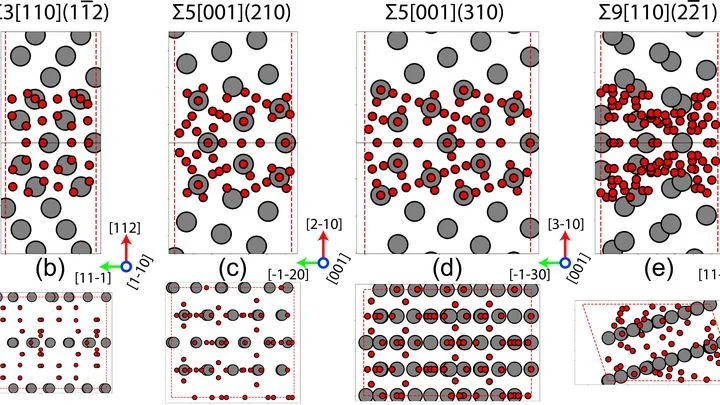
An iron crystal is like a mosaic of tightly packed grains. Where one grain meets another, a boundary forms — a narrow seam with disrupted order. It is in these seams that surprises for magnetism hide.
Scientists calculated how iron atoms interact with each other at three types of such boundaries.
Deep inside Earth lies a solid iron core about the size of the Moon. It floats in liquid metal and sways slightly, like a pit in a peach when you shake the fruit. Such oscillations are called Slichter modes: the core shifts both along the planet's axis and perpendicular to it.
Three forces act together to damp this motion.
Iron dust burns like a tiny firework: a flash, heat, sparks. To turn that firework into a safe fuel for power plants, you need to know exactly when and how a particle will ignite. Until now, engineers were working blind: they saw that the powder burns, but couldn't peek inside a single grain.
When a baker kneads dough, the grains of flour can tell you which mill they came from. It's the same with Earth: the composition of iron in its depths preserves a memory of where the pieces that assembled the planet were born.
In 1978, physicists bombarded a target with a beam of ions and measured how quickly they slowed down in matter. Using the Doppler shift of gamma rays, they calculated the lifetimes of excited nuclear states. For iron-58, they obtained a value that did not agree with shell-model calculations.
A lithium battery is like a house with a storage room: during charging, lithium goes inside; during discharging, it comes out. But if the storage room gets cluttered, some lithium stays inside forever. How much lithium returns depends on the metal the walls are made of.
The authors of the study took four metals: aluminum, magnesium, silver, and copper.
Deep inside a dying star, just before it goes supernova, nuclear reactions determine which chemical elements will be scattered across the cosmos. One such reaction is the collision of an oxygen nucleus with a proton, producing a nitrogen nucleus and an alpha particle (a helium nucleus).
The gas in a galaxy glows like a neon sign, and by the color of that glow, astronomers can tell how hot it is. The logic is simple: the more heavy elements (which astronomers call metals) in the gas, the better it cools. So galaxies rich in metals should have cooler gas. But new observations show the opposite.