Wind from a Black Hole express
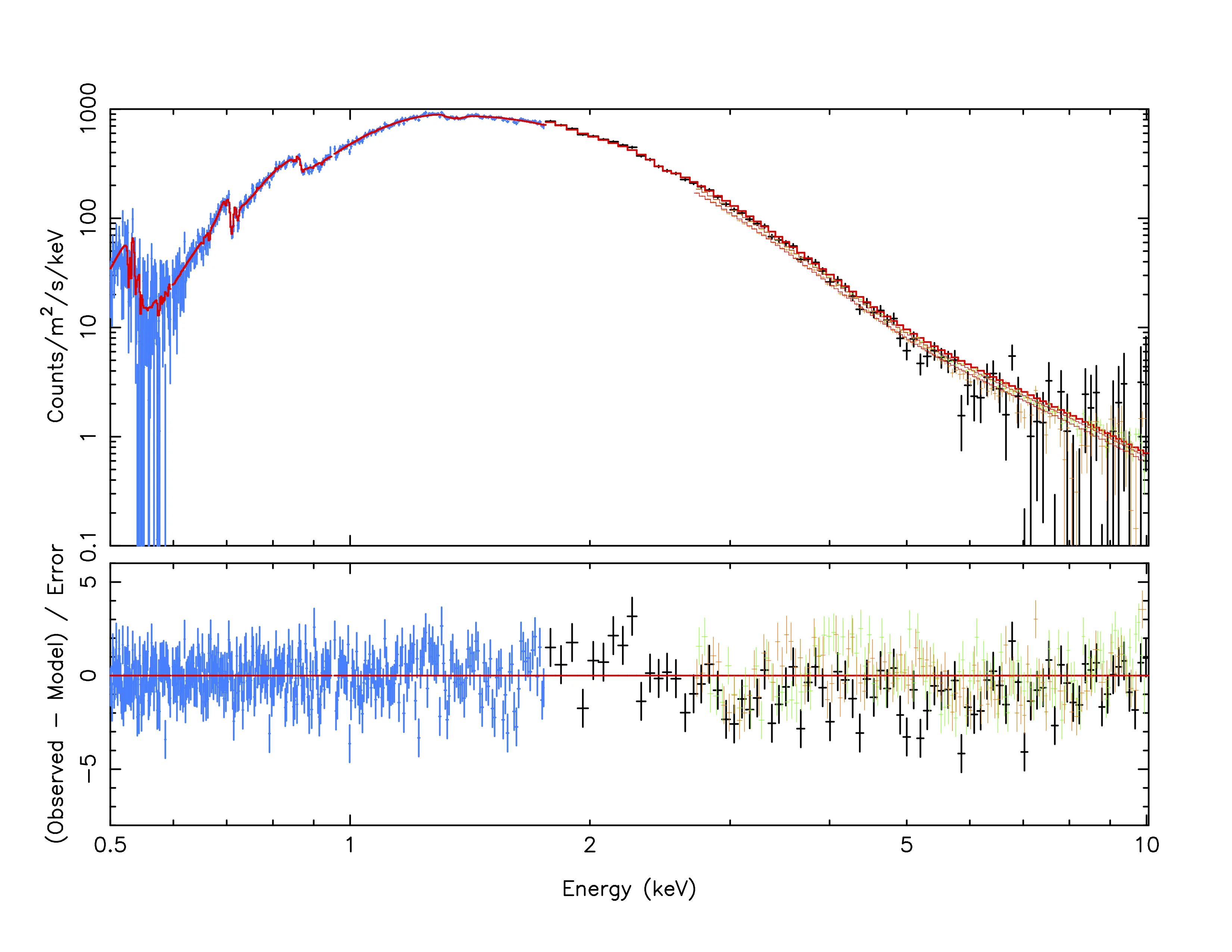
The black hole MAXI J1810-222 behaves like a giant vacuum cleaner with a reverse valve: it pulls in matter, but some of it gets spat back out into space. This "backflow"—a stellar wind — had been spotted by astronomers before, but only as a blurry smudge in X-rays. Now, the RGS spectrometer on the XMM-Newton satellite came to the rescue. It can split X-ray light by wavelength, just as a prism splits sunlight into a rainbow. And in that rainbow, sharp dark lines appeared — the telltale signs of light absorbed by iron atoms in the rushing wind.
The wind's speed turned out to be enormous — about 30,000 kilometers per second. That's a tenth of the speed of light. For comparison, the fastest spacecraft ever built by humanity, the Parker probe, travels 200 times slower. Such speed can't arise from mere gas heating — something extra must be accelerating it. Most likely, magnetic fields twisted around the black hole act like a coiled spring that straightens out and flings matter outward.
The new observations confirmed that the wind is real, not a measurement error. But now it looks less like a narrow jet and more like a broad outflow with fuzzy edges. That means matter isn't being carried away in a single blob but as a whole cloud with varying speeds and temperatures. The researchers hope that the upcoming Japanese X-ray telescope XRISM, with its ultra-sensitive detector Resolve, will reveal this wind in even greater detail, and then it will become clear how black holes pump mass and energy into their galaxies.
The wind from black hole MAXI J1810-222 carries away as much matter in one second as a small asteroid weighs — about a billion tons.
In the series "Stargate Universe," the ship Destiny refuels from stars, but here a black hole itself ejects matter that could serve as fuel for future interstellar probes.