Measurement error is the difference between a measured value and the true value of a physical quantity. It arises from limitations in instruments, environmental influences, and the inherent statistical nature of many measurements. In physics, no measurement is exact; every result carries some uncertainty, and understanding this uncertainty is as important as the result itself. Measurement errors are typically classified as systematic (consistent biases) or random (statistical fluctuations), and their analysis allows scientists to quantify how much confidence they can place in their conclusions.
History
The formal treatment of measurement error dates to the 18th century, with contributions from mathematicians like Carl Friedrich Gauss, who developed the method of least squares and the normal distribution to handle astronomical and geodetic data.
How it works
Measurement error is characterized by comparing repeated measurements to a known standard or by analyzing the spread of results. Random errors follow statistical distributions, often Gaussian, allowing the calculation of standard deviation and confidence intervals. Systematic errors, by contrast, shift all measurements in one direction and can be identified through calibration or cross-checking with independent methods. The total error combines both types, and modern techniques like Bayesian inference or noise modeling help separate signal from noise in complex experiments.
In practice
Measurement error analysis is essential in every experimental science, from particle physics (where significance levels like '5 sigma' are used) to medical diagnostics, where distinguishing a true disease from a technical artifact requires understanding error rates.
Fun fact
The 2016 detection of gravitational waves by LIGO required separating a signal of amplitude 10^-21 from noise that was thousands of times larger, making measurement error analysis the core of the discovery.
Two dancers on the same stage mirror each other's moves even when a curtain separates them. In the quantum world, such pairs are called entangled, and physicists have spent half a century probing how far this connection reaches. Until now, all tests with massive particles concerned their internal properties, such as spin, but not their motion itself.
In winter, one part of town gets three times as much snow as the neighborhood next door. One year is a scorcher, the next is a cold snap. That's the whims of weather. But over decades, a different, slow shift emerges: winters, on average, get milder. Telling the two apart is the central challenge for climate scientists.
If a smell seeps into a room through a slightly open door, you could stand in the middle and sniff. But the most accurate way to catch the moment the smell arrives is to stand right at the threshold. A cell behaves much the same way when it needs to measure the concentration of a substance around it.
A glucose meter that doesn't prick your finger but just looks at your wrist: that's the dream for millions of people with diabetes. It's the promise of algorithms that extract glucose levels from the ordinary pulse signal, the photoplethysmogram (the same one that measures heart rate in smartwatches).
Two particles behave like a pair of unusual dice: thrown at opposite ends of the universe, they always land on the same face. Physicist John Stewart Bell calculated: if the dice had hidden rules, the frequency of matches would have a strict limit.
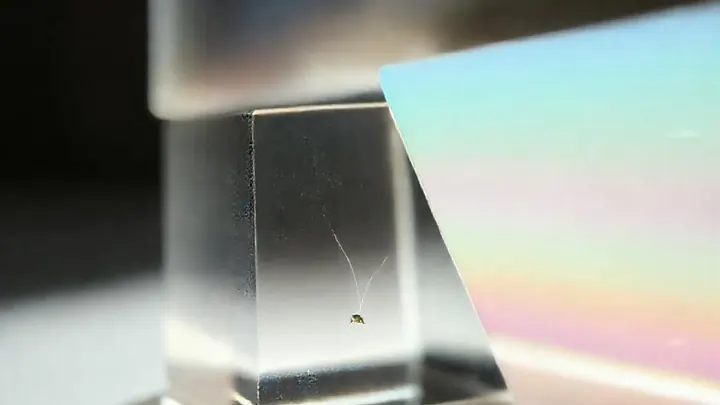
On a lab table sits an instrument that looks like a balance, but instead of pans it has two weights made of different metals — beryllium and aluminum. The balance is suspended from a thin fiber that twists if the weights are pulled differently. The whole apparatus turns to follow the Sun, like a sunflower tracking the light, but instead of light it catches the Sun's gravity.
In 1935, Einstein, Podolsky, and Rosen proposed a thought experiment that, in their view, exposed the incompleteness of quantum mechanics. Two particles fly apart after interacting, and measuring the momentum of one instantly gives exact knowledge of the other's momentum.