concept

x ray spectrum

The distribution of X-ray intensity as a function of wavelength or energy from a source.
20 related articles

Description

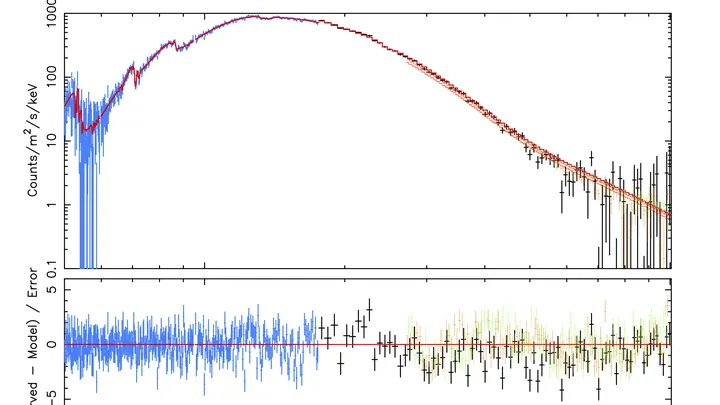
The X-ray spectrum is the distribution of X-ray intensity across wavelengths or energies, emitted by sources like neutron stars, black hole accretion disks, or laboratory plasmas. It carries a fingerprint of the physical conditions — temperature, density, magnetic fields, and geometry — of the emitting region. By analyzing X-ray spectra, astronomers can infer how matter behaves under extreme gravity, how accretion disks are tilted, and how radiation escapes from dense stellar objects.

History

X-rays were discovered by Wilhelm Röntgen in 1895, and cosmic X-ray sources were first detected in the 1960s with rocket-borne detectors. The field of X-ray astronomy grew rapidly with satellites like Chandra and XMM-Newton, which have mapped spectra from black holes and neutron stars.

How it works

X-rays are produced when high-energy electrons interact with matter, either via thermal emission (hot gas) or non-thermal processes (like synchrotron radiation). The spectrum is shaped by atomic transitions, Compton scattering, and absorption along the line of sight. Instruments like X-ray telescopes use gratings or detectors to measure photon energies, and the resulting spectrum is fitted with physical models to extract parameters like the disk's inclination or the temperature profile.

In practice

X-ray spectroscopy is used in medicine (CT scans), materials science (X-ray fluorescence), and astrophysics to study black holes, neutron stars, and supernova remnants.

Fun fact

The X-ray spectrum of a neutron star can reveal the star's radius and mass, providing direct constraints on the equation of state of nuclear matter.


Concept graph →

Related articles · 20

Stellar2026-08-272 minarXiv:2608.27344
X-ray passports for habitable worlds
Twelve stars have received X-ray passports. Now, for each of them, we know the exact radiation dose received by a planet in the habitable zone, the region where liquid water is possible.
Optics2026-08-211 minarXiv:2608.20746express
Light That Remembers How the Crystal Is Oriented
Light born when a fast electron enters a material is usually assumed to be the same in all directions. But in crystals where optical properties depend on direction, that's not the case. Run your hand over velvet: one way it's smooth and shiny, the other — dark and rough. Similarly, a crystal responds differently to light depending on how it's oriented.
Plasma Physics2026-08-182 minarXiv:2608.17555express
Twin X-ray Flashes from a Plasma Accelerator
When a laser beam hits a gas, it tears electrons from atoms and accelerates them to nearly the speed of light. As these electrons fly through the plasma, they emit X-rays, like a glowing trail from a fast particle. In the new work, physicists made a single laser pulse create not one but two such trails in succession.
A Sponge That Absorbs Differently: Why Ultrafast Irradiation Spares Tissues
A sponge slowly watered from a watering can gets soaked all the way through. But if you dump the same bucket of water on it all at once, the middle gets wet while the edges stay almost dry. That's roughly how a material with nonlinear absorption behaves: the more intense the flux, the more it gets stuck at the point of impact.
General Relativity2026-08-101 minarXiv:2608.11264express
Where Stars End and the Invisible Begins
A galaxy is like a city: bright lights and dense buildings at the center, sparse lights and emptiness toward the outskirts. But if you watch how gas rotates in a galaxy's disk, you see that its speed barely drops at the edges. As if invisible neighborhoods keep the motion going. Astronomers have found a way to map this invisible city.
High Energy2026-05-212 minarXiv:2605.22918express
Gusts of Wind Around a Black Hole
The beacon flares up and then nearly goes out, even though the lamp inside burns steadily. That is exactly what astronomers saw when they pointed their telescopes at the galaxy I Zwicky 1. At its center sits a supermassive black hole that devours gas and dust so greedily that a scorching disk forms around it, shining brighter than an entire galaxy.
Cosmology2026-05-071 minarXiv:2605.05906express
Dark Matter Speaks in Radio Waves
Dark matter is invisible, but its gravity governs the motion of galaxies. What it's made of is a mystery. One idea: it consists of ultra-light particles akin to axions.
High Energy2026-05-012 minarXiv:2605.01146express
How a pulsar paints us a map of invisible pillars
A lighthouse that changes the color of each flash in time with its rotation: that's one way to describe what astronomers saw when they pointed the latest X-ray telescope, XRISM, at the pulsar Hercules X-1. This object is a neutron star pulling matter from a companion ordinary star.
High Energy2026-04-272 minarXiv:2604.24750express
Heavy Nuclei in the Fire of a Magnetar
The crust of a neutron star is not just a solid shell. Under pressures of billions of tons per square centimeter, atoms lose their electrons, and the remaining nuclei arrange into a rigid crystal lattice, reminiscent of a honeycomb, but made of matter a trillion times denser than steel.
Plasma Physics2026-04-262 minarXiv:2604.23687express
An X-ray Flashlight for Invisible States of Matter
When matter is heated to millions of degrees, it turns into plasma — a mix of free electrons and ions, like a boiling soup of charged particles. You can't measure the temperature of such a 'soup' with an ordinary thermometer, but you can shine X-rays through it.
High Energy2026-04-232 minarXiv:2604.21224express
Cosmic Mirage of Radio Waves
A galaxy is like a glowing pancake studded with stars. If you look at it face-on, you see everything at once — both the bright spiral arms and the dark dust lanes. But tilt the pancake, and the picture changes: layers overlap, light blends together. This very effect, it turns out, creates the illusion of a tight link between radio and gamma-ray emission in distant star systems.
Instrumentation2026-04-232 minarXiv:2604.21846express
A Sensitive Thermometer for X-rays
An X-ray beam is a stream of tiny packets of energy, photons. Ordinary detectors count them but don't distinguish shades: two photons with close energies look the same to them. The new device works like a sensitive thermometer: it catches each photon and measures how much it warms a thin film. From the warming, you can tell exactly how much energy the photon brought.
High Energy2026-04-201 minarXiv:2604.18048express
X-rays reveal the tilt of an accretion disk
The neutron star 4U 1735-44 is gobbling up matter from a companion star. The matter spirals into a flat disk, like water going down a bathtub drain. But this disk shines in X-rays, and astronomers have for the first time measured how "combed" those rays are: that is, how polarized.
High Energy2026-04-102 minarXiv:2604.09761express
A Black Hole's Hot Corona Puffed Up and Flew Away
At the center of the distant galaxy MCG-6-30-15 lies a supermassive black hole. Around it swirls a disk of incandescent gas, and above the disk hangs a cloud of even hotter particles — the corona. In February 2024, three X-ray telescopes (XRISM, NuSTAR, and XMM-Newton) observed this system simultaneously.
High Energy2026-04-082 minarXiv:2604.07588express
An X-ray Tangle at the Heart of the Milky Way
The center of our galaxy is a crowded kitchen where several dishes are simmering at once, and their steam blends into a single cloud. X-rays from the exploded star's remnant, from the stellar wind around the supermassive black hole, and from hot gas between stars all overlap.
High Energy2026-03-182 minarXiv:2603.17609express
Wind from a Black Hole
The black hole MAXI J1810-222 behaves like a giant vacuum cleaner with a reverse valve: it pulls in matter, but some of it gets spat back out into space. This "backflow"—a stellar wind — had been spotted by astronomers before, but only as a blurry smudge in X-rays.
High Energy2026-03-171 minarXiv:2603.17210express
An X-ray Trail at the Center of the Galaxy
At the center of the Milky Way, among dense clouds of gas and dust, lies a region called Sagittarius C. It's like a bustling crossroads: stars are born here, streams of matter collide, and the whole scene is illuminated by X-rays. For a long time, this glow remained a mystery.
High Energy2026-02-042 minarXiv:2602.04622express
A Cosmic Magnet in 4U 1700-37
In the binary system 4U 1700-37, the massive supergiant star HD 153919 sheds a powerful stellar wind. This wind, like an invisible stream, rushes toward its compact companion — likely a neutron star. As it falls, the matter heats to millions of degrees and flares in X-rays.
High Energy2026-02-031 minarXiv:2602.03982express
How Light Escapes a Neutron Star
When an X-ray burst erupts on a neutron star, its atmosphere heats up to millions of degrees. The light we catch with telescopes passes through this dense layer of gas, and gets dramatically altered along the way. The spectrum no longer looks like that of an ideal radiator: some colors get amplified, others dim.
High Energy2026-01-262 minarXiv:2601.18139express
How a neural network tells black holes from neutron stars
For years, an X-ray telescope in orbit recorded how binary systems shine, where an ordinary star orbits a black hole or a neutron star. Matter from the companion falls onto the compact object, heats up to millions of degrees, and emits X-rays.