Quantum Glue: How Matter Changes the Vacuum express
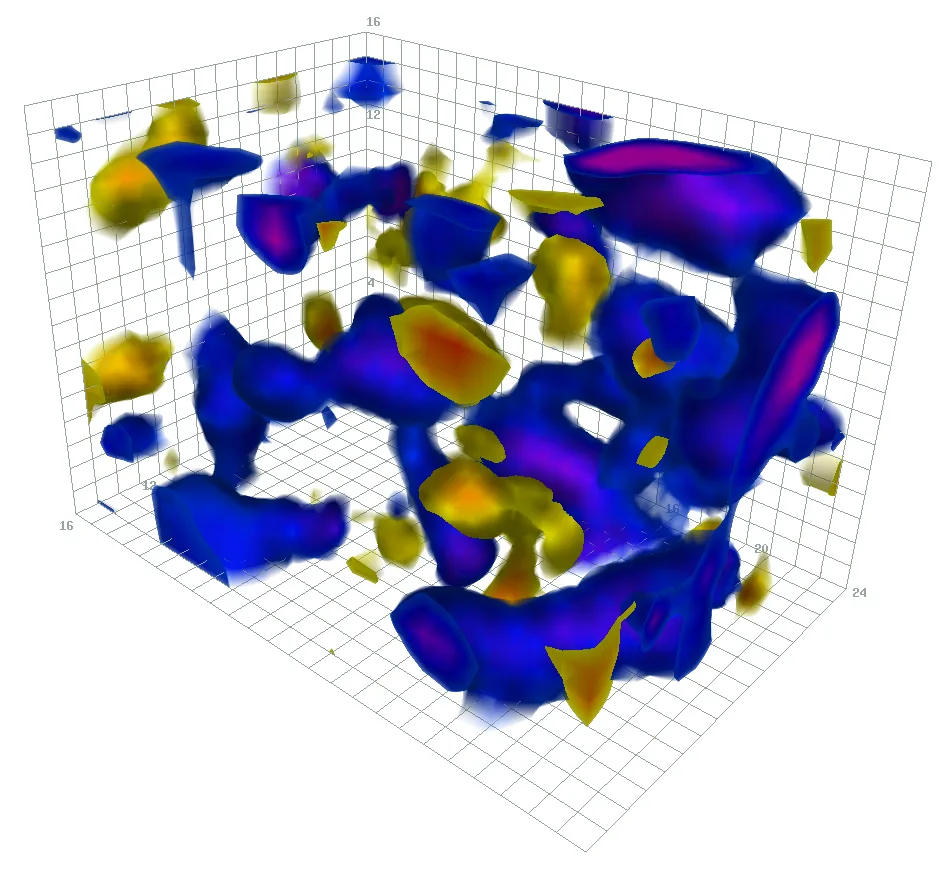
Inside every proton and neutron, invisible work is underway: gluons, the particles that carry the strong force, glue quarks together into a single whole. You can think of this field as rubber bands that keep quarks from flying apart. But what happens to these bands when matter becomes very dense, like in the depths of neutron stars or in the first moments after the Big Bang?
Physicists simulated a world with two quark "colors" (instead of three, as in ours) on a lattice and gradually increased the matter density. They measured the strength of the chromo-electric and chromo-magnetic fields — analogs of ordinary electric and magnetic fields, but for the strong interaction. Near the expected phase transition boundary, the field unexpectedly weakened: the chromo-electric part dropped by 11%. Then, at even higher density, the field recovered and even exceeded its initial values.
The difference between the squares of the chromo-electric and chromo-magnetic fields grew monotonically with increasing density. This is important: this combination is related to the vacuum energy and topological properties of the field. The authors carefully calibrated four different ways of "smoothing" the field to ensure the result did not depend on the method. The transition point they found matched the theoretical prediction.
This calculation is a step toward understanding how matter at extreme density changes the very fabric of the strong interaction. In the real world with three quark colors, the picture will be more complex, but the principle is likely the same: the field does not simply "switch off" but goes through a stage of weakening before it rearranges itself.
Gluons are named after the English word "glue": they literally glue quarks together inside protons and neutrons.