Double Radio Echo from a Galaxy Cluster Collision express
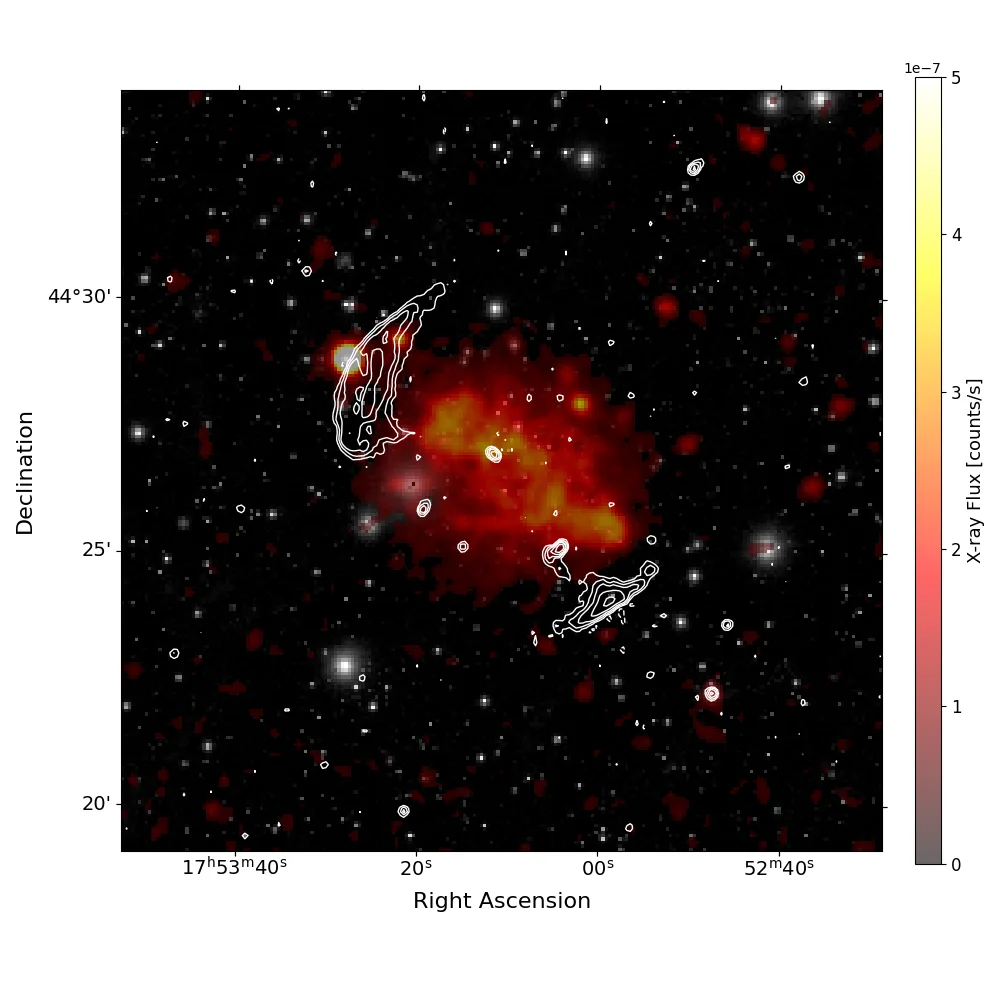
When two galaxy clusters collide, shock waves are born in the space between them, like the sonic boom from a supersonic jet, but instead of air, it's the tenuous gas. These waves compress the gas and accelerate charged particles to enormous energies. The accelerated particles, moving through magnetic fields, emit radio waves that we see as giant arcs — radio relics.
In the cluster MACS J1752, there are two such arcs, one on each side of the center. Astronomers used three radio telescopes to observe them at high resolution. It turned out that the northeastern relic has a double brightness peak and a bright band — a "bar"—inside it. The spectral index (how energy is distributed across frequencies) of both relics is surprisingly flat: this means the particles haven't had time to lose energy, so the acceleration happened recently or is still ongoing.
The simple picture of a single shock wave doesn't explain the observed details. It seems the relic is shaped by multiple shock surfaces, possibly re-acceleration of particles, and projection effects. This changes our understanding of how cosmic shock waves act as natural particle accelerators.
The double relic system in MACS J1752 is an excellent laboratory for studying shock wave physics on cosmic scales. The more precisely we measure their shape and spectrum, the better we'll understand where the most energetic particles in the universe come from.
Original abstract
as written by the authors arXiv:2604.02410
Radio relics are diffuse, extended synchrotron sources located at the outskirts of merging galaxy clusters. Their origin has been linked with shock waves injected into the intracluster medium, but the acceleration mechanism at the shock front is still under debate. Some clusters, like MACS J1752.0+4440, host a double relic system, with two relics found on opposite sides with respect to the cluster center. To investigate the acceleration mechanism that generates radio relics, we study the morphological and spectral properties of the double relic system in MACS J1752. We present new wideband radio continuum observations made with uGMRT and JVLA, and LOFAR data. We perform a detailed, high-resolution spectral analysis of the double relic system in MACS J1752, observing and characterizing substructures, particularly for the brighter relic. We find a double-peaked surface brightness and spectral index profile for the NE relic and identify a "bright bar" substructure. Moreover, we observed surprisingly flat integrated spectral indices for both relics, at $$\alpha_{\mathrm{int}}^{\mathrm{NE}} = -0.91 \pm 0.06$$ and $$\alpha_{\mathrm{int}}^{\mathrm{SW}} = -0.83 \pm 0.05$$. We study the spatial variation of the spectral index, observing a coherent trend with the observed substructures. We estimate an injection Mach number of $$\mathcal{M}_{\mathrm{NE}} = 3.1^{+0.1}_{-0.1}$$ and $$\mathcal{M}_{\mathrm{SW}} = 3.2^{+0.1}_{-0.1}$$. By performing a spectral curvature analysis for both relics, generating color-color plots and a spectral curvature maps, we observe two "concave" spectra represented by positive spectral curvature, in contrast with particle population ageing models. The observed properties of the NE relic are not consistent with a simple scenario with a single shock front. Multiple shock surfaces, re-acceleration, and projection effects likely play a role in shaping the morphology of the relic.
Radio relics can stretch for millions of light-years, tens of times larger than our galaxy, yet their radio emission is millions of times fainter than that of an ordinary radio station.
In the series Star Trek, shock waves from cosmic collisions have often been a source of danger and mystery, just like in real galaxy clusters.