Relic neutrinos are the cosmic neutrino background (CνB), a faint sea of neutrinos that has filled the universe since about one second after the Big Bang. Just as the cosmic microwave background (CMB) is the afterglow of photons from the early universe, the CνB is the analogous remnant for neutrinos. These particles decoupled from matter when the universe was extremely hot and dense, and they have been streaming freely ever since, cooling as the universe expanded.
History
The concept was first proposed in the 1960s, with key contributions from physicists such as George Gamow and later refined by others who realized that the neutrino background would have a temperature and could affect cosmological processes like nucleosynthesis.
How it works
In the early universe, neutrinos were in thermal equilibrium with other particles through weak interactions. As the universe expanded and cooled, these interactions became too rare to keep neutrinos in equilibrium, so they 'froze out' and continued as a free gas. Their temperature today is predicted to be about 1.95 Kelvin, slightly cooler than the CMB's 2.73 K. Because neutrinos are extremely light and interact only via the weak force, they are incredibly difficult to detect, and the CνB has not yet been directly observed, though its existence is strongly supported by cosmological evidence.
In practice
Detecting relic neutrinos would provide a direct window into the universe's first second, potentially revealing physics beyond the Standard Model. Experiments like PTOLEMY are currently attempting to capture these elusive particles.
Fun fact
There are about 300 relic neutrinos per cubic centimeter in the universe today, making them the second most abundant particle after photons.
The night sky in neutrino light resembles a canvas worked on by two hands. One holds a broad, soft brush: these are supernova remnants, the shells left behind after stellar explosions. The other grips a fine, hard pen — microquasars, binary systems where a black hole twists matter into narrow jets.
Boiling milk develops a trembling skin. By watching its movements, you can guess the strength of the fire beneath the pot and the fat content of the milk. In a similar way, astrophysicists peer into the ancient microwave radiation — the oldest light that has reached us from an era when the universe was only 380,000 years old.
When a star many times heavier than the Sun dies, it collapses and explodes as a supernova. This is not just a flash of light — the entire process, from core collapse to the ejection of the outer layers, makes space itself tremble. These ripples are called gravitational waves.
In June 2024, the CHIME radio telescope recorded over 700 radio bursts per hour from source FRB 20240114A. Such a hyperactive repeater releases in one hour nearly all the magnetic energy of a typical magnetar (a neutron star with an ultra-strong field).
The mystery of antimatter in space has long puzzled astrophysicists: where do positrons come from, settling like snowflakes into our detectors? The answer might lurk in the most ubiquitous gamma-ray background. The Universe is soaked in diffuse light — the cosmic photon background (CPB).
In the first seconds after the Big Bang, the Universe left us not only light but also something far more elusive — the relic neutrino background. This echo of creation permeates every cubic centimeter, yet we barely notice it.
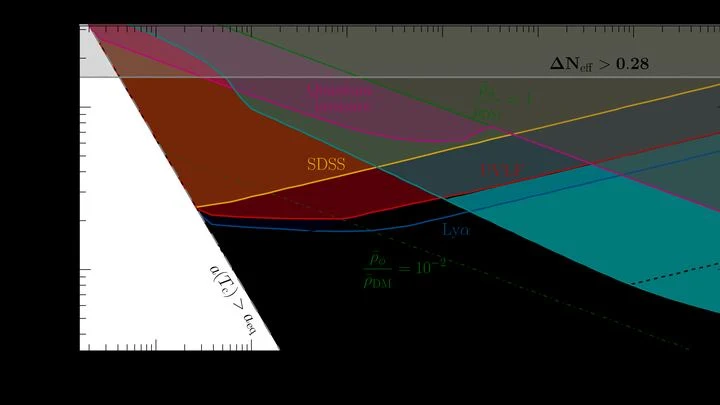
The universe is filled with invisible dark matter. Just as a drop of water, as it evaporates, leaves behind a tiny salt crystal, so too can a black hole evaporate, leaving behind a minuscule stable remnant.
An architect checks the blueprint when building a house. For cosmologists, the blueprint is the Standard Model, and the measuring tape is the light from distant galaxies. Recently, a new 'tape measure,' the DESI instrument, measured distances to millions of galaxies with unprecedented precision. And the numbers didn't match the blueprint.
In the first moments after the Big Bang, the universe was a boiling soup of elementary particles. Even the light neutrinos were actively colliding with everything around. But the rapid expansion cooled this soup, and the neutrinos broke free, becoming almost indifferent to the surrounding world.
Two lamps in a shop window: one glows with a cool, bluish light, the other a bit warmer and yellower. That's roughly how the two types of supernovae, Ib and Ic, look when astronomers view them through a telescope.
In the first moments after the Big Bang, the cosmos resembled a giant cooling pond. Just as water, when freezing, becomes covered with a network of cracks, so the cooling universe could have cracked — not into ice, but into the thinnest filaments of pure energy. These filaments are called cosmic strings.
When the first stars ignited, their ultraviolet light began stripping electrons from hydrogen atoms. The universe transformed from a neutral fog into transparent plasma. This process, cosmic reionization, proceeded unevenly: slowly at first, like a fire catching in damp wood, then faster as the flames spread through dry tinder.
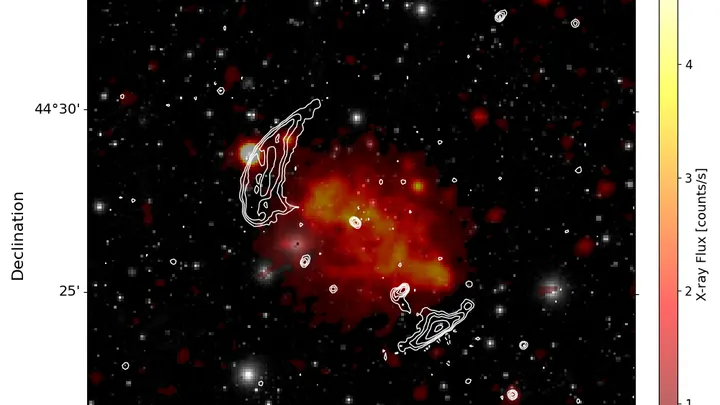
When two galaxy clusters collide, shock waves are born in the space between them, like the sonic boom from a supersonic jet, but instead of air, it's the tenuous gas. These waves compress the gas and accelerate charged particles to enormous energies.
About 380,000 years after the Big Bang, the universe cooled enough for electrons and protons to finally combine into neutral hydrogen. Although this event is called recombination, it was actually their first meeting — the heat had kept them from sticking together until then.
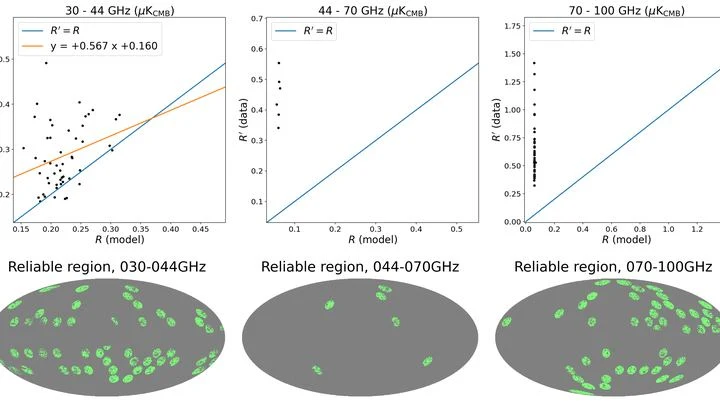
Astronomers are trying to capture the radio echo of the Big Bang — a faint glow that fills the entire universe. But the receiver is choking with noise: our Galaxy is packed with glowing interstellar dust, whose emission can easily be mistaken for a signal from the distant past.
When a massive star runs out of fuel, its core collapses and a shock wave races outward. But even before the star tears apart, particles that barely interact with ordinary matter may be born in its depths. If they decay into light, that energy leaks into the dense gas around the star.
This gas, like a blanket, wraps the star.
The universe can behave like a spring: compressing to microscopic sizes and then expanding again. In this cycle of contraction and bounce, black holes and dark matter are born.
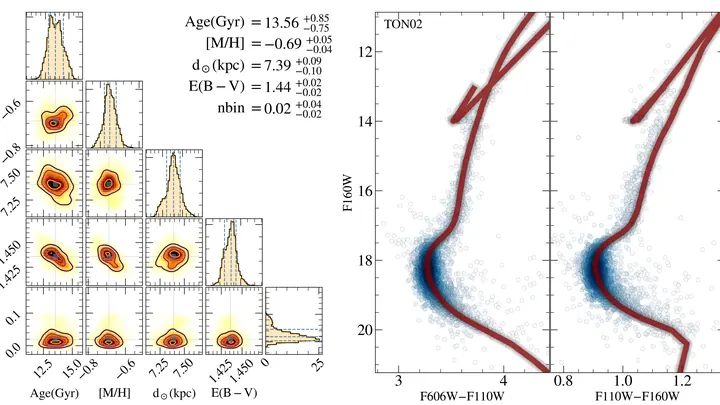
Hidden in the dense swarm of stars at the center of the Milky Way lies the globular cluster Tonantzintla 2. It went unnoticed for decades, yet it holds the key to the earliest history of our galaxy.
When a massive star exhausts its thermonuclear fuel, its core collapses and the outer layers are blown off in a colossal explosion — a supernova (a term coined by Fritz Zwicky while studying these catastrophes).
Short, powerful bursts of radio static from deep space have long puzzled scientists. Their source is believed to be the ultra-dense cores of dead stars, where magnetic fields are unimaginably strong.
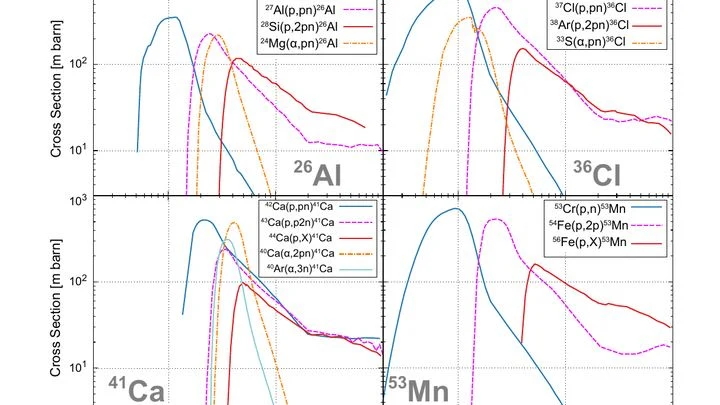
Just as yeast turns flour into fluffy dough, radioactive 'seasoning' from a supernova — the explosion of a massive star at the end of its life helps mold a rocky planet. The key ingredient here is aluminum-26, a radioactive isotope that releases heat as it decays.
The Universe after the Big Bang was almost perfectly homogeneous. Almost, because tiny density perturbations stretched by inflation became the seeds of galaxies. But what if these same perturbations could give birth not only to stars but also to black holes?