A Cosmic Siren and Its Nebulous Afterglow express
Radio telescopes have caught a signal that repeats like a beacon in the fog. It's a fast radio burst — a brief flash of radio waves from a distant galaxy. Nearby, astronomers search for a persistent source — a faint glow that lingers after the burst, like embers after fireworks. In the new study, researchers pointed a network of radio telescopes at two such candidates.
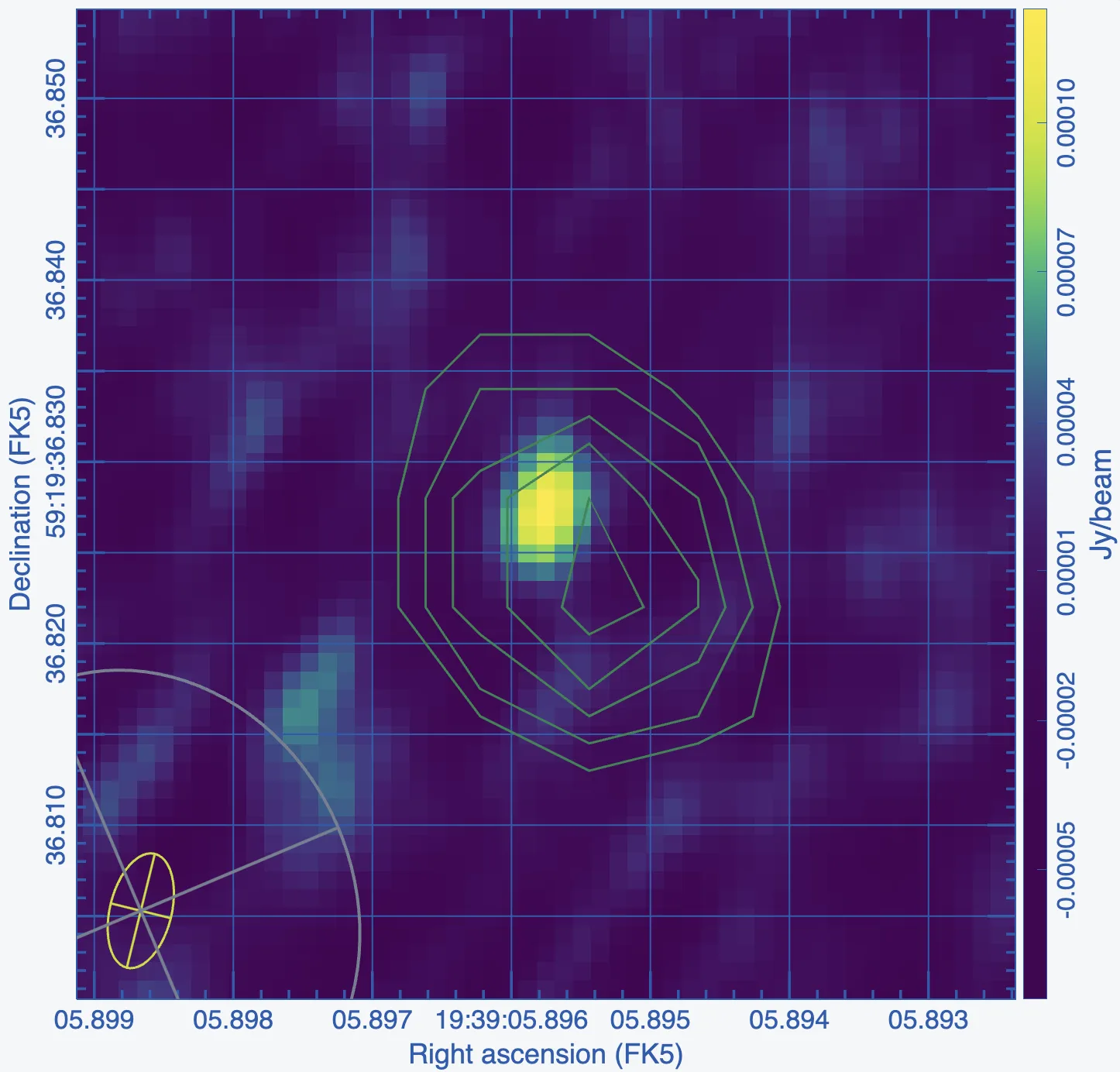
The first source, linked to burst FRB 20190417A, was detected at 5 gigahertz. It turned out to be extremely compact — smaller than one milliarcsecond on the sky, which is like spotting a coin from a thousand kilometers away. Its brightness temperature exceeds one hundred thousand kelvins, meaning the emission isn't thermal but comes from charged particles moving in magnetic fields. The source's spectrum is nearly flat: it shines equally bright at low and high frequencies. This behavior resembles light from a nebula inflated by a young pulsar — a rapidly spinning neutron star.
The second candidate, linked to burst FRB 20181030A, did not show up at these frequencies. If its emission is truly compact, the spectrum must be very steep: it fades sharply at high frequencies. This sets it apart from the first source and hints at a different mechanism.
This approach, catching the faint persistent glow next to short flashes, helps separate the burst's "engine" from the surrounding nebula. The more such sources we can measure, the clearer it becomes what machines drive these cosmic sirens.
Original abstract
as written by the authors arXiv:2604.03429
We aim to confirm the compact nature and constrain the radio spectra of candidate persistent radio sources (PRSs) associated with repeating fast radio bursts (FRBs). We performed European VLBI Network (EVN) observations at 5 and 8 GHz targeting two candidates identified in a recent VLA survey. We measured flux densities and upper limits at milliarcsecond resolution and combined them with published VLBI data at lower frequencies to derive spectral constraints. We detect a compact source associated with FRB 20190417A at 5 GHz with a flux density of $$150\pm45$$ uJy, while no detection is obtained at 8 GHz. The source is unresolved and has a brightness temperature $$T_{\rm b}>10^{5}$$ K, confirming its non-thermal nature. Combining our measurement with VLBI data at 1.4 GHz, we derive a spectral index $$\alpha = -0.19 \pm 0.29$$, consistent with a nearly flat spectrum. This makes FRB 20190417A only the second PRS with a spectral index constrained using VLBI data. The inferred luminosity places the source on the proposed $$L_{ u}$$-|RM| relation. Including this source yields a scatter of $$\sigma_\Delta = 0.65$$, corresponding to $$\hat{\alpha}|\epsilon| = 1.5 \pm 0.7$$, consistent with forward shocks in the free-expansion phase or young pulsar wind nebulae. For the candidate PRS associated with FRB 20181030A, we report upper limits of 80 uJy at 5 GHz and 150 uJy at 8 GHz, corresponding to $$L_{5\,\mathrm{GHz}} \lesssim 3.8 \times 10^{25}\ {\rm erg\ s^{-1}\ Hz^{-1}}$$, and implying a steep spectral index ($$\alpha \lesssim -1.2$$) if the VLA emission arises from a compact component. Our results highlight the importance of VLBI in isolating compact emission from FRB engines and provide one of the few spectral constraints for PRSs at milliarcsecond resolution. The consistency of FRB 20190417A with the $$L_{ u}$$-|RM| relation supports a nebular origin for the persistent emission.
The source's brightness temperature exceeds one hundred thousand kelvins. For comparison, the Sun's surface is about six thousand kelvins. Such a high temperature for a radio source means its emission is produced not by hot atoms but by magnetic fields accelerating particles.
In Carl Sagan's novel "Contact," the protagonist picks up a radio signal from an alien civilization. Fast radio bursts were also initially mistaken for artificial signals, but now we know they're natural phenomena.