How Physicists Tested the Pauli Exclusion Principle Using Carbon express
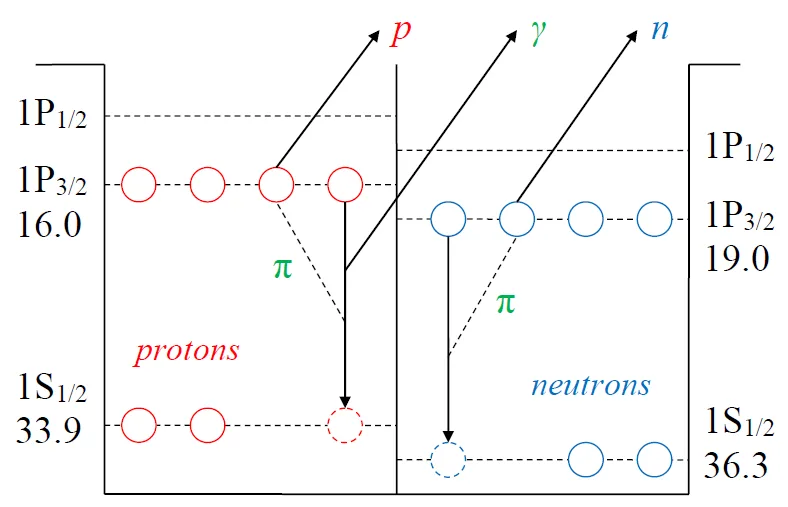
In a carbon atom's nucleus, particles occupy their own 'apartments'—like residents who cannot share the same room. Physicists call this rule the Pauli exclusion principle: two identical inhabitants of a nucleus cannot be in the same state. But what if the rule is sometimes broken? Then one 'resident' could move into an already occupied room, with the excess energy escaping as a flash of light or an ejected particle.
The Borexino detector, buried deep beneath the Italian Alps, watched a huge tank of liquid scintillator, a substance that flashes when particles hit it, for fourteen years. The scientists were looking for exactly such 'illegal moves' in carbon nuclei: transitions where a particle occupies an already filled spot. But over the entire observation period, the detector registered not a single such event.
The absence of a signal is also a result. It allowed them to determine that a carbon nucleus lives at least 10 to the 32nd power years before violating the Pauli exclusion principle. That's a number with thirty-two zeros — billions of billions of times the age of the Universe. In other words, if the Pauli exclusion principle is ever violated, it happens so rarely that in the entire history of the cosmos, no carbon nucleus in the detector has ever done it.
The Standard Model of particle physics, which incorporates the Pauli exclusion principle, has passed another test. Now we have the strongest evidence yet that this rule is not just a convenient invention but a strict law of nature.
The Pauli exclusion principle was formulated by Wolfgang Pauli in 1925, when he was just 25 years old. For this discovery, he received the Nobel Prize in 1945.