Borexino is a particle physics experiment located deep underground at the Laboratori Nazionali del Gran Sasso in Italy. Its heart is a spherical vessel filled with a liquid scintillator—a special fluid that emits a flash of light when a particle passes through it. The detector was designed to study low-energy neutrinos, particularly those coming from the Sun, as well as rare nuclear decays and other exotic processes. Because neutrinos interact extremely weakly with matter, the detector is shielded by layers of water and rock to reduce background noise from cosmic rays and natural radioactivity.
History
The Borexino collaboration was formed in the early 1990s, and the detector began taking data in 2007. It was designed and built by an international team of physicists from Italy, Germany, the United States, and other countries. The experiment achieved its first major result in 2007 with the direct detection of solar neutrinos from the beryllium-7 decay chain, a milestone in neutrino physics.
How it works
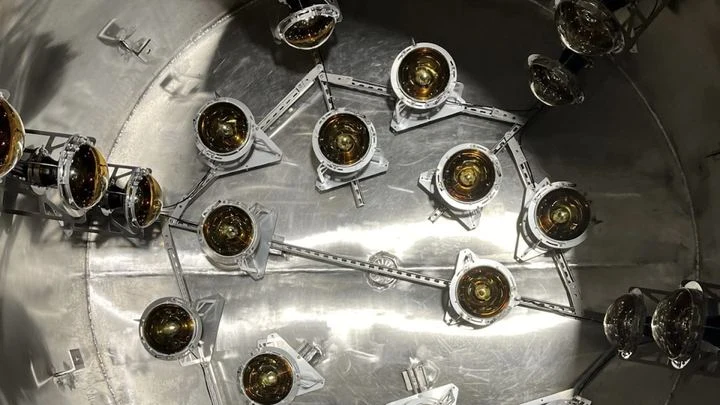
When a neutrino interacts with an electron in the liquid scintillator, it transfers energy, causing the scintillator molecules to excite and then emit photons. These photons are detected by an array of photomultiplier tubes lining the detector. By measuring the timing and energy of the light flashes, physicists can reconstruct the energy and direction of the incoming neutrino. The extreme purity of the scintillator and the careful shielding allow Borexino to observe the faint signals from solar neutrinos, which are otherwise drowned out by background radiation.
In practice
Borexino's techniques for ultra-low background detection have been adapted for use in other rare-event searches, such as dark matter detectors and neutrino observatories, and its measurements of solar neutrinos provide crucial constraints on models of stellar structure and nuclear fusion.
Fun fact
Borexino was the first experiment to detect neutrinos from the Sun's primary fusion cycle (the pp chain) in real time, confirming that the Sun's energy comes from proton-proton fusion.
Deep inside a mountain, where cosmic-ray muons are muffled by a thick layer of rock, stands a detector that catches not light but its absence. Positronium is a tiny atom in which an electron and its antiparticle, the positron, circle each other like a pair of dancers. Usually they come together and vanish in a flash of two or three gamma quanta.
In a tank holding three tons of liquid xenon, buried deep underground, something stirred one day. Not the xenon itself, but one of its atomic nuclei: it received a kick with an energy of 248 thousand electronvolts and recoiled like a billiard ball struck by an invisible cue ball.
Solar neutrinos are tiny particles born in the Sun's core by the trillions every second. They pass through Earth almost without noticing it, and for a long time they were considered absolutely stable. But perhaps they too can "age"—decaying imperceptibly, vanishing on their way to us.
One hundred forty parsecs, a distance light traverses in four and a half centuries, separate us from the Taurus molecular cloud. Within its depths hide dark condensations: prestellar cores, where gas and dust slowly contract under their own weight.
At nine in the morning, the DarkSide-50 detector, 1400 meters beneath Gran Sasso, records a weak ionization pulse. By eleven at night, the frequency of such events drops noticeably. This is not an electronics glitch or a seasonal background variation.
A huge pool of clear liquid is hidden deep underground. Inside, there is nothing but a pristine 'broth' that flashes with faint light when an invisible particle flies through. This is the JUNO detector—20,000 tons of liquid scintillator built to hunt for neutrinos.
The main enemy of such a hunt is not darkness but its own noise.
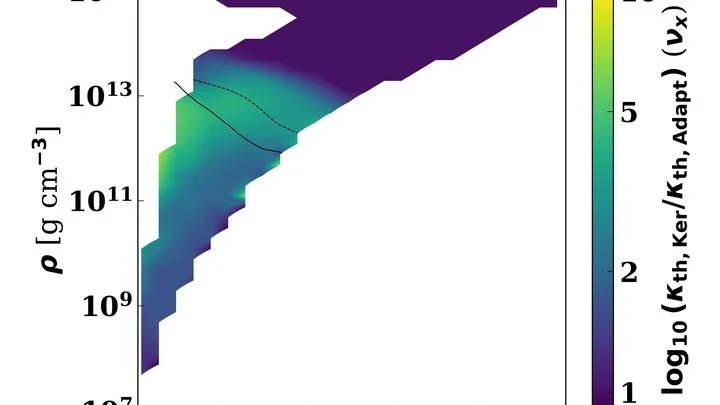
The collision of two neutron stars is a cosmic laboratory where matter is compressed to unimaginable densities. In the first moments after the merger, a hot cloud forms and cools by emitting neutrinos. These ghostly particles carry away energy and dictate how much matter is ejected into space and which heavy elements are synthesized.
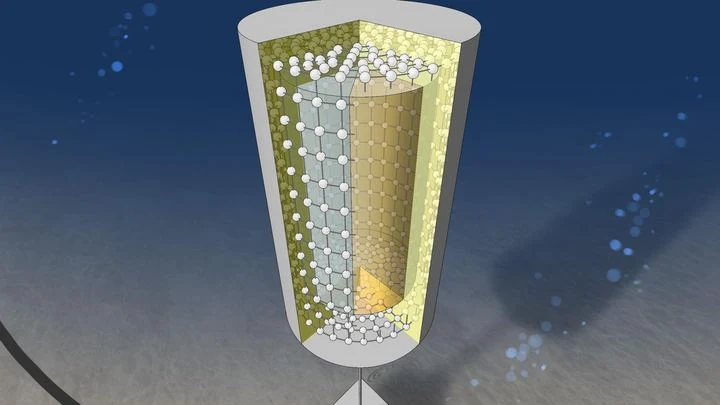
In the depths of the ocean, where light never reaches, a plan is taking shape to capture particles that barely interact with anything. Geoneutrinos, tiny messengers from the scorching mantle, are emitted during the decay of uranium and thorium. Their flux carries information about how much heat lies hidden beneath our feet.
The Sun is a giant nuclear reactor that continuously sends us light and heat. But it also has another, almost silent postal service: every second, tens of billions of neutrinos, ghostly particles born in the thermonuclear furnace, fly through a square centimeter of your palm. Most of them leave no trace.
Dark matter detectors are essentially incredibly sensitive microphones, capable of hearing a whisper amid the roar of a rock concert. Their job is to catch the rare nudges from hypothetical dark matter particles, which are thought to occasionally collide with atomic nuclei of ordinary matter.
The story began almost a century ago, when Edwin Hubble showed that galaxies are receding, and Fritz Zwicky and Vera Rubin later realized: to explain their motions, invisible mass is needed — dark matter.
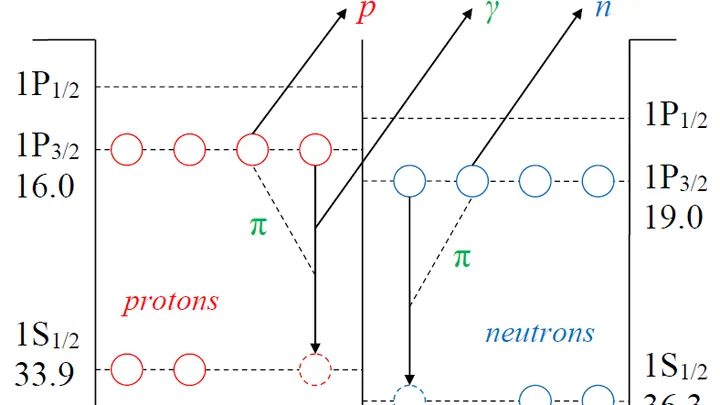
In a carbon atom's nucleus, particles occupy their own 'apartments'—like residents who cannot share the same room. Physicists call this rule the Pauli exclusion principle: two identical inhabitants of a nucleus cannot be in the same state. But what if the rule is sometimes broken?
Neutrinos are tiny particles that pass through the planet's bulk like light through a windowpane. Every second, billions of them fly through your pinky fingernail, but catching even one is no easy feat. To do it, scientists dug a two-kilometer-deep mine in Canada and installed the SNO+ detector.
Deep beneath the Apennine Mountains, in a tank holding three tons of liquid xenon, something gives a barely perceptible shudder every few days. It's a solar neutrino, a ghostly particle born in the Sun's thermonuclear furnace, that has traveled 150 million kilometers through empty space and solid rock to finally collide with a xenon nucleus.
Deep beneath our feet, within the planet's bulk, radioactive elements are slowly decaying. This process spawns tiny particles — geoneutrinos. They pass through the crust, mantle, and core, barely interacting with anything.
Underground, in a former gold mine, sits a tank of liquid xenon. If a dark matter particle flies through it, the xenon flashes. But it also flashes from ordinary particles, like neutrinos or leftover radioactivity. The task is to tell which flash comes from dark matter and which from noise.
In a dark tank holding thirty tons of water, the liquid glows when a ghostly particle streaks through. Neutrinos barely interact with matter, but occasionally they bump into atoms, and a flash is born. To catch it, a special substance, a liquid scintillator, is added to the water to amplify the light.
A tiny ghostly particle zips through a piece of germanium. Usually it leaves no trace, but sometimes, like a billiard ball, it smacks into an atom's nucleus. The nucleus recoils, and that jolt can be detected. At Oak Ridge National Laboratory, the Ge-Mini detector caught such recoils for two years.
Neutrinos are the most elusive of known particles.
In a dark chamber where the temperature sits just four degrees above absolute zero, a sapphire crystal the size of a grain of rice lies waiting. When a neutrino, a ghostly particle that barely notices matter, flies through it, the crystal shudders and warms by a tiny fraction of a degree.
Electrons in a metal are like a crowd in a subway: each on their own, but at the slightest push, everyone moves at once. Physicists call this collective oscillation of the electron gas a plasmon. In superconductors, these oscillations are especially important because they reveal how electrons interact with each other.
Neutrinos are ghost particles: predicted by the Standard Model, they barely interact with matter. Catching them is like trying to hear a whisper in the roar of a waterfall.
Inside a giant spectrometer in Karlsruhe, shaped like a huge metal barrel, scientists are catching particles that are nearly impossible to catch. Neutrinos are the ghosts of the microcosm: every second, trillions of these particles fly through your body, and you don't even notice. But they do have mass, and scientists want to measure it.