Balls That Roll Against the Field express
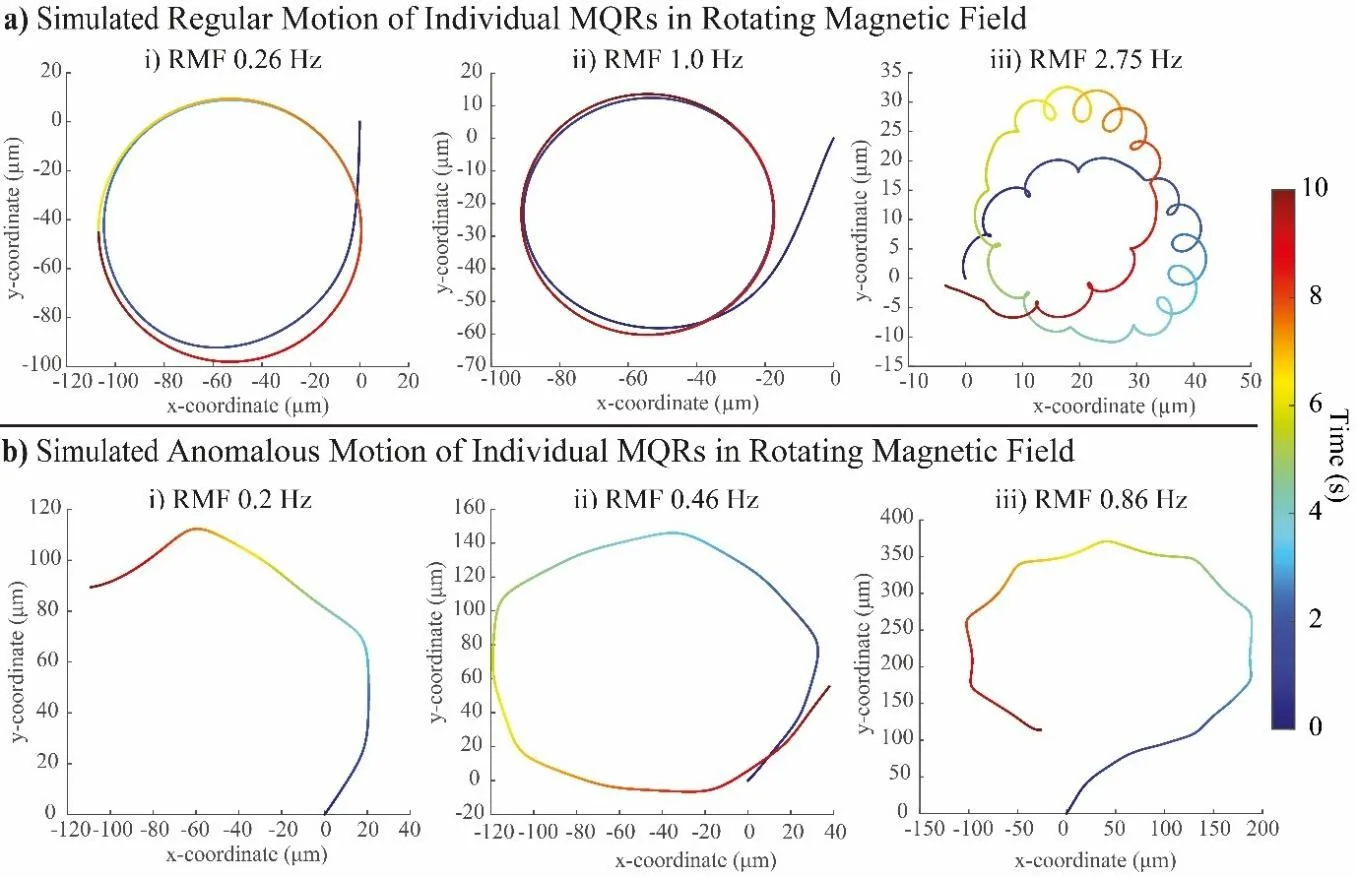
A small ball with an iron core lies on a surface while a magnetic field spins around it. The ball starts rolling like a wheel and usually goes in the direction the field rotates. But sometimes it suddenly turns around and rolls the other way — against the field.
At first, the field was rotated slowly, and the balls traced circles or spirals, obediently following the field. Then the field was spun faster, and wavy trajectories appeared: the ball was still rolling in a circle, but its path became uneven. And under certain conditions, the ball would even change direction and start rolling counterclockwise, even though the field was rotating clockwise.
To understand why this happens, scientists built a model that accounts for electric forces, friction with the fluid, and the ball's magnetic properties. It turned out that three things decide everything: how the ball was magnetized at the very start, how fast the field rotates, and how fast the ball was already rolling. If these three conditions align in a certain way, the ball "chooses" the reverse direction.
Now that it's clear how to control their motion, we can fine-tune the behavior of microscopic machines. And perhaps in the future, such balls could help deliver drugs inside the body or assemble tiny devices.
Original abstract
as written by the authors arXiv:2604.11132
We report the motion of individual magnetic Quincke rollers composed of silica particles doped with superparamagnetic iron oxide nanoparticles, whose activity arises from the coupling between Quincke rolling and an externally applied rotating magnetic field. We applied a clockwise (CW) rotating magnetic field of magnitude approximately 11 mT and rotational frequencies ranging from 0.2 to 2.75 Hz. At low frequencies, the dominant mode of motion is a CW helical trajectory. Circular trajectories emerge as a limiting case of this helical motion, in which lateral translation vanishes and the particle traces overlapping closed loops in the xy-plane. At higher frequencies, a second regular mode becomes prevalent, characterized by helical wavy trajectories in which the particle follows a CW helical path with a spatially varying curvature. Under specific conditions, however, we observe the unexpected emergence of anomalous counterclockwise (CCW) trajectories, in which individual particles roll in a direction opposite to that of the applied CW rotating magnetic field. A theoretical model incorporating electrostatic interactions, far-field hydrodynamic coupling, and a magnetic dipole approximation indicates that the anomalous behavior results from the interplay among the magnitude and orientation of the initial magnetic dipole moment, the frequency of the rotating magnetic field, and the magnitude of the initial translational velocity. Together, these factors determine the likelihood of a particle exhibiting regular or anomalous rotational motion.
The smallest balls in this experiment were tens of times thinner than a human hair, yet their motion could be tracked with an ordinary microscope.