The magnetic moment of a particle is a measure of how strongly it interacts with a magnetic field, essentially its internal 'magnet' strength. For a simple, point-like particle like the electron, the Dirac equation—the relativistic quantum equation that describes it—predicts a specific value for this magnetic moment, known as the 'g-factor' of exactly 2. However, careful measurements show that the actual value is slightly larger than 2. This tiny deviation is the anomalous magnetic moment, often denoted as 'g-2' (since the anomaly is the difference from 2).
History
The concept was first identified by Julian Schwinger in 1948, who calculated the leading quantum correction to the electron's magnetic moment. His result, a famous factor of α/(2π) (where α is the fine-structure constant), was a landmark success of quantum electrodynamics.
How it works
The deviation arises because the particle is never truly alone. In quantum field theory, the electron constantly emits and reabsorbs virtual particles—fleeting photons, electron-positron pairs, and others—that pop into existence from the vacuum. These quantum fluctuations effectively 'dress' the electron, altering its interaction with a magnetic field. The anomaly is calculated by summing up all possible Feynman diagrams representing these virtual processes; the leading contribution comes from a single virtual photon, giving a correction of about 0.00116, with further corrections from more complex diagrams.
In practice
The anomalous magnetic moment of the electron and muon is used as an ultra-precise test of the Standard Model of particle physics. Any discrepancy between theoretical predictions and experimental measurements could hint at new physics beyond the Standard Model, such as unknown particles or forces.
Fun fact
The theoretical prediction for the electron's anomalous magnetic moment agrees with experiment to about one part in a trillion, making it one of the most precisely verified predictions in all of science.
The orchestra plays without a conductor. Each instrument follows its own schedule: the violin on Monday, the flute on Wednesday, the timpani on Saturday. Astronomers hear not music but isolated notes scattered across the calendar. A telescope sees a star only when it is above the horizon and when the schedule has allotted time for it.
A laser beam is like a swift vortex that briefly captures a passing electron. As the particle moves through the pulse, its spin (the intrinsic rotation, like a tiny top) experiences a weak kick. After leaving the beam, the top no longer points in the same direction; it has turned a little.
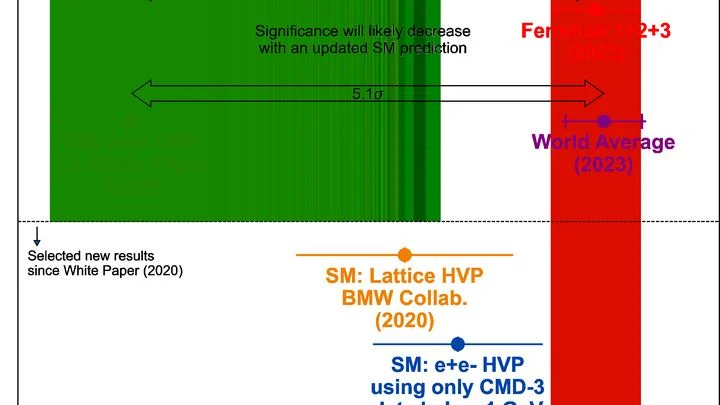
In a giant ring of magnets outside Chicago, muons whirled like figure skaters on an ice rink. But instead of music, there's a magnetic field, and instead of spinning, there's a barely perceptible wobble of the spin. Physicists call this wobble the anomalous magnetic moment.
Imagine a translator working in a noisy hall. The hum of voices, the clatter of dishes, fragments of other people’s conversations: it seems they should constantly make mistakes. But by the end of the day, their notes match perfectly with what they would have written in the quiet of an office. This is roughly how the quantum rule known as the axial anomaly behaves.
Electrons and muons are tiny magnets. Their magnetism is slightly more than two (in special units), and this 'excess fraction' (anomalous magnetic moment) arises from constant ripples in the vacuum: particle pairs momentarily pop into existence and vanish.
Every quantum particle has spin — an intrinsic magnetic property, like a tiny arrow. In an experiment, a beam of such particles passing through a magnet splits in two, like a coin that lands either heads or tails. That’s exactly how particles like a hydrogen atom behave.
A crystal is like a row of soldiers on a parade ground: every atom is in its place, and electrons march through it in neat waves. An amorphous material is like a crowd at a train station, where there is no order, just a jostling throng. In such a crowd, an electron usually gets stuck quickly, like a person trying to push through a dense mass of people.
The void can produce particles if a strong enough field is applied. Physicists call this the Dirac–Klein paradox. Previously, explaining it required the most complex calculations of quantum field theory. But we can make do with a visual image: a tightly stretched rubber band with a knot. The knot is a particle.
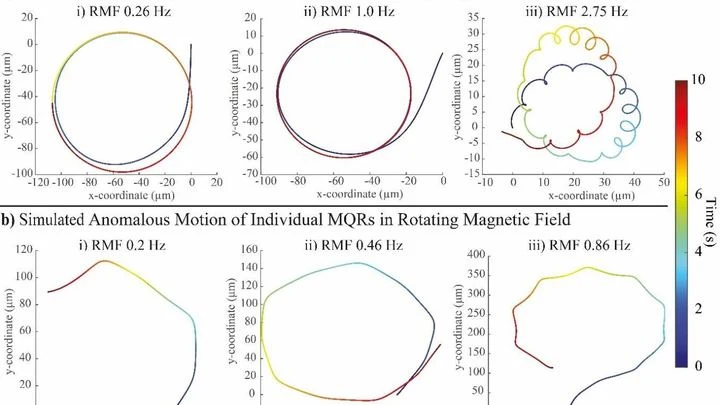
A small ball with an iron core lies on a surface while a magnetic field spins around it. The ball starts rolling like a wheel and usually goes in the direction the field rotates. But sometimes it suddenly turns around and rolls the other way — against the field.
The magnetic refrigerator of the future won't hum with a compressor. Instead, it will cool your groceries by exploiting a special material that heats up in a magnetic field and cools down when the field is removed. This cycle resembles the compression and expansion of gas in a conventional fridge, but here a magnet does the work of a piston.
In layers of molybdenum telluride twisted at a specific angle, electrons behave unusually: they can split into parts. This is akin to a whole pie suddenly being cut into perfectly equal slices, even though there's only one knife. In ordinary materials, the electron's charge is indivisible, but in these layers, under strong cooling, states emerge where the charge splits into three parts.
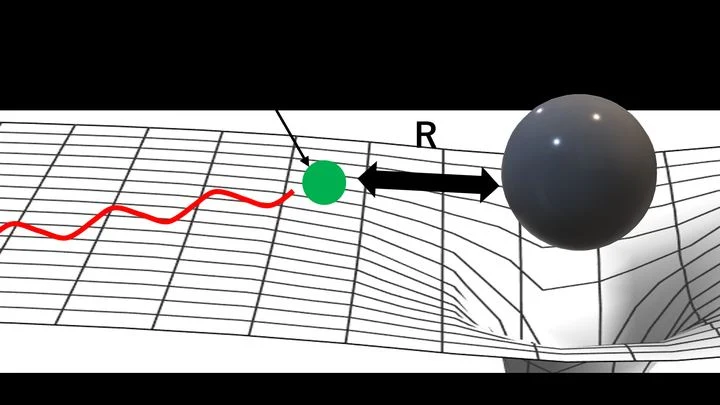
An atom excited by light gives its energy back in an instant — it emits a photon. This process is like a tired runner dropping a heavy load. But if the runner is on a mountain slope, it's harder to pick up speed. Gravity acts on the atom similarly: near a massive body, time flows slower, and the atom emits differently.
The neutron is a particle with no charge but with internal structure. Like a ball that looks smooth on the outside but has a complex filling inside. Scientists have long wanted to understand how electric and magnetic forces are distributed inside the neutron. To do this, you need to "feel" it — collide it with its antiparticle and see what happens.
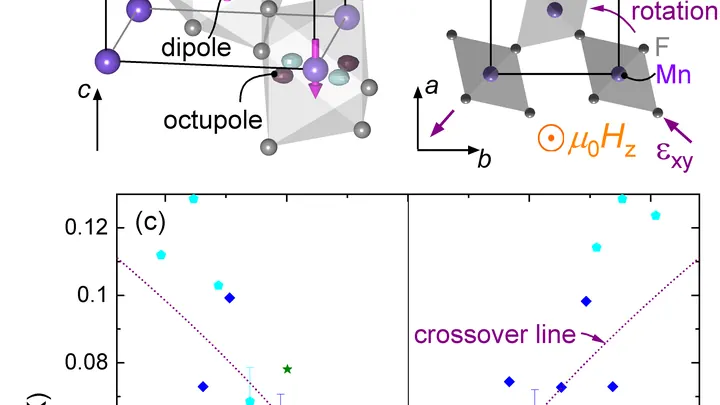
In a manganese fluoride crystal, atoms are lined up like soldiers in formation. But within this formation lies a hidden pattern: the magnetic moments of the atoms point in opposite directions, and the pattern itself changes when the crystal is rotated.
The muon is a tiny spinning top, twirling in the turbulent sea of the vacuum. Its magnetic axis points slightly away from what the Standard Model predicts. The deviation is just a couple of parts per million, but for physicists, it's a full-blown mystery.
The vacuum is not a dead calm.
Hot water sometimes freezes faster than cold — that's the classic Mpemba effect. In the quantum world, its counterpart is even more astonishing: tiny particles can reach equilibrium many times faster than expected, and what helps them is not forgetfulness, but memory.
Two translators listen to the same symphony. One hears only the fundamental tone: a clean, predictable melody. The other catches the overtones that color every note.