Angular frequency is a measure of how fast something rotates or oscillates, expressed in radians per second. It is the rotational analog of ordinary frequency (cycles per second, or hertz), but instead of counting complete cycles, it counts the angle swept out per unit time. For any periodic motion—like a swinging pendulum, a vibrating string, or a rotating wheel—angular frequency connects the period and the speed of the motion in a single number.
History
The concept emerged naturally with the development of trigonometric descriptions of periodic motion in the 18th and 19th centuries, particularly in the work of mathematicians and physicists like Euler and Fourier, though no single inventor is credited.
How it works
For a system that repeats every T seconds, the angular frequency is ω = 2π/T. The factor 2π comes from the fact that one full cycle corresponds to a rotation of 2π radians. In equations of motion, angular frequency often appears inside sine or cosine functions, so it directly sets the rate at which the phase changes. It is also related to ordinary frequency f by ω = 2πf, making it a convenient shorthand in many physics formulas.
In practice
Angular frequency is used in electrical engineering to describe alternating current, in mechanical engineering for rotating machinery, and in quantum mechanics where it appears in the energy–frequency relation E = ħω.
Fun fact
In a typical household electrical outlet, the angular frequency is about 377 radians per second, corresponding to 60 hertz.
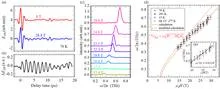
A taut string sounds higher when you pull it tighter. Magnetization in an antiferromagnet behaves similarly: the stronger the external field, the faster it oscillates. But in chromium oxide crystals, something goes awry.
In fields from 20 to 30 tesla, the resonance frequency grows more slowly than it should.
Imagine a string stretched between two tuning pegs. The slightest touch makes it vibrate, and from the pitch you can guess exactly how it was plucked. Physicists at the University of Arizona have stretched a similar string — not on a musical instrument, but on a silicon membrane just a hundred nanometers thick.
Strike a diamond and it rings, but sound lives inside it even without a strike. Waves of compression and rarefaction constantly ripple through it, like the ripples a stone makes on water. Except this ripple is the thermal jitter of the atoms themselves, and it can be detected with a laser.
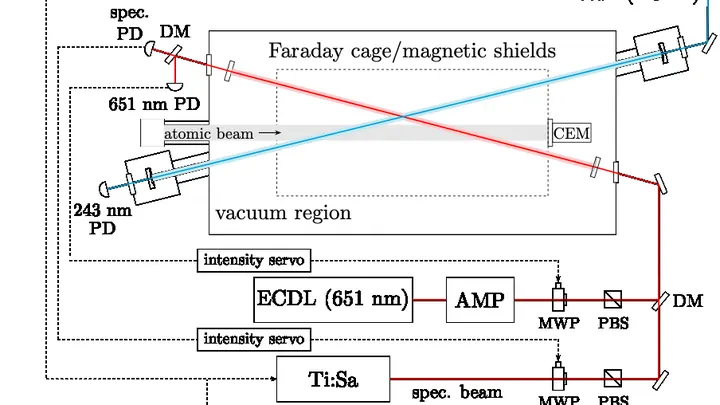
Hydrogen is the simplest atom: one proton and one electron. You'd think there's nothing left to study. But it's precisely on hydrogen that physicists test the most delicate laws of the microcosm. The electron in an atom can occupy different energy levels, like steps on a ladder.
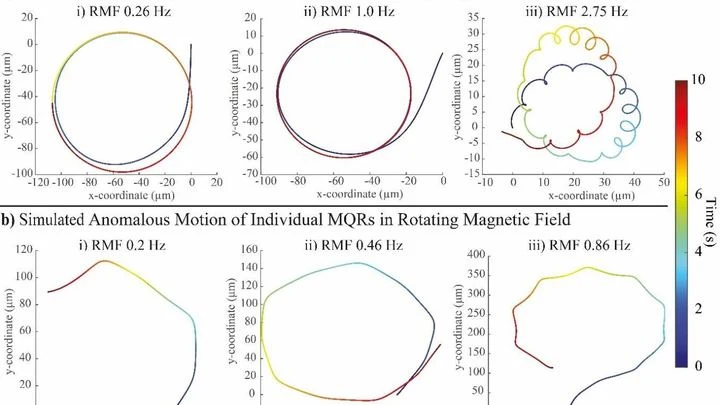
A small ball with an iron core lies on a surface while a magnetic field spins around it. The ball starts rolling like a wheel and usually goes in the direction the field rotates. But sometimes it suddenly turns around and rolls the other way — against the field.
An ordinary camera captures light reflected from objects and builds a picture from it. But if the object is hidden behind an obstacle or does not reflect light, radio waves come to the rescue: they pass through walls and fog, and a computer reconstructs the image from scattered signals.
A tiny defect in a diamond crystal works like a sensitive antenna. When a magnetic field oscillates nearby, this defect, a nitrogen vacancy, responds by glowing. Previously, to hear the signal, you had to accumulate many repeated measurements, like listening to a whisper with your ear pressed against a door. Now a single short "look" suffices.
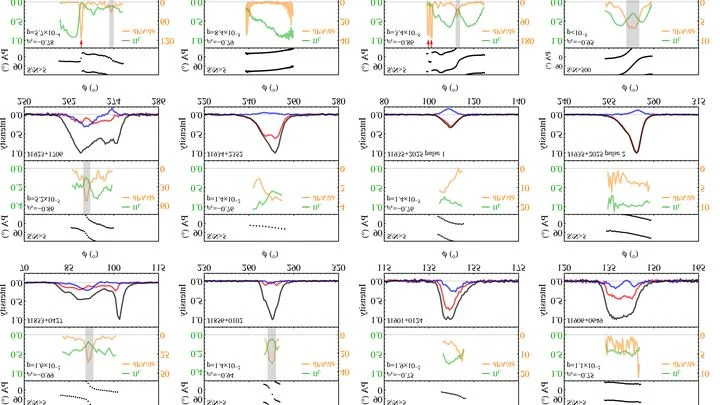
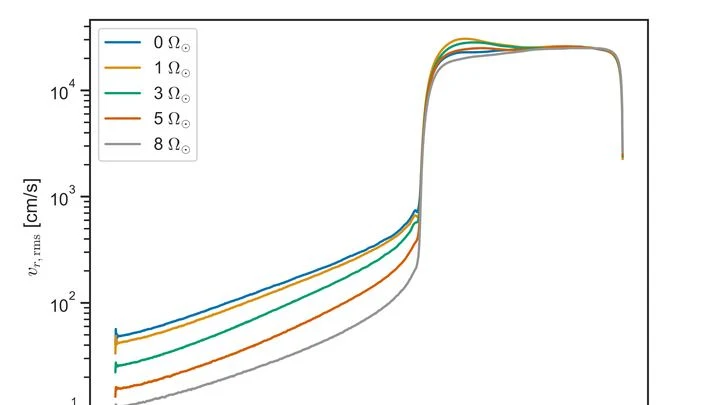
A star like the Sun hums like a bell: sound waves inside make its surface tremble ever so slightly. From this trembling, astronomers, like doctors reading a pulse, infer the star's temperature, density, and age. But the Kepler telescope spotted an oddity: many stars that spin fast and are covered in spots show no trembling at all. It's as if they've lost their voice.
Earth's climate resembles a choir, where each member sings their own part at their own pitch. Some voices hold low notes, like multi-year ocean temperature oscillations, while others produce rapid trills, like short atmospheric waves. The conductor needs to hear each one, but the voices overlap and the notes blend into a mush.