Quantum magnetism describes magnetic behavior that cannot be explained by classical physics, arising from the quantum mechanical nature of electron spins and their interactions. In materials like certain insulators and superconductors, spins can form exotic states such as spin liquids, where they remain entangled and never settle into a fixed order even at absolute zero. This field bridges condensed matter physics and quantum information science.
History
The foundations were laid by Werner Heisenberg and Paul Dirac in the late 1920s, who formulated the quantum mechanical model of exchange interactions. The concept of magnons was introduced by Felix Bloch in 1930.
How it works
Electrons have an intrinsic angular momentum called spin, which acts like a tiny magnet. In a crystal lattice, neighboring spins interact through exchange interactions, favoring parallel or antiparallel alignment. Quantumfluctuations can prevent these spins from freezing into a classical pattern, leading to collective excitations called magnons—quasiparticles that carry spin waves. These magnons can transport energy and information without moving electric charge, enabling novel spintronic devices.
In practice
Quantum magnetism underpins magnetic storage technologies, spintronic devices, and is being explored for quantum computing using spin qubits and magnon-based logic.
Fun fact
In a quantum spin liquid, the electron spins remain in a state of constant quantum entanglement, behaving like a liquid of magnetic moments even at temperatures near absolute zero.
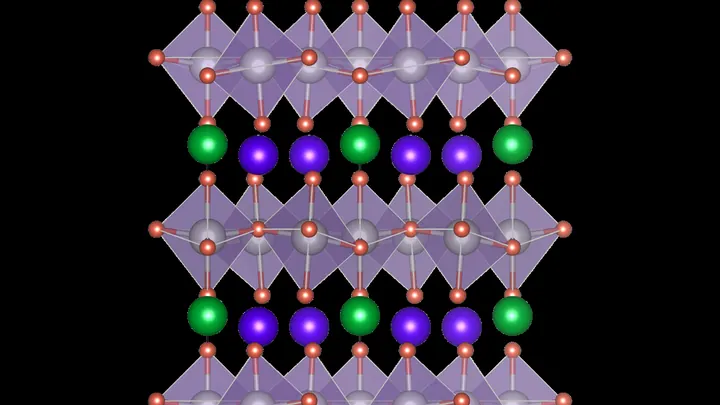
Two dancers on one stage: one pulls the partner in one direction, the other in the opposite. In the crystal Cu2(OH)3Br, known as botallackite, copper atoms form chains where the spins (magnetic moments) of neighboring ions align either parallel, as in a ferromagnet, or antiparallel, as in an antiferromagnet.
In nature's workshop, there is a strange lathe: it cuts threads on screws but forbids left-handed ones. You can tighten a screw as much as you like, in any clockwise direction, but counterclockwise is not allowed. This lathe is not a fantasy but an exact quantum rule that physicists have just built for magnetic materials.
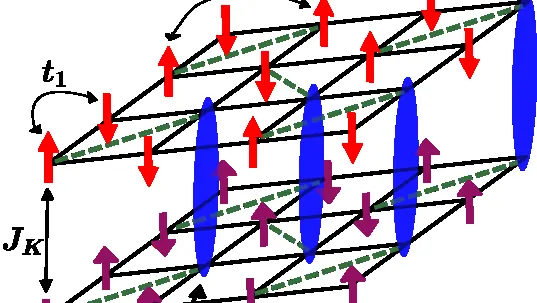
Imagine a ladder whose rungs are tiny magnets. If neighboring magnets point in opposite directions, the ladder is "calm." But if you make them all point the same way, the whole structure becomes magnetized and "stubborn."
Scientists built such a ladder from germanium atoms — a semiconductor used to make transistors.
A tiny magnetized sphere floats in a vacuum, held by invisible fields. It starts to spin around the axis of the magnetic field, just like a top that's been given a gentle nudge. That's precession. But when the sphere becomes really small, quantum laws come into play.
A parquet floor where every other plank is turned the opposite way looks symmetric. But if you run your hand over it, in one direction your fingers glide along the grain, and in the other they catch. That's roughly how the new type of magnetism studied in the crystal AgCrP2S6 works.
Inside planets and stars, in rotating oceans of plasma, turbulent flows, Coriolis forces, and magnetic tension collide. The central question is how the energy of this chaos crystallizes into a stable magnetic framework that can last billions of years.
A superfluid flows without friction, like water that never stops. But when you spin it, it doesn't just rotate: each tiny vortex remembers exactly how it was spun. This 'trace' is not a metaphor but a real geometric imprint, which physicists call the Berry phase (the phase acquired by a wave as it travels along a closed path).
In the world of magnetism, a simple dichotomy long reigned: ferromagnets, where spins point in one direction, and antiferromagnets, where they line up in a checkerboard pattern, canceling each other out. But a recent 'third player' — altermagnets — forced a rewrite of the rules.
Right after the Big Bang, space was a hot plasma — a mix of charged particles and light. In such a medium, electric currents couldn't flow on their own: a 'potential difference' was needed to push electrons relative to photons.
An ordinary magnet is like a compass: its needle points north. But a quantum compass can look in both directions at once. If a magnet floating in a vacuum is gently spun, its electron 'tops' synchronize so the whole piece of metal starts living by the rules of the microworld — freezes in a superposition, like a split pointer.
The magnetic field increases, but the magnetization stays put. It's like a scale where you add weight, yet the needle doesn't move until enough has accumulated to jump to the next mark. That's exactly how rare-earth tetraboride crystals behave, and physicists have been puzzled for decades.
A handful of copper coins scattered on a triangular grid freezes into a strange order when a current is passed through them. That's roughly how tiny magnetic arrows, electron spins, behave in a crystal with the rare name Y-capellasite.
A juggler tosses clubs while sitting on a spinning chair. If he starts spinning the clubs all in one direction, the chair will rotate the opposite way — otherwise, the conservation of angular momentum would be violated.
A handful of rice grains falls onto a hot skillet, and they start jumping. Each grain pushes its neighbors, and the whole pile stirs without any external hand. That's active matter: a multitude of particles that draw energy on their own and convert it into motion.
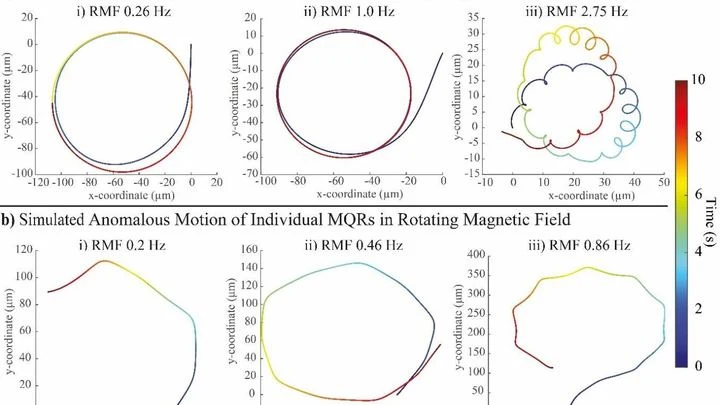
A small ball with an iron core lies on a surface while a magnetic field spins around it. The ball starts rolling like a wheel and usually goes in the direction the field rotates. But sometimes it suddenly turns around and rolls the other way — against the field.
A tiny magnet, made from just two molecules, was placed on a metal surface, and it behaved like a temperamental conductor. Normally, electrons in a metal move in a coordinated way, like a crowd on an escalator. But when cooled significantly, this order breaks down, and the motion becomes unpredictable.
A magnetar is a neutron star with a magnetic field hundreds of millions of times stronger than Earth's. If you brought an ordinary magnet near such a field, it would instantly lose its magnetism, and atoms would stretch into thin filaments.
The atomic nucleus is not just a ball of protons and neutrons. Inside it, like a tiny magnet, there is its own distribution of magnetization. Until now, it has been difficult to see: nuclei live for tiny fractions of a second, and their magnetic field is weak. Now physicists at CERN have found a way to look inside.
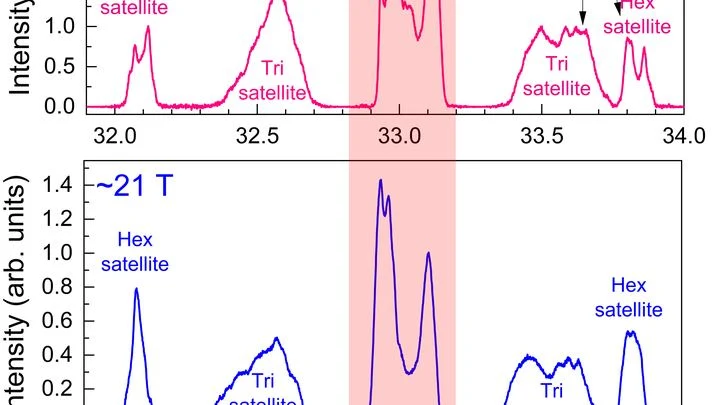
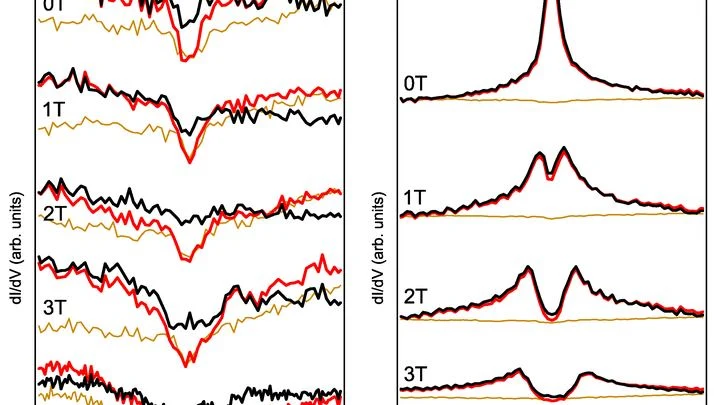
A flat magnet is like a thin sheet with waves of magnetization running across it. Under normal conditions, these waves quickly die out, but when a strong magnetic field is switched on, an unexpected signal appears in the material — sharp and narrow, like a shadow cast by the main wave.
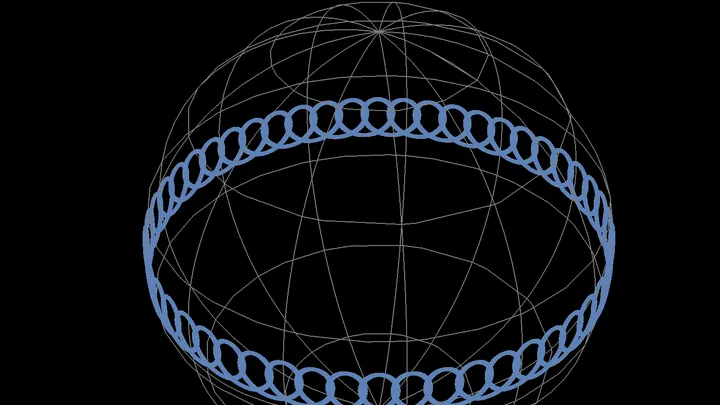
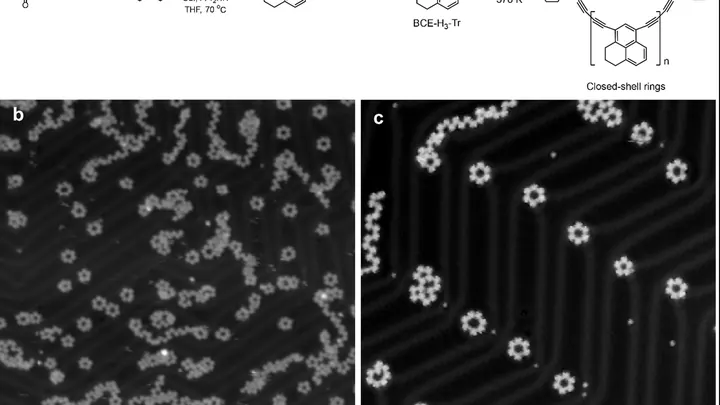
A ring of magnetic atoms resembles a round dance where each participant holds hands with their neighbors. In ordinary magnets, each atom has its own permanent magnetic moment, and they interact like little arrows striving to align opposite to each other.
Magnetic atoms in a solid are like compass needles: usually, when cooled, they align in one direction: that's how magnetism arises. But in TbInO3, the terbium needles sit on a triangular lattice where it's impossible to please all neighbors at once. One needle wants to point north, another south, and in the end none can settle into a stable position.
An ordinary superconductor expels magnetic fields, but this ring does the opposite: it creates a magnetic field inside itself. The ring is made of Fe(Te,Se) — a compound of iron, tellurium, and selenium that loses its electrical resistance at very low temperatures.
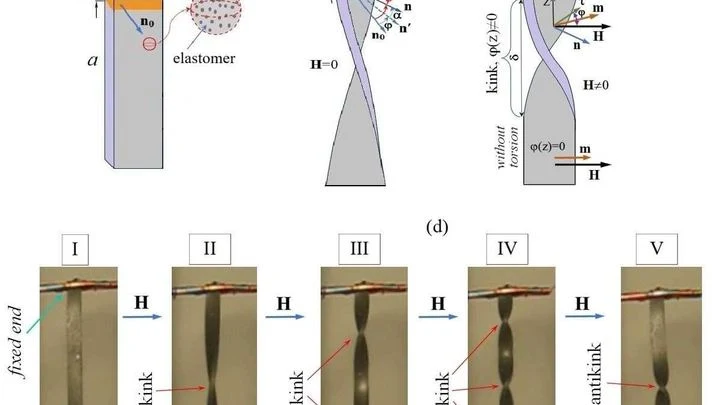
An ordinary rubber strip filled with fine iron filings doesn't just bend in a magnetic field: it ties itself into a stable knot. This effect was predicted and reproduced in experiments by physicists working with magnetoactive elastomers: a silicone base with carbonyl iron particles.
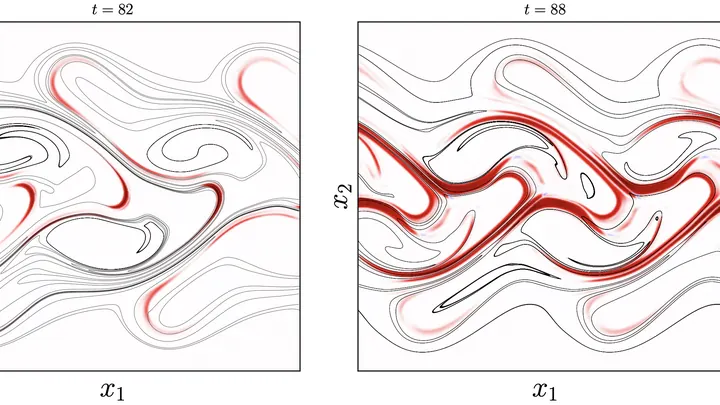
A calm river suddenly starts churning in the middle of a flat stretch: that's the puzzle the authors of a new study set out to solve. They took a thin layer of charged gas with a very weak magnetic field and tracked on a computer what would happen to it. At first, everything flows smoothly, like water from a tap.
A laser flash strikes a copper oxide crystal, and magnetic excitation waves, magnons, ripple outward like ripples on water. For the first time, scientists traced their path from birth to disappearance with femtosecond precision (millionths of a billionth of a second).
A football kicked with spin doesn't fly straight: it bends to the side. A tightly focused beam of light does something similar: it starts pushing an atom not just forward but also sideways. Physicists measured this shift on a single calcium ion trapped in a light trap.
The beam was aimed at the atom like a spotlight on a grain of sand.
In a typical magnet, all spins of electrons (internal ‘arrows’-magnets, discovered by Pauli) point one way. Altermagnets, like MnTe, are trickier: these arrows alternate direction, like ripples spreading from a pebble tossed into water. But here’s the twist — the ripple arises from the electrons’ own motion.