Little Red Dots: What the Cosmic Tots Are Hiding express
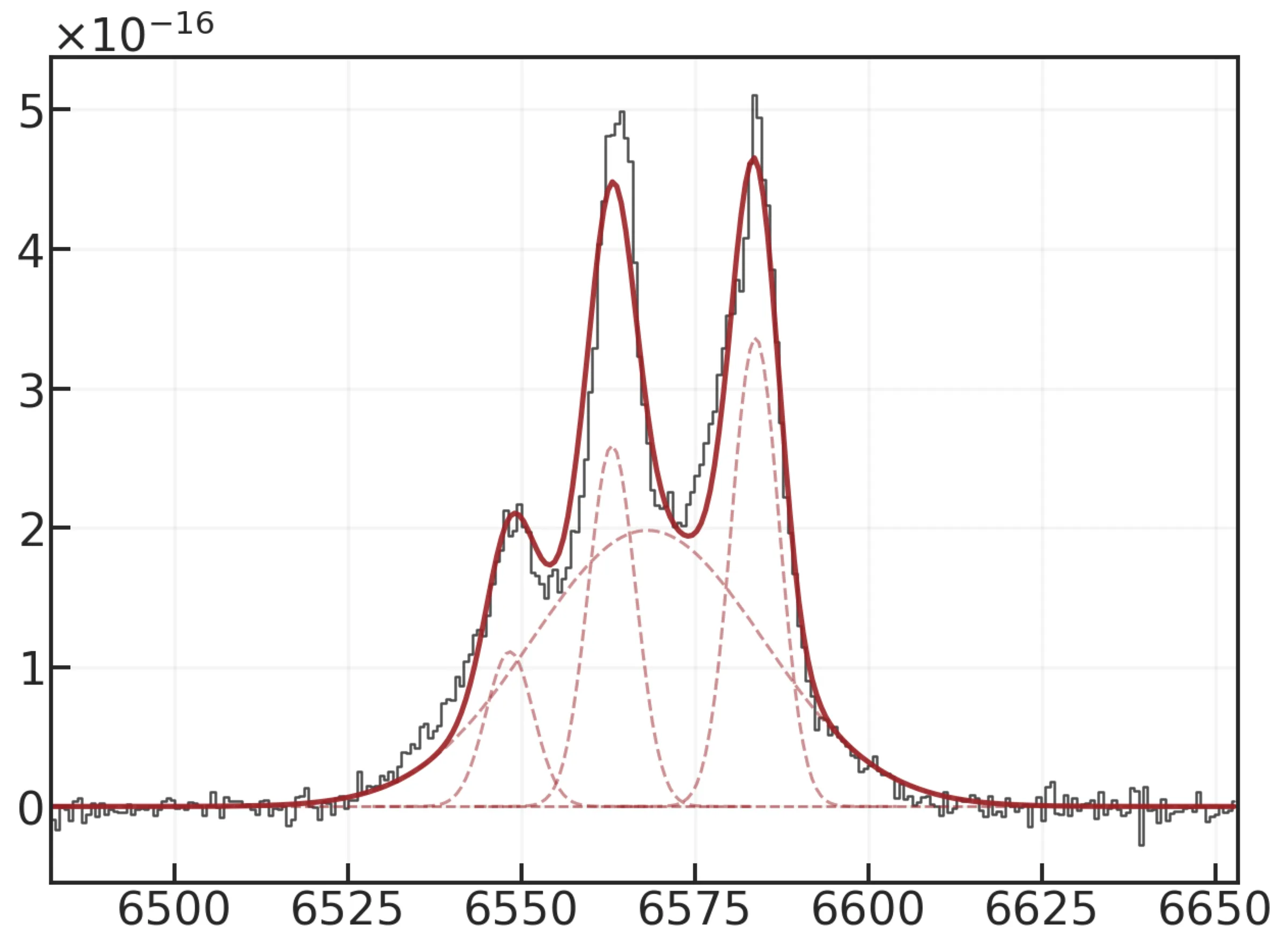
In the vast cosmic web, the James Webb Space Telescope spotted something unusual — tiny but bright red sparks that astronomers have nicknamed 'little red dots.' They shine as if an invisible fire is raging inside: their spectrum looks like a letter V, and the hydrogen lines are broadened, as if someone smeared paint across a canvas. These dots hide at enormous distances, where the universe was just one and a half billion years old, and peering directly into their nature is nearly impossible.
It's like looking at an old photograph of a stranger: you stare at the picture and try to guess who they became. That's roughly how astronomers are searching for 'grown-up' versions of these dots in our cosmic neighborhood. Using the DESI instrument (a setup for obtaining spectra of thousands of objects), they selected five candidates at distances where light took about 3–4 billion years to reach us. These objects also sport a V-shaped spectrum and broad hydrogen lines, but here's the catch: they are noticeably heavier, as if a scrawny teenager had turned into a stocky adult.
The difference isn't just in mass. The local 'dots' shine differently: they have a greater contribution from calm stars rather than from the frantic activity of a central black hole. This hints that we're not seeing an exact copy, but rather the next chapter in evolution — when the system has feasted, settled down, and accumulated stellar ballast. Or perhaps entirely different mechanisms are at play, merely pretending to be familiar.
Such a 'zoo' of similar but not identical objects is a real gift. Now they can be studied in detail, as if under a magnifying glass, and we can test which theories about the growth of the first black holes and galaxies survive the test of proximity. The red dots are no longer distant ghosts but a tangible mystery right on our doorstep.
Original abstract
as written by the authors arXiv:2604.14551
The James Webb Space Telescope (JWST) has recently discovered a population of compact, red sources at z > 4 known as "Little Red Dots" (LRDs). They are characterized by their V-shaped continuum spectra and prominent broad Balmer emission lines. As their underlying physical nature remains debated and direct study at high-redshift is challenging; therefore, we seek to identify and characterize LRD analogues in the low-redshift universe to constrain their properties and potential evolutionary pathways. We identified five candidates at z = 0.2-0.4 from the Dark Energy Spectroscopic Instrument (DESI) that exhibit spectral energy distributions (SEDs) and broad Balmer emission lines closely resembling their high-redshift counterparts. However, we find significant differences: our low-redshift sample occupies a different region on the Baldwin, Phillips \& Terlevich (BPT) diagram, and their stellar masses are significantly higher, suggesting a more substantial host galaxy contribution. These sources are not necessarily direct local analogues of high-redshift LRDs, but may represent later evolutionary stages of compact, rapidly accreting systems, or systems with related observational properties arising under different physical conditions. This sample provides a valuable laboratory for detailed follow-up studies to elucidate the nature of LRD-like phenomena.
The hydrogen lines in these objects are broadened due to the Doppler effect: gas moving toward us appears slightly bluer, and gas moving away appears redder, so together the line smears out, like the sound of a passing siren.
In Carl Sagan's novel 'Contact,' a mysterious signal from space also first seemed like an artifact, but led to the discovery of unimaginable structures — what a 'little red dots' moment!