Reddening is the process by which interstellar dust scatters and absorbs blue light more efficiently than red light, making distant stars and galaxies appear redder than they actually are. This is analogous to why sunsets appear red on Earth — the same physics of scattering applies, but on a cosmic scale. Reddening is a form of extinction, which also dims the total light from an object, but the color change is a distinctive signature that astronomers must correct for to determine true colors and temperatures.
History
The effect was first quantified by Robert Trumpler in 1930, who showed that distant star clusters appeared redder and fainter than expected, providing early evidence for interstellar dust and its wavelength-dependent extinction.
How it works
Interstellar dust grains, typically a fraction of a micron in size, interact with starlight. Blue light, having a shorter wavelength, is more effectively scattered and absorbed by these grains than red light, which has a longer wavelength. As light travels through a dusty region, the blue component is preferentially removed, so the remaining light is shifted toward the red end of the spectrum. The amount of reddening depends on the column density of dust along the line of sight and the size distribution of the grains.
In practice
Astronomers use reddening measurements to map the distribution of dust in the Milky Way and other galaxies, and to correct observations of distant objects so they can determine intrinsic properties like stellar temperatures and the true brightness of supernovae.
Fun fact
Reddening can be so severe that a star's light is shifted from blue to red, making it appear thousands of times fainter in blue light than in red, a fact that can mislead astronomers into thinking a star is cooler or more distant than it really is.
A ground-based image of a distant galaxy looks like a view through frosted glass: the atmosphere smears details, hiding the internal structure. Astronomers have long wanted to know where exactly star formation shuts off in galaxies, but ground-based telescopes could not resolve the subtle color gradients.
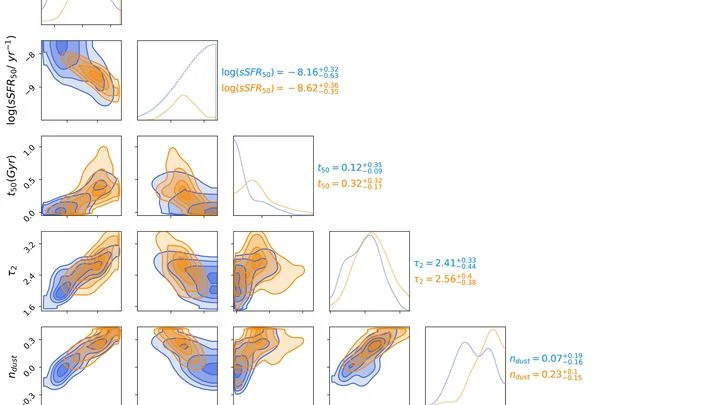
Light from a distant galaxy reaches us through its own dust. This dust is not a smooth haze but ragged clouds, like wisps of cotton. Old models treated it as a uniform mist, and then the galaxy didn't add up energetically: too much light disappeared in the ultraviolet and too little came back in the infrared.
Astronomers did what a cook does when they dice a potato instead of tossing it in whole.
Cosmologists are facing a curious situation: two reliable tools draw slightly different maps of the same universe. One tool is the map of ancient light (the cosmic microwave background), and the other is the map of galaxy distribution. They broadly agree, but in details they diverge.
In the deep field of JWST, among thousands of galaxies, astronomers zoomed in on the source JADES-GS 209777 – and saw a cosmic chick. Its "shell" is a thick cocoon of gas and cosmic dust that long hid the growing black hole at its center. But at a redshift of 3,711 (1,8 billion years after the Big Bang), the shell began to crack.
In the early universe, just a few hundred million years after the Big Bang, astronomers see strange objects — little red dots. They are compact, red, and in their spectra, broad Balmer lines scream the presence of supermassive black holes. But how did the hole manage to accumulate millions of solar masses in such a short time?
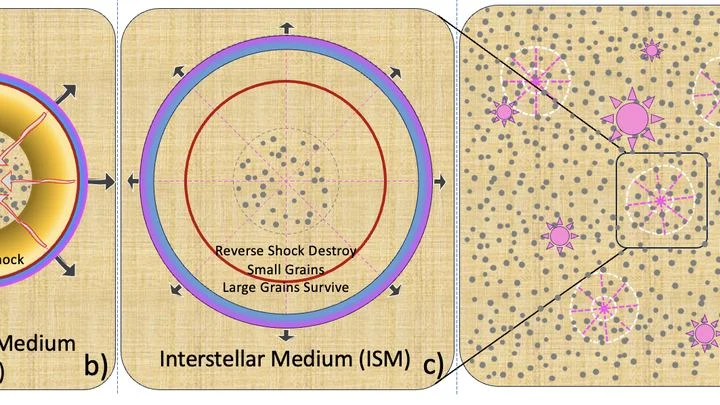
Two cities endure a series of fires. In one, the wind carries ash far beyond the outskirts, leaving the sky clear. In the other, ash settles as a dense veil, painting sunsets crimson. Roughly the same thing, just on a galactic scale, happens with supernova explosions, the final flares of massive stars.
Ten billion years ago, the universe was speckled with strange crimson sparks. The JWST spotted them in images at distant redshifts — compact sources blazing like entire galaxies yet no larger than a tiny central region. Astronomers nicknamed them “little red dots.” Their nature long defied explanation.
The mystery of the radius valley — a sharp drop in the number of exoplanets with radii ~1.8 Earth — haunts astronomers. JWST, transit surveys like Kepler and TESS draw a clear gap: rocky super-Earths and gaseous sub-Neptunes are separated by almost a chasm.
When JWST peered into the young universe at redshifts of 6–10, it revealed a scattering of mysterious 'little red dots' (LRDs). These objects combined features of galaxies and active nuclei, but their spectra refused to fit into familiar patterns.
In the boundless night of space, galaxies come together in a slow gravitational dance, merging into one. Such collisions are not head-on impacts but rather like fingers moving slowly through water, leaving swirls and tails behind.
Type Ia supernovae are the final, blinding chords in the symphony of stellar evolution: when a white dwarf crosses the limit predicted by Chandrasekhar, it explodes so brightly that for a moment it outshines an entire galaxy.
When the James Webb Space Telescope turned its gaze deep into time, astronomers expected to see familiar galaxies. Instead, the images were dotted with a scattering of bright, incredibly compact red dots.
The James Webb space telescope peered into an era when the Universe was less than a billion years old and discovered hundreds of strange objects there. Tiny yet dazzlingly bright, they glowed a deep red — like burning coals scattered across the black velvet of space.
Images from the James Webb Space Telescope have revealed unexpectedly intense light from the first galaxies — colossal star systems that formed shortly after the Big Bang. Imagine a toaster browning a slice of bread in a minute, while an oven takes an hour to bake a loaf — the result is essentially the same.
Among the precious scatterings of the early Universe captured by James Webb, there are objects that resemble ruby beads scattered on black velvet. These are the 'little red dots' (LRDs) — compact sources with steep red spectra, inside which lurk supermassive black holes up to a hundred million solar masses.
A street where houses have just been built. Some shine with clean windows, others are covered in construction dust. That's roughly what galaxies looked like when the universe was only a few hundred million years old. The new James Webb telescope peered into that era and saw dozens of bright star islands.
A distant galaxy always looks redder than it really is. That's the work of cosmic dust — tiny solid particles that scatter blue light more than red, like haze at sunset. Astronomers measured this effect for tens of thousands of galaxies using two powerful instruments.
Two stars circle each other like dancers in a slow waltz. This dance is not eternal: the partners gradually draw closer until they collide and merge into a single entity. At that very moment, a red nova is born — a flash that lights up the sky for a few weeks, then slowly fades, enveloped in a dense cloud of dust.
The JWST telescope has spotted a multitude of bright galaxies in the young universe. Their ultraviolet light was barely absorbed by cosmic dust — defying previous expectations.
Two lamps in a shop window: one glows with a cool, bluish light, the other a bit warmer and yellower. That's roughly how the two types of supernovae, Ib and Ic, look when astronomers view them through a telescope.
Edwin Hubble and Georges Lemaître discovered the expansion of the Universe nearly a century ago. One way to test it is the surface brightness test: in an expanding cosmos, the light of a distant galaxy should fade like a pattern on a stretching film.
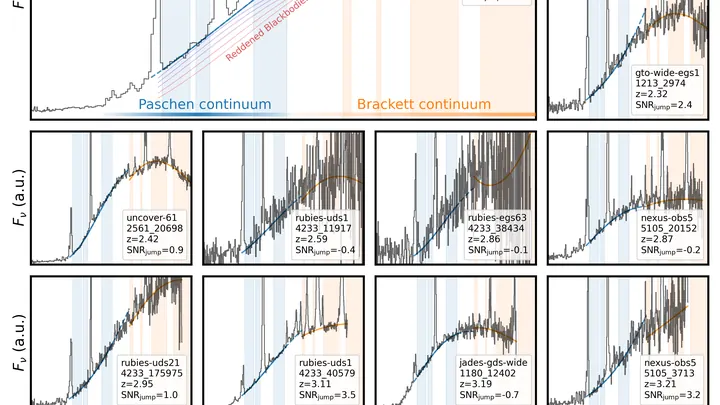
In the vast cosmic web, the James Webb Space Telescope spotted something unusual — tiny but bright red sparks that astronomers have nicknamed 'little red dots.' They shine as if an invisible fire is raging inside: their spectrum looks like a letter V, and the hydrogen lines are broadened, as if someone smeared paint across a canvas.
In a disk of gas and dust around a young star, dust particles behave like sand grains in a stream of water: the gas flows faster, the dust lags behind, and friction arises between them. This friction can rock the magnetic waves that run through the disk. The galaxy is full of such disks: it is precisely in them that planets are born.
Out in the distant cosmos, there are galaxies that astronomers have nicknamed 'little red dots': in images they appear as tiny reddish specks, even though they are mind-bogglingly far away. Their light looks red not because they are cold, but because the expanding universe stretches light waves.
Light from a distant star cuts through dust like a flashlight beam through fog. Dust holds back blue rays more than red ones, making the star appear redder than it really is. From this reddening, astronomers gauge how much dust lies in the light's path.
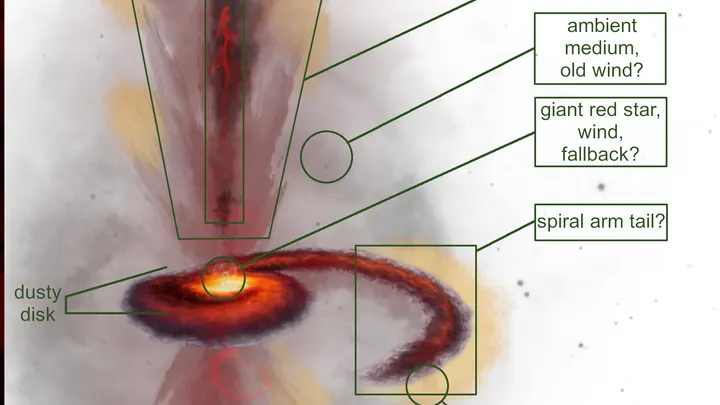
A flashlight wrapped with red tape on its sides shines white straight ahead and reddish from the side. Active galactic nuclei work the same way: at the center, a supermassive black hole is surrounded by a disk of hot gas and cosmic dust. Dust accumulates in the plane of the disk. Looking from above, we see a bright blue glow.
Long before stars appeared, the universe was filled with cold hydrogen. This gas can 'sing'—emitting radio waves with a wavelength of 21 centimeters. When the first stars and galaxies ignited, their ultraviolet light began to strip electrons from hydrogen atoms, turning neutral gas into ionized gas.
A distant red object usually means one thing: we're seeing a dust veil over a scorching disk falling into a black hole. But when the James Webb split its light into shades, a shadow appeared inside — just like steam from boiling water intercepts rays.
The cosmic microwave background is a faint glow left over from the Big Bang, like the cooling embers of a campfire. It encodes gravitational waves that may have arisen in the first fractions of a second, when the universe inflated faster than light.
When an X-ray burst erupts on a neutron star, its atmosphere heats up to millions of degrees. The light we catch with telescopes passes through this dense layer of gas, and gets dramatically altered along the way. The spectrum no longer looks like that of an ideal radiator: some colors get amplified, others dim.
Light from a streetlamp passing through blinds flickers: the stripes shift, and brightness rises and falls. From that rhythm, you can guess how wide the lamp is. The new method for measuring stars works similarly: instead of capturing a sharp image, astronomers monitor the "twinkling" of light collected by two or more telescopes simultaneously.
The James Webb telescope peered into the early universe and saw a multitude of mysterious red dots. Their glow didn't resemble familiar galaxies or stars. The answer was unexpected: these are growing black holes, born without a stellar stage.
A red giant is like a balloon slowly letting out gas. The star swells, its outer layers weaken, and stellar wind carries mass into space. But exactly how much does a star lose? This is a crucial question: the answer determines what kind of remnant it will leave behind — a white dwarf, a neutron star, or a black hole.
Astronomers pointed the James Webb at three galaxies whose light traveled 12 billion years. Early data pointed to incredibly fast growth — like an infant reaching adult height in just a year, clashing with the expansion of the Universe.
Light from distant galaxies carries a hidden recipe — a color barcode revealing the elements inside. For decades, astronomers used familiar tricks to decode it, but the James Webb Space Telescope shows these tricks fail for the earliest galaxies.
Thanks to gravitational lens — an effect predicted by Fritz Zwicky, where a galaxy cluster acts like a magnifying glass — the James Webb Space Telescope spotted two red dots in a galaxy 800 million years after the Big Bang.
Some stars fizzle out like a dud firework: instead of a bright blast, just a cloud of smoke. Usually, a massive star ends with a supernova explosion, leaving a black hole. But sometimes there's no bang: the star collapses straight into a black hole, almost unnoticed.
The James Webb telescope spotted “red dots” in the early Universe — dense objects tens of light-years across. Spectroscopic analysis of their light revealed the hue of hydrogen. Yet in X-rays they are nearly invisible, like a powerful spotlight wrapped in layers of gas curtains.
Two houses with identical facades but different interior layouts: from the outside the V-shaped spectrum looks the same, but inside there are different light sources and different amounts of dust. That is exactly how the two populations of distant galaxies that astronomers have long confused appear.