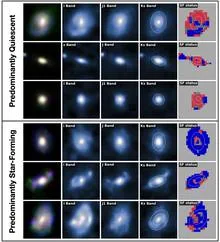
A quiescent galaxy is a galaxy that has essentially stopped forming new stars. In the local universe, these galaxies appear as dim, red collections of old stars, in stark contrast to the bright, blue, star-forming spiral galaxies like our Milky Way. The red color comes from the fact that the most massive, blue, short-lived stars have all died out, leaving behind only the cooler, redder, longer-lived stars. The study of quiescent galaxies is a major part of understanding galaxy evolution, as it addresses the fundamental question of why and how galaxies 'turn off' their star formation.
History
The concept of quiescent galaxies has been central to galaxy evolution studies since the late 20th century, with the development of large galaxy surveys that could classify galaxies by their colors and spectral features. The term 'quiescent' became standard in the 2000s as a more precise alternative to 'passive' or 'red and dead'.
How it works
Star formation in a galaxy requires cold, dense gas clouds that can collapse under their own gravity. A galaxy becomes quiescent when it loses or heats up its supply of cold gas. This can happen through various processes, such as the shockwaves from supernovae or active galactic nuclei blowing the gas out of the galaxy, or the gas being stripped away by interactions with other galaxies. Once the cold gas is gone or too hot to collapse, no new stars can form, and the galaxy's stellar population ages and reddens over time.
In practice
Quiescent galaxies serve as cosmic clocks: by measuring the ages of their oldest stars, astronomers can constrain the timing of when star formation ceased, providing crucial tests for models of galaxy formation and the role of feedback from supermassive black holes.
Fun fact
Some 'quiescent' galaxies have been found to contain significant reservoirs of cold gas, meaning they are not permanently 'dead' but could potentially reignite star formation in the future.
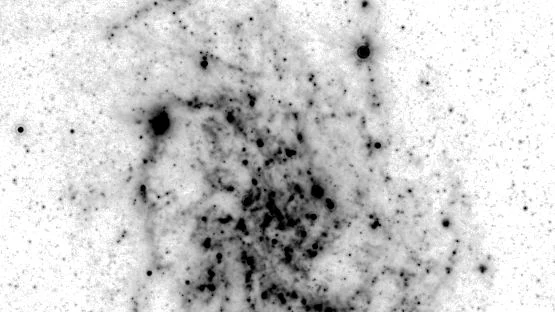
A ground-based image of a distant galaxy looks like a view through frosted glass: the atmosphere smears details, hiding the internal structure. Astronomers have long wanted to know where exactly star formation shuts off in galaxies, but ground-based telescopes could not resolve the subtle color gradients.
An old city gains new suburbs. In the center, narrow streets where life has nearly stopped, while on the outskirts construction is booming. That is what a spiral galaxy looks like when its core stars have long aged and new stars are still being born in the outer disk.
Around every galaxy lies an invisible corona of cold gas. It extends far beyond the stellar disk and serves both as a fuel depot for new stars and as a graveyard for ejected material.
Think of a merry-go-round: the farther you sit from the center, the faster you're carried around. For a long time, astronomers assumed galaxies work the same way — stars at the edges should orbit more slowly than those near the center. But back in the 1970s, it turned out that in many spiral galaxies, the speed of stars barely drops with distance from the center.
In the deep field of JWST, among thousands of galaxies, astronomers zoomed in on the source JADES-GS 209777 – and saw a cosmic chick. Its "shell" is a thick cocoon of gas and cosmic dust that long hid the growing black hole at its center. But at a redshift of 3,711 (1,8 billion years after the Big Bang), the shell began to crack.
In the early universe, just a few hundred million years after the Big Bang, astronomers see strange objects — little red dots. They are compact, red, and in their spectra, broad Balmer lines scream the presence of supermassive black holes. But how did the hole manage to accumulate millions of solar masses in such a short time?
Two cities endure a series of fires. In one, the wind carries ash far beyond the outskirts, leaving the sky clear. In the other, ash settles as a dense veil, painting sunsets crimson. Roughly the same thing, just on a galactic scale, happens with supernova explosions, the final flares of massive stars.
The standard cosmological model ΛCDM, where dark matter and dark energy act as the chief architects of the cosmos, has predicted astronomical data with Swiss-watch precision for decades. Its foundation was laid by three geniuses.
Civilizations in the Universe are separated not just by distance, but by the vast gulf of time. Hunting for their traces is like archaeology: instead of palace ruins, we find clouds of cosmic dust.
When the James Webb Space Telescope turned its gaze deep into time, astronomers expected to see familiar galaxies. Instead, the images were dotted with a scattering of bright, incredibly compact red dots.
The James Webb space telescope peered into an era when the Universe was less than a billion years old and discovered hundreds of strange objects there. Tiny yet dazzlingly bright, they glowed a deep red — like burning coals scattered across the black velvet of space.
The first two billion years after the Big Bang were an era when the universe resembled a boiling construction pit. Dark matter clumped the gas together, igniting the first stars. It seemed there simply wasn't enough time to assemble massive elliptical galaxies—'dormant' stellar metropolises — from this raw material.
Images from the James Webb Space Telescope have revealed unexpectedly intense light from the first galaxies — colossal star systems that formed shortly after the Big Bang. Imagine a toaster browning a slice of bread in a minute, while an oven takes an hour to bake a loaf — the result is essentially the same.
Among the precious scatterings of the early Universe captured by James Webb, there are objects that resemble ruby beads scattered on black velvet. These are the 'little red dots' (LRDs) — compact sources with steep red spectra, inside which lurk supermassive black holes up to a hundred million solar masses.
A street where houses have just been built. Some shine with clean windows, others are covered in construction dust. That's roughly what galaxies looked like when the universe was only a few hundred million years old. The new James Webb telescope peered into that era and saw dozens of bright star islands.
Two stars circle each other like dancers in a slow waltz. This dance is not eternal: the partners gradually draw closer until they collide and merge into a single entity. At that very moment, a red nova is born — a flash that lights up the sky for a few weeks, then slowly fades, enveloped in a dense cloud of dust.
The JWST telescope has spotted a multitude of bright galaxies in the young universe. Their ultraviolet light was barely absorbed by cosmic dust — defying previous expectations.
Two lamps in a shop window: one glows with a cool, bluish light, the other a bit warmer and yellower. That's roughly how the two types of supernovae, Ib and Ic, look when astronomers view them through a telescope.
Edwin Hubble and Georges Lemaître discovered the expansion of the Universe nearly a century ago. One way to test it is the surface brightness test: in an expanding cosmos, the light of a distant galaxy should fade like a pattern on a stretching film.
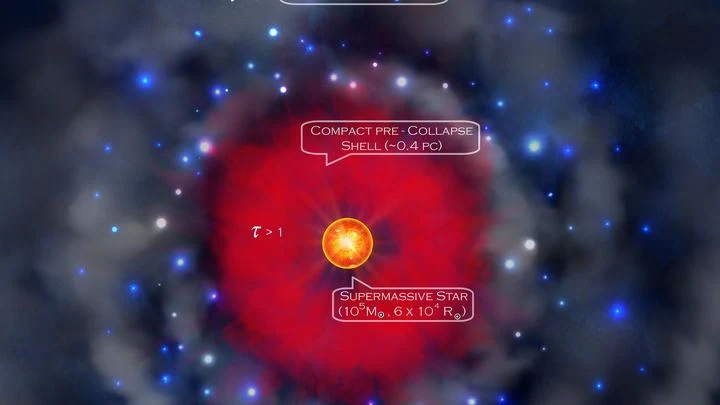
A star weighing a hundred thousand Suns lives bright and brief. Its finale is a rapid collapse into a black hole. But just before the end, it manages to wrap itself in a dense gas cocoon.
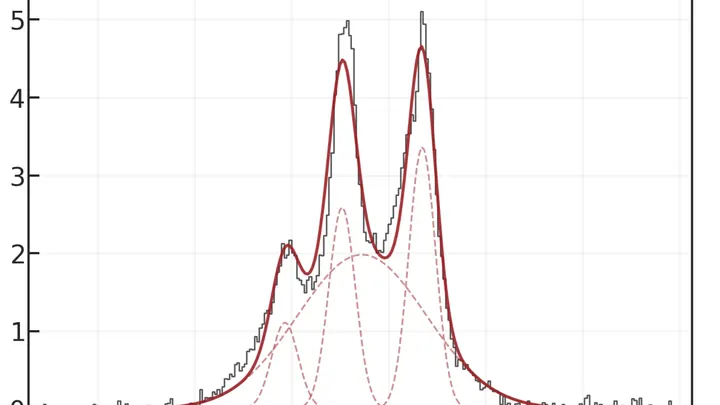
In the vast cosmic web, the James Webb Space Telescope spotted something unusual — tiny but bright red sparks that astronomers have nicknamed 'little red dots.' They shine as if an invisible fire is raging inside: their spectrum looks like a letter V, and the hydrogen lines are broadened, as if someone smeared paint across a canvas.
On a playground, a merry-go-round has just been set spinning. In the first moments, kids are still crowding, grabbing the rails, and the overall picture is chaos. But a couple of seconds later, centrifugal force lines them up in a circle, giving the motion a clear shape.
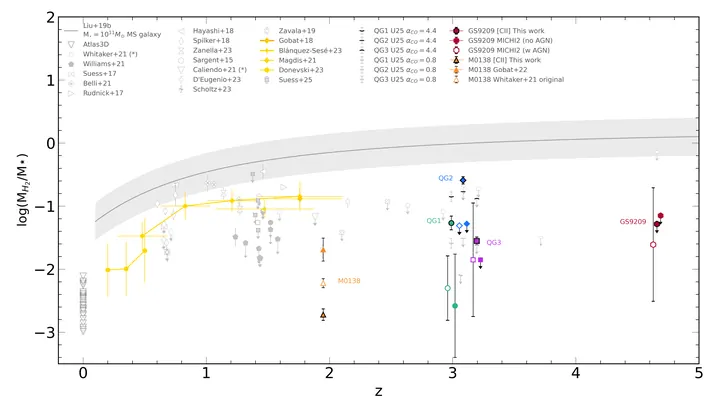
Five galaxies that long ago stopped igniting new stars look like houses with darkened windows. But the ALMA radio telescope and the James Webb Space Telescope peered inside and saw that in these 'sleeping' houses, a fire still smolders.
In the first few hundred million years after the Big Bang, the cosmos was like a noisy teen club: galaxies flared up, collided, and churned out stars by the hundreds.
The night sky looks still, but many stars tremble like a drum after a strike. For seven straight years, the TESS satellite stared at the same patches of sky and caught this trembling in 19,151 red giants — old, bloated stars. Previously, far fewer of these 'singing' giants were known, and now the list has grown by 80%.
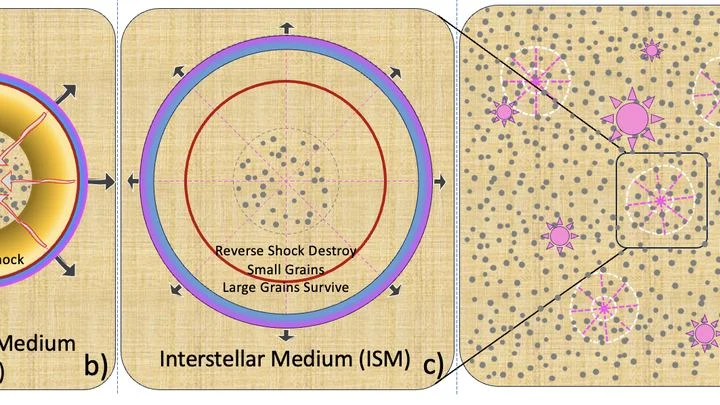
Light from distant stars, as it travels through cosmic dust, loses some of its energy. Dust grains absorb and scatter light, and the way they do so at different wavelengths reveals their composition and size. Astronomers call this the dust extinction curve.
The mystery of how black holes grew so fast in the early Universe might be solved by quasi-stars. These are giant gas cocoons with a black hole tucked inside. Matter falling into the hole heats up and blasts out so much light that it prevents the cocoon from collapsing. Such an object weighs thousands of Suns and outshines an entire galaxy.
If you build a giant blanket around a star, you get a Dyson sphere. It absorbs all the radiation and glows in invisible heat rays. No such sphere has been seen yet, but astronomers know: to find it, look for this thermal glow.
Deep in the constellation Ophiuchus lies the galaxy NGC 6447. Until recently, it was quiet and unremarkable, like a house with its windows dark. But over the past 14 years, something has ignited at its center, and now it's visible in infrared light.
In 2015, astronomers were examining the Coma galaxy cluster and noticed something odd: huge, almost invisible "fluff balls." These galaxies are as large as our Milky Way but shine hundreds of times fainter.
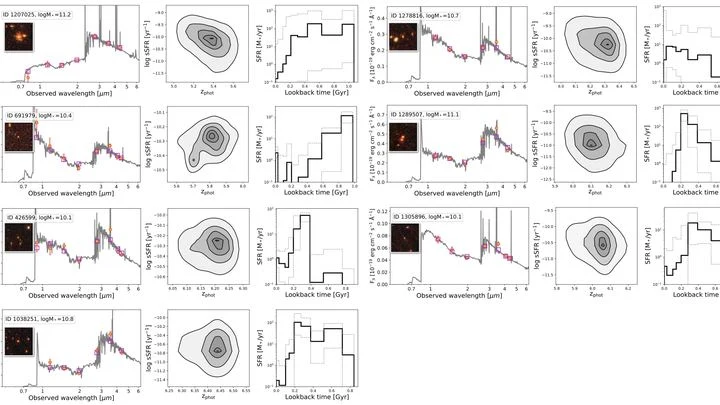
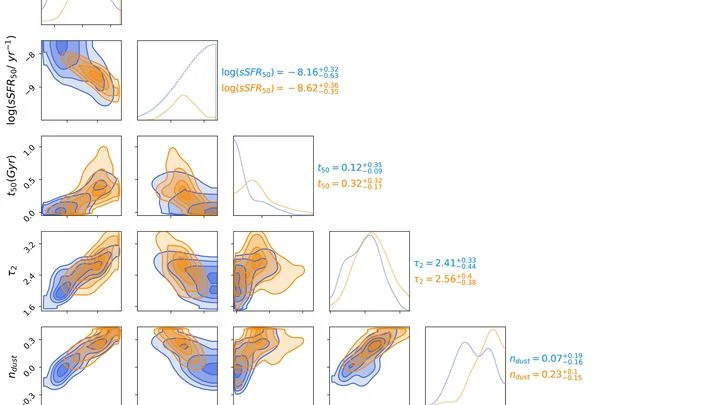
A galaxy is like a city where no new houses are being built. Stars are no longer born there, and the old buildings tell you when construction was bustling. Astronomers peered into 14 such 'ghost towns' on the edge of the visible universe: their light has been traveling to us for 11–12 billion years.
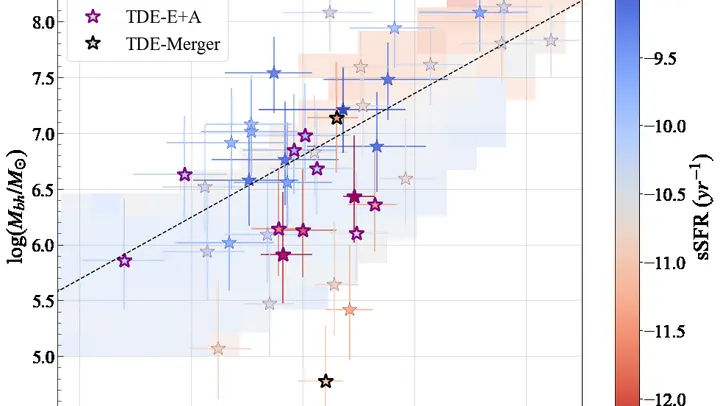
You can't see a black hole until a star wanders too close. Then tidal forces stretch the star like a cook rolling out dough, and some of the material falls into the hole, flaring up as a final goodbye. Such events, called tidal disruptions, are a rare chance to weigh a black hole that would otherwise remain invisible.
The James Webb telescope peered into the early universe and saw a multitude of mysterious red dots. Their glow didn't resemble familiar galaxies or stars. The answer was unexpected: these are growing black holes, born without a stellar stage.
A red giant is like a balloon slowly letting out gas. The star swells, its outer layers weaken, and stellar wind carries mass into space. But exactly how much does a star lose? This is a crucial question: the answer determines what kind of remnant it will leave behind — a white dwarf, a neutron star, or a black hole.
Astronomers pointed the James Webb at three galaxies whose light traveled 12 billion years. Early data pointed to incredibly fast growth — like an infant reaching adult height in just a year, clashing with the expansion of the Universe.
Thanks to gravitational lens — an effect predicted by Fritz Zwicky, where a galaxy cluster acts like a magnifying glass — the James Webb Space Telescope spotted two red dots in a galaxy 800 million years after the Big Bang.
The night sky seems full of stars, but between them lurk clouds of gas where not a single star has ever ignited. Such objects are called dark galaxies: they contain enough gas, but it is too diffuse and cold to collapse into stars.
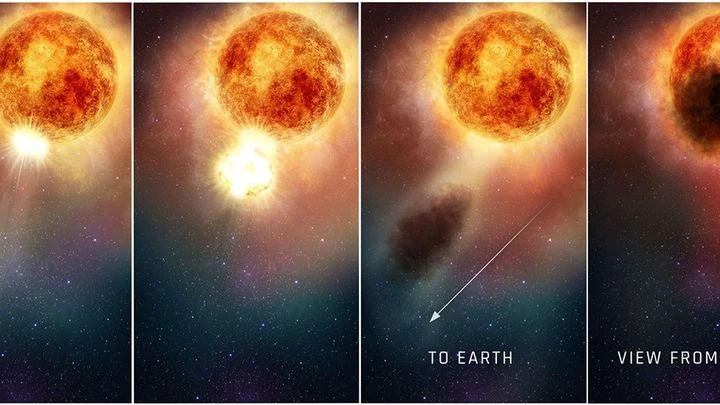
In 2019, Betelgeuse suddenly dimmed, sparking rumors of an imminent explosion. But clouds of cosmic dust turned out to be the culprit. Now, the Gemini North telescope has discerned a minuscule companion star in its dazzling glare, just as calculations had predicted.
The James Webb Space Telescope looked back to a time when the universe, just after the Big Bang, was only a billion years old, and found the 'Sleepy' galaxy. Unlike its neighbors, which shone with young stars, it looked tired and dim.
The James Webb Space Telescope has spotted a scattering of compact objects in the early universe, nicknamed 'little red dots.' They are too red and too dim to be ordinary quasars, and astrophysicists are scratching their heads over what powers them.