The brown dwarf desert is a striking observational pattern: very few brown dwarfs are found in close orbits around Sun-like stars, even though brown dwarfs themselves are not rare. Brown dwarfs are 'failed stars' — objects too massive to be planets but too light to sustain hydrogen fusion in their cores. Surveys have found plenty of them floating freely in space or orbiting at large distances, but within a region roughly equivalent to the orbit of Mercury or closer, they are almost absent. This scarcity is so pronounced that astronomers call it a 'desert'.
History
The term 'brown dwarf desert' was coined in the late 1990s by astronomers analyzing the first radial-velocity surveys for extrasolar planets, which found a sharp drop in the number of brown dwarf companions at orbital distances smaller than a few astronomical units.
How it works
The desert is thought to be carved out by orbital dynamics and formation processes. In the leading scenario, a brown dwarf forming close to its host star would migrate inward due to interactions with the protoplanetary disk, but tidal forces from the star would then either tear it apart or cause it to spiral into the star before it can settle into a stable close orbit. Alternatively, close-in brown dwarfs may be ejected by gravitational interactions with giant planets or other companions, leaving the inner region empty. The exact balance of these mechanisms is still debated, but the observed gap is a strong constraint on models of star and planet formation.
In practice
The brown dwarf desert helps astronomers refine models of how planetary systems form and evolve, and it guides the design of exoplanet surveys by predicting where brown dwarfs are unlikely to be found.
Fun fact
The Gaia space telescope recently mapped the brown dwarf desert in three dimensions, revealing that the desert is not completely empty but contains a sparse population of brown dwarfs in eccentric orbits that occasionally dip close to their stars.
A million orbits: the same score. Nine dark matter halos: nine orchestras without a conductor. All musicians play from the same notes, but in each hall the music sounds different: sometimes in tune, sometimes out of sync. Likewise, satellite galaxies falling into a host halo follow orbits that depend not only on mass but also on the shape of the invisible stage.
A stone thrown into water quickly loses speed. A meteor entering the atmosphere should behave the same way: air slows it down, and friction burns up its material. But cameras of the Global Fireball Observatory network have captured hundreds of bright fireballs over ten years that streak across the sky with almost no deceleration.
A distant light in the fog looks tiny and reddish: you'd think it's miles away. But then the light shifts sideways, and it becomes clear: it's a cyclist twenty steps away, just with a nearly dead rear light. That's how, in 2025, astronomers stumbled upon 'Capotauro'—a compact red source in images from the James Webb Space Telescope.
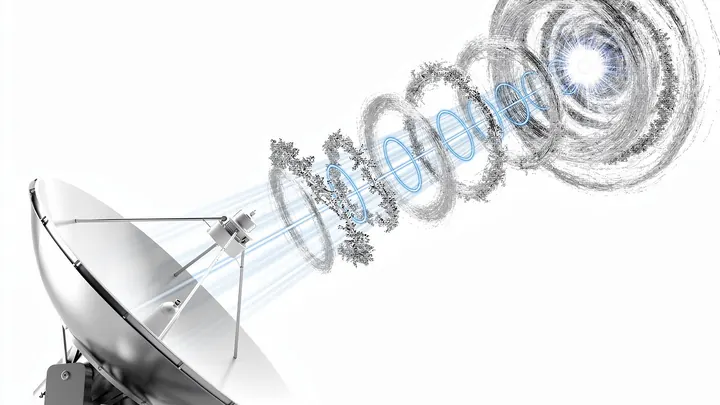
A fast radio burst is a short but powerful flash of radio waves from deep space. As it travels to us, the signal passes through clouds of tenuous gas, and the more gas it encounters, the more the signal is smeared across frequencies. Astronomers call this delay the dispersion measure — essentially, it's a "weighing" of all the matter along the line of sight.
A star's radius drops by a thousand kilometers. Not because its mass increased, but because its own magnetic field squeezed the crust like an invisible corset.
Tabby's Star, a beacon in the cosmic sea, has baffled astronomers since 2015. Its light flickered not in the rhythm of planets, but as if scattered by a storm — deep dips, sharp spikes. But amid this chaos, a smooth, nearly perfect dip was found. The eye of the storm.
Dark matter remains the inaudible bass line of the cosmic symphony — it emits no light, but its gravitational pull shapes galaxies. Vera Rubin first caught this rhythm in the 1970s by observing the rotation of stars.
A quarter-century ago, Michel Mayor and Didier Queloz discovered the first hot Jupiter, and shattered all the rules of planet formation. A gas giant on a days-long orbit couldn't have formed next to the star: it's far too hot and lacks building material. So, it must have been born far away and then migrated.
The Moon is an airless sphere of dense rocky grit called regolith. When fast particles from space slam into it, muons are born in the soil — unstable relatives of electrons, but two hundred times heavier. Most fly downward and fade away in the depths. But those that pop upward into the vacuum can travel tens of kilometers before decaying.
The gravitational dances of celestial bodies long remained silent to astronomers. We learned to catch the shadows of planets against stars with the transit method — a breakthrough that delivered thousands of worlds thanks to William Borucki and his Kepler telescope.
In 2007, astronomers heard a mysterious millisecond click from space — that's how fast radio bursts, or FRBs, were discovered. Since then, they've become a cosmic-scale detective story: as bright as an entire galaxy and compressed into an instant, these signals race through the Universe at the speed of light.
Think of a merry-go-round: it's easier to spin a light one, harder to spin a heavy one. Neutron stars, the ultra-dense remnants of exploded stars, behave in a similar way. Astronomers looked at fifty binary systems where one neutron star orbits another and noticed: the heavier the star, the longer its spin period. The link isn't strict, but it's statistically noticeable.
A pebble drops into a night lake, and ripples spread across the water. You can't see the pebble itself, but the ripples give it away. Astronomers use a similar trick when hunting for dark bodies in space: these objects betray themselves by the way they warp the light of distant stars.
Some 158 light-years away, around the dim star TOI-6894, a red dwarf, a planet moves leisurely. Its year lasts less than two Earth days, yet it is a cool world with an equilibrium temperature around 420 K, just a bit warmer than a sauna.
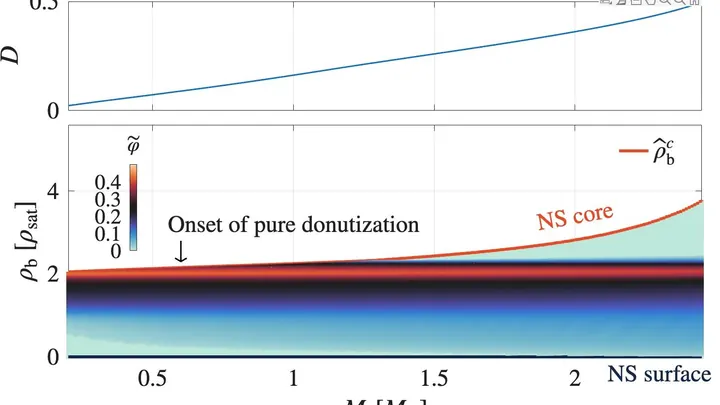
Neutron stars are cosmic 'ice cubes' of unimaginable density: a tablespoon of their material would outweigh Mount Everest. It was a mystery what lay in their cores: ordinary neutron matter (a giant atomic nucleus) or exotic quark matter, where particles are not bound into neutrons.
Heir to the ideas of Edwin Hubble, the James Webb Space Telescope has peered back to an era when the expansion of the universe was still picking up speed. At redshifts z>4, it spotted bizarre objects—"Little Red Dots" (LRDs).
Picture a tightrope walker balancing over an abyss. Every step changes the rope's tension, and the slightest shift in center of gravity can prove fatal. That's roughly what the dance of an ordinary sun-like star around a black hole of ten solar masses looks like when the orbit is highly elongated.
Galaxies without dark matter are like beads from which the invisible thread has been ripped. Stretching around the elliptical NGC 1052 is a chain of eight ghostly dim dwarfs: they contain almost none of the mysterious mass that makes spiral arms rotate. Vera Rubin first showed that without the invisible framework, stars would fly apart.
When the James Webb Space Telescope turned its gaze deep into time, astronomers expected to see familiar galaxies. Instead, the images were dotted with a scattering of bright, incredibly compact red dots.
Among the precious scatterings of the early Universe captured by James Webb, there are objects that resemble ruby beads scattered on black velvet. These are the 'little red dots' (LRDs) — compact sources with steep red spectra, inside which lurk supermassive black holes up to a hundred million solar masses.
Among the hundreds of moons in the Solar System, Nereid dances the most desperate dance: diving toward Neptune as close as 1.4 million kilometers, then soaring away to 9.7 million — all within less than an Earth year. An eccentricity of 0.75 — the brand of a captured wanderer.
Neutron stars are super-dense spheres of the remnants of exploded stars. Some of them we see as pulsars — cosmic lighthouses sending out radio bursts. What's inside them long remained a mystery. Physicists assumed that hidden fields could affect their structure, but it was believed that if the field is short-range, its effect is negligible.
For a long time, a void yawned in the family of ultra-dense remnants of dead stars. Neutron stars, swift city-sized tops, rarely weigh more than two Suns. Black holes start at about five solar masses. Between them lies a 'gap' where for decades no object could be found.
A handful of sand weighing as much as a small mountain: that's roughly what strangelets are like: tiny clumps of 'strange' quark matter where particles are squeezed to unimaginable densities. In a new study, astrophysicists tested whether such objects could exist in nature and what they would look like.
In 2017, detectors picked up a tremor in space — gravitational waves from the merger of two neutron stars. At the same moment, telescopes saw a flash. For the first time, one event spoke in two languages at once: light and gravity.
The Universe is structured like a sponge: there are dense regions packed with galaxies and gas, and giant pores — cosmic voids. These voids occupy most of space, but their contents have remained a mystery because matter there barely reveals itself.
Now astronomers have 'felt' the voids using fast radio bursts — super-powerful pulses from distant galaxies.
In the vast cosmic web, the James Webb Space Telescope spotted something unusual — tiny but bright red sparks that astronomers have nicknamed 'little red dots.' They shine as if an invisible fire is raging inside: their spectrum looks like a letter V, and the hydrogen lines are broadened, as if someone smeared paint across a canvas.
In the open cluster Trumpler 5, where hundreds of stars move together, one star behaves like a teenager among elders. It pulsates — expanding and contracting, changing brightness every few hours.
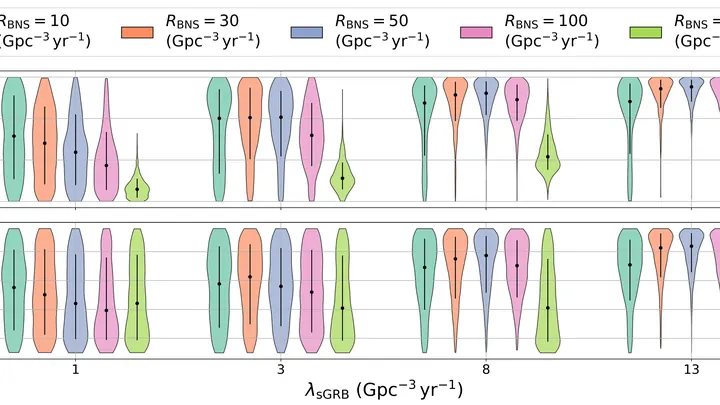
Two neutron stars collide, and the space around them ripples like the surface of a pond after a stone is thrown. Huge gravitational wave detectors catch these ripples. If the collision also launches a narrow beam of gamma rays, space telescopes see it as a short gamma-ray burst.
A pulsar is a dead star spinning at breakneck speed, sending out radio pulses like a lighthouse. But for PSR J1928+1815, the signal sometimes cuts out for 3.6 hours. Something is blocking the beacon. A companion star orbits the pulsar, and its shadow falls on us.
There are faint points in the sky that slowly crawl among the stars. They are cooler than embers in a fireplace and smaller than the Sun: these are brown dwarfs. There are so many of them that astronomers can't keep up with reviewing all the images. That's when volunteers stepped in: ordinary people examined pictures from the telescope and flagged moving objects.
Two faint embers circle each other in the dark so closely that one begins to tear glowing chunks off the other. That is the picture of the system ZTF J1239+8347, caught by the Zwicky Transient Facility telescope.
Globular clusters are dense stellar archives, where the youth of the Galaxy is recorded. But reading this chronicle was hindered by imprecise chronometers: age estimates diverged by a billion years.
GJ 504, a star almost the same age as our Sun, is spinning with remarkable vigor: it completes a full rotation in just 3.4 Earth days, while actively emitting X-rays. For comparison, typical stars of the Sun's age rotate much more slowly, as if they've lost their youthful energy. GJ 504, however, behaves like a figure skater who has received a powerful push and launched into a rapid spin.
Two spotlights placed side by side: from a distance, their light blends into one patch, and it seems there's a single source. The same happens in space: about 10–20% of faint stars are actually close pairs of identical stars. Individually, they can't be resolved, but together they shine noticeably brighter than a single star with the same parameters.
Earth is like dough mixed to a precise recipe: two parts water to one part land. Too much water, and the planet becomes a vast ocean where intelligence has nothing to grasp onto. Too much land, and water retreats deep, leaving a desert. Scientists put this culinary analogy to the test with statistics.
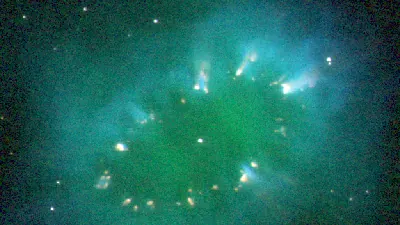
Deep in space, there's a cloud of gas that looks like a necklace with bright beads. This is the Necklace Nebula — the remains of a star that once swelled up and swallowed its neighbor. At the center, a pair remains: a small, hot star and its bloated companion, rich in carbon.
For ten hours, the star HD 137010 dimmed a little, like a lamp with a speck of dust on it. The K2 telescope caught this in 2017, and in all the observing time, it happened only once. Astronomers realized: a planet had passed in front of the star.
This way of finding worlds is called the transit method. When a planet crosses the star's disk, the star briefly fades.
A family moves into a cramped apartment in the city center. If the move was calm, relatives might have moved in with them. But if the family was evicted from their old home by a storm, they'll end up alone in the new place.
The cosmos is full of objects that lacked the mass to become stars. These 'failed stars'—brown dwarfs — resemble campfire embers that never ignited, just slowly smoldering and cooling.