Simple

Two Dust Grains Search for New Dimensions

Original: "Entanglement probes of gravitational Kaluza-Klein spectra: signal hierarchy and model discrimination"
· Yi Zhong, Tao-Tao Sui, Ke Yang
arXiv:2605.00749v1 · 2026-05-01 · CC BY · ⏱ 1 min · General Relativity
A simple experiment with two dust grains can detect traces of extra dimensions.
Abstract

Imagine: if extra dimensions exist at tiny scales, then gravity between particles would change slightly. Scientists proposed detecting this through quantum entanglement — as if we're hearing echoes from invisible walls. They compared three versions of such dimensions and showed that some are easier to spot than others. Could we soon be able to 'hear' extra dimensions?

Links in the knowledge graph 1

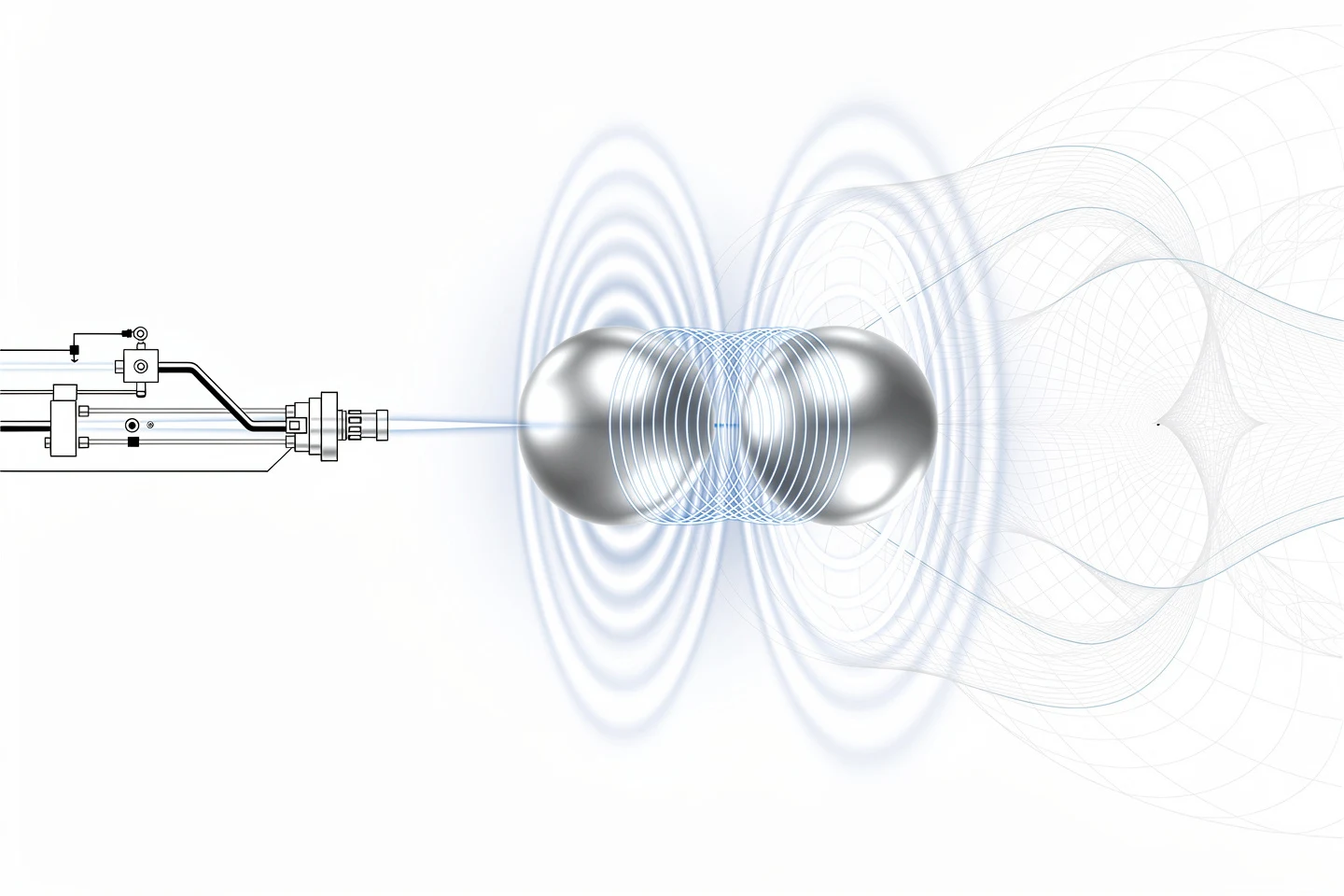
Two dust-sized particles, linked by quantum entanglement, are like a duo of musicians with perfect pitch. Their gravitational attraction is a shared rhythm, sensitive to any distortions. Hidden dimensions introduce a barely perceptible glitch into this rhythm.

To detect it, the particles are placed in a superposition — forced, like Schrödinger's cat, to be in two places at once. Their wave nature makes gravity behave differently than in the familiar world of Newton: a measurable phase shift appears. If string theory with its extra dimensions is correct, the shift will differ from what the Standard Model predicts. This bypasses the electrical noise that drowns out the signal in conventional experiments.

The main foe is decoherence, which destroys fragile quantum states. But even modest progress in combating it would open the door to laboratory studies of spacetime curvature — the very thing Einstein considered almost mystical. And if hidden dimensions were just a bit larger, we’d feel them every second: objects at close range would pull on each other like magnets.

🎯 If extra dimensions were slightly larger than predicted, gravity at short distances would become much stronger. Dropped keys wouldn't clatter—they'd literally stick to your palm.

🎬 The idea of hidden dimensions has inspired sci-fi creators: in the film 'Interstellar,' the hero enters a five-dimensional space and moves through time—a hint at how extra dimensions alter the laws of physics.

U(r) = U_N(r) \left[1 + \Delta(r)\right]
Gravitational potential with a correction from extra dimensions: even a tiny shift Δ(r) can alter the nature of interaction on microscopic scales.
\Phi(d) \simeq \frac{t}{\hbar} \frac{\Delta x^2}{d} U'(d)
Accumulated phase, proportional to the potential’s derivative and the square of the superposition size: a tiny spatial separation gets amplified over time, making the signal measurable.
Scientists
Erwin SchrödingerHugh Everett IIINiels BohrPascual JordanWerner HeisenbergStephen Hawking
Tags
string theory gravity quantum entanglement superposition Standard Model quantum measurement spacetime curvature wave-particle duality quantum decoherence
Laws
Schrödinger equationHeisenberg uncertainty principleHawking radiationNoether's theoremPlanck–Einstein relationde Broglie formula
Original: arXiv:2605.00749v1 · CC BY · bridge42worlds