Mass Entanglement Probes Hidden Dimensions ✛ ✎ ✦
Context
The hierarchy problem between the electroweak and Planck scales is a key motivator for searching for physics beyond the Standard Model. Models with extra dimensions, such as string theory and brane theory, predict deviations from the Newtonian potential at submillimeter distances, opening the possibility for experimental testing. However, classical torsion balances face electromagnetic noise, so methods based on quantum entanglement offer an alternative way to test gravity at small scales.
Methods
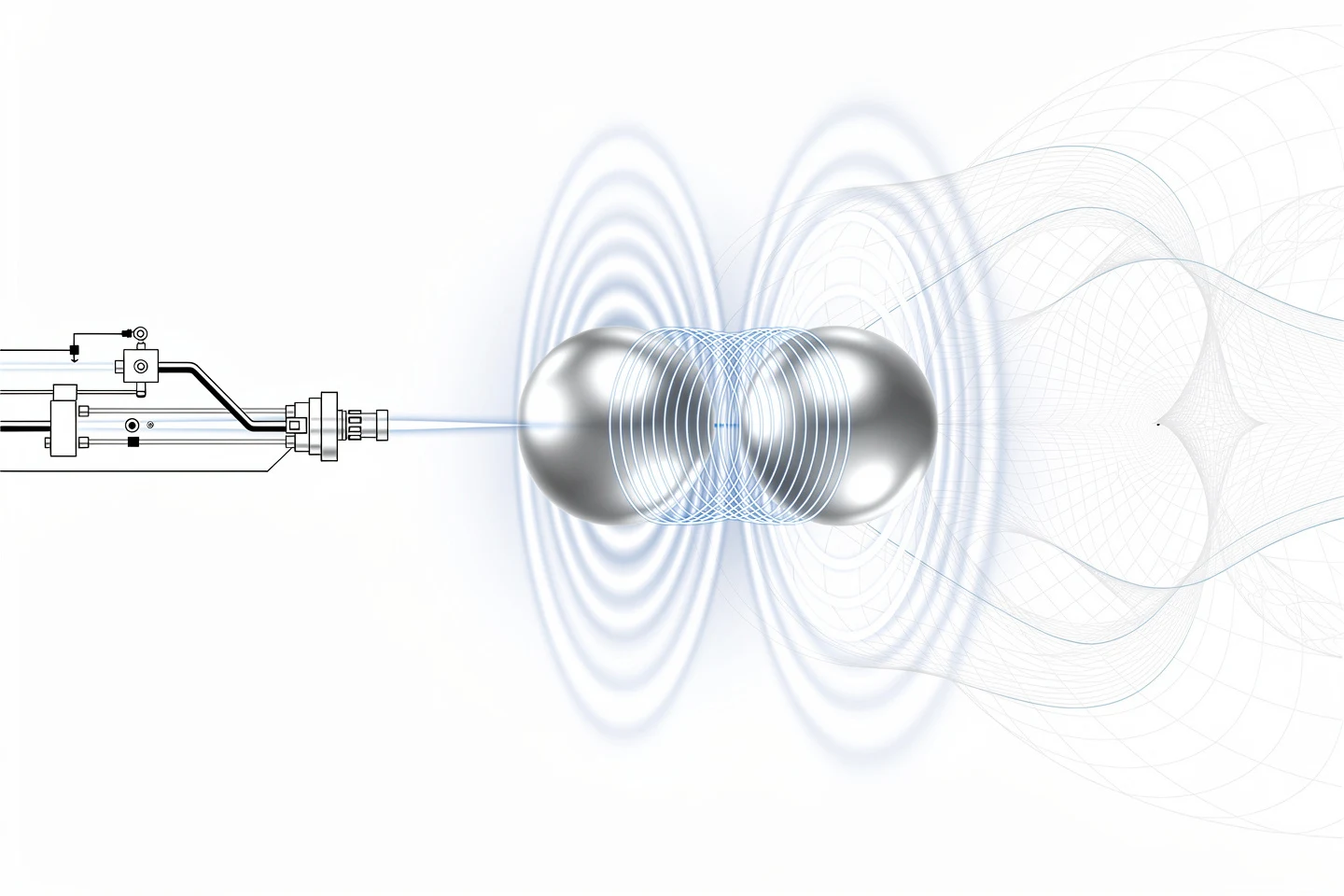
The researchers used a quantum-induced mass entanglement (QGEM) protocol, in which two identical bodies are placed in a spatial superposition of states with separated wave packets. Thanks to the wave nature of massive particles, their gravitational interaction creates a branch-dependent phase shift. Analytical expressions for the entangling phase and competition were derived and numerically evaluated for three representative Kaluza–Klein spectra with parameters consistent with current gravity tests. Conservative and optimistic configurations with masses on the order of $10^{-14}$ kg, superpositions of 10–15 µm, and interaction times of 0.1–0.3 s were considered.
Results
Over the entire scanned distance range of 40–80 µm, the relative phase shift exhibits a robust hierarchy: ADD > gapped continuum > RSII. For conservative parameters, the ADD signal exceeds the competition threshold (~0.01) at small distances, while the gapped continuum reaches it only at the edge of the window, and RSII remains below. In the optimistic scenario, all three models are confidently detected, with ADD entering the strong entanglement regime. The normalized phase response profile clearly separates RSII from the other two, but ADD and the gapped continuum can be nearly degenerate—the maximum difference in optimized residuals was only 0.38%.
Implications
This work demonstrates the potential of quantum entanglement to test gravitational theories at submillimeter scales. Unlike torsion balances, the interferometric method through the potential derivative enhances sensitivity to the interaction shape, paving the way for laboratory study of spacetime curvature in the quantum regime and testing predictions of string theory.
Future development
Future work will incorporate realistic geometries and noise budgets, including decoherence, for statistical discrimination between models. Extension to resonant Kaluza–Klein spectra may reveal unique crossover signatures in the phase response, turning tabletop quantum sensors into full-fledged tools for physics beyond the Standard Model.
Impact
The method will impact experimental gravity and quantum metrology, accelerating the development of compact interferometers for searching quantum gravity effects.
Next steps
The immediate task is detailed modeling of decoherence and optimization of electromagnetic background suppression to achieve the required phase sensitivity.
Key open problems
The study directly addresses the mass hierarchy problem and the quantum nature of gravity, a puzzle that preoccupied Albert Einstein. Detection of modifications to Newton's potential would confirm the existence of extra dimensions predicted by string theory.
The knowledge machine's view
This section is addressed to the author of the paper and their colleagues. Neighbouring works were found by meaning-based search across our archive, not by word overlap. We do not review: we show the field around the work.
What the work does
The paper proposes a protocol for quantum-induced entanglement of masses (QGEM) to test modifications of Newtonian gravity arising from extra dimensions. Analytical expressions for the entangling phase and concurrence are derived and numerically evaluated for three Kaluza–Klein scenarios (ADD, warped continuum, RSII) in both conservative and optimistic configurations. It is shown that the phase response allows distinguishing between models, although ADD and the warped continuum may be nearly degenerate.
Where its strength is
The strength of the work lies in the use of a phase-sensitive interferometric method that, through the derivative of the potential, enhances sensitivity to the shape of the gravitational interaction, providing an advantage over classical torsion balances and opening the way to testing theories with extra dimensions in laboratory conditions.
Where it could go next
- It may be interesting to compare the obtained constraints with predictions for the spectral properties of thick branes, where effects of extra dimensions also manifest in modifications of the gravitational potential at short distances.based on: The Spectral Butterfly Effect in Thick Branes arXiv:2604.23364
- Closely related is the analysis of potential disturbances in experiments searching for quantum gravity; accounting for such systematic effects could refine realistic detection thresholds for the proposed protocol.based on: Invisible Obstacles in the Hunt for Quantum Gravity arXiv:2604.22593
- It would be interesting to explore connections with approaches where extra dimensions are used to explain dark matter: perhaps similar signatures could be tested in an extended version of QGEM.based on: Dark Matter in Extra Dimensions arXiv:2606.23178
Worth trying
- Assess the impact of non-gravitational interactions (e.g., Casimir) on concurrence in configurations close to experimental ones.
- Investigate whether ADD and the warped continuum can be distinguished using the dependence of the phase on interaction time or superposition geometry.
- Consider using more masses or multipartite entangled states to amplify the signal from weak models.
Why this may matter
If the proposed method can be realized, it will provide a new tool for probing fundamental theories of gravity at scales inaccessible to classical experiments, and potentially allow distinguishing competing models of extra dimensions.
Nearby works in our archive
- The Spectral Butterfly Effect in Thick Branessimilarity 0.66
- Invisible Obstacles in the Hunt for Quantum Gravitysimilarity 0.66
- How Particle Knots Rewrite the Rules of Statisticssimilarity 0.66
- The Key to Quantum Gravity Lies in a Single Atomsimilarity 0.65
- Hunting Dark Matter with Qubitssimilarity 0.65
- Gravitational Waves to Put New Theory to the Testsimilarity 0.65
- Dark Matter in Extra Dimensionssimilarity 0.65
The closest work in the archive sits at 0.66 by meaning — the usual level for our corpus.
If the radii of extra dimensions were slightly larger, gravity at small distances would grow so fast that everyday objects would stick together — drop your keys, and you wouldn't hear a clang; they'd just cling to your hand.
The idea of hidden dimensions has inspired science fiction, for example in the film 'Interstellar,' where the hero uses a five-dimensional tesseract to move through time — a metaphor for how extra dimensions can alter familiar physical laws.
Key numbers
- ADD compactification radius (δ=2): no more than 30 µm
- maximum AdS curvature for RSII: 52 µm
- mass gap length in the PT model: 94 µm
- interaction time (conservative): 0.1 s
- interaction time (optimistic): 0.3 s