Gravitational Duet: How Entangled Masses Listen to the Whisper of Other Dimensions ✛ ✎ ✦
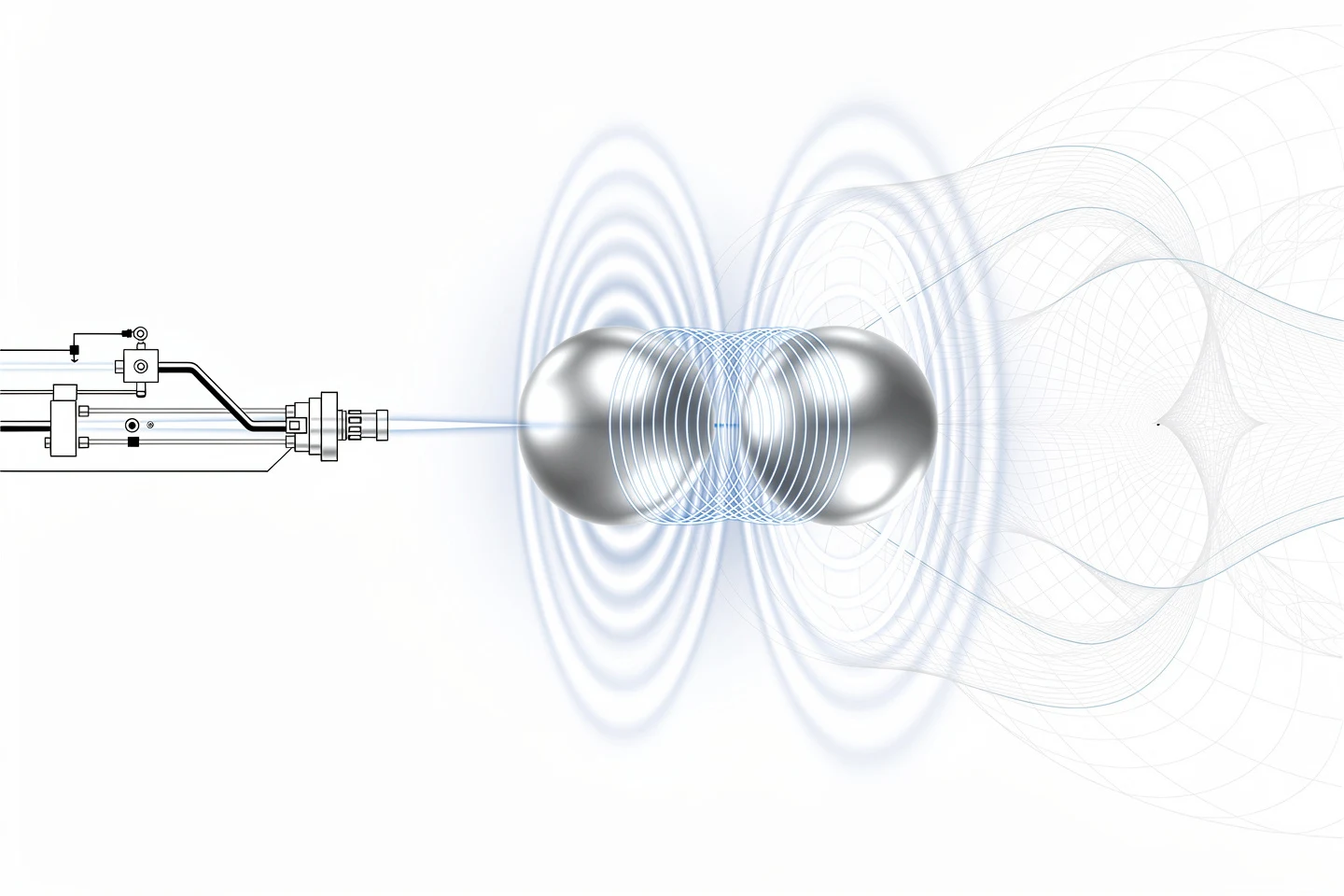
The universe, according to the Standard Model, seems to be a three-dimensional canvas upon which familiar physics unfolds. Yet deep down, beyond the threshold of the everyday, there may be curled-up, invisible dimensions — six or seven tightly wound loops, as predicted by string theory. Detecting them directly is as impossible as hearing an orchestra in the next room through a concrete wall. But Newtonian gravity, like a low-frequency hum, can seep through any barrier — and if other dimensions exist, they must distort that hum at short distances.
Two microscopic diamonds, suspended in a vacuum, become the strings of an unseen duet. The protocol of quantum-induced entanglement of masses (QGEM) places them in a spatial superposition — each body simultaneously exists in two locations separated by tens of microns. Thanks to the wave-particle duality of massive objects, their gravitational interaction generates a phase shift that depends on the branches of the superposition — the very note we’re trying to catch. If gravity obeys the old laws from Einstein to Newton, the duet sounds predictable. But add hidden dimensions, and the chord changes key. A tiny correction Δ(r) to the potential, like a misadjusted tuning peg, shifts the phase Φ(d) by fractions of a radian, and the derivative of the potential only amplifies this discord.
Numerical results paint an almost detective-like picture. Under conservative parameters (mass ~10⁻¹⁴ kg, interaction time 0.1 s), ADD confidently exceeds the quantum entanglement threshold, while the gapped continuum only steps onto the stage at the edge of the measurement window, and RSII remains backstage. In an optimistic scenario, all three models are detectable, and ADD even enters the strong-entanglement regime. Most intriguing: the normalized phase-response profile clearly separates RSII from the other two, but ADD and the gapped continuum are almost indistinguishable — their “melodies” differ by no more than 0.38%, like two variations on a single theme.
This is more than academic elegance. The experiment directly tackles the hierarchy problem and the quantum nature of gravity, a puzzle that Schrödinger himself pondered. Detecting modifications to the Newtonian potential would confirm the existence of extra dimensions, turning a quantum interferometer into a tabletop detector of spacetime curvature at submillimeter scales. Remarkably, reading out this phase would be the first direct evidence of the quantum nature of gravity — not via elusive gravitons, but through the interference of spacetime trajectories. The next challenge is to overcome decoherence and noise, boosting phase sensitivity. Once these disturbances are tamed, the experiment, like a supremely precise seismograph, will begin to register vibrations from the very fabric of reality. And then, perhaps, we will at last hear the true music of a multidimensional cosmos.
If the radii of extra dimensions were just a bit larger, gravity on microscopic scales would grow so steeply that dropped keys would silently stick to your hand, and a comb would cling to your hair like a burr.
The idea of hidden dimensions has stirred science fiction for ages: in Interstellar, the hero enters a five-dimensional tesseract to outwit time — a poetic metaphor for the power of extra dimensions to rewrite the laws of the cosmos.