Light is a universal actor: in the role of a wave, it bends around obstacles and paints rainbow rings; in the role of a particle, it knocks electrons out of metal, giving rise to an electric current. Any particle, even an electron or a massive molecule, possesses both roles.
History
Louis de Broglie put forward a revolutionary hypothesis in 1924 about the wave properties of matter, assigning a wavelength λ = h/p to any moving particle. Erwin Schrödinger in 1926 built on this by creating wave mechanics, describing particles as waves distributed in space. The experiments of Davisson and Germer (1927) and independently G.P. Thomson with electrons confirmed the prediction, demonstrating electron diffraction by crystals.
How it works
The duality is quantitatively expressed through Heisenberg's uncertainty principle: Δx·Δp ≥ ħ/2. The more precisely the particle characteristic (momentum) is measured, the more blurred the wave characteristic (position) becomes. The wave function ψ(x) contains complete information about the system, and its squared modulus gives the probability of finding the particle at a point. The Schrödinger equation governs the evolution of the wave pattern, and measurement collapses it into a localized particle.
Fun fact
Scientists passed huge fullerene molecules (almost a millimeter in size) through two slits and obtained interference patterns—the molecules behaved like waves, even though you could touch them.
A layered cake of molybdenum disulfide MoS2 sits on the lab bench. It is prepared in the usual way: adhesive tape peels off the top layers to obtain a thin sample. But beneath the tape remains an invisible cavity where the atomic floors are no longer pressed together. It is there that electrons begin to behave differently than in the crystal bulk.
A storm in the upper atmosphere lasts a few millionths of a second. A cosmic ray, a proton or a helium nucleus, strikes air molecules, sending a swarm of particles downward. Most of them stay together, but occasionally one particle gains so much energy that it surges ahead.
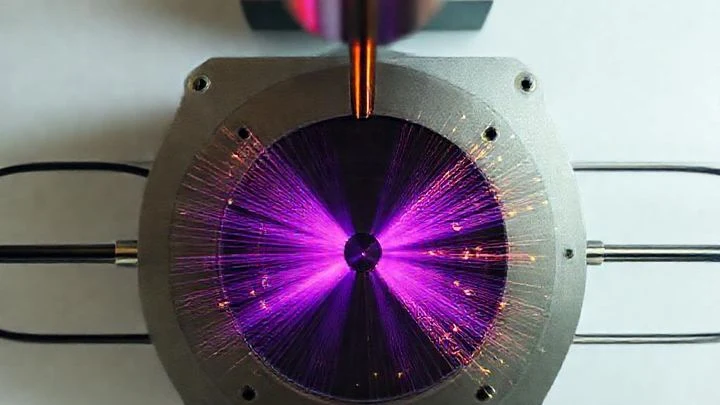
A laser pulse slams into a gas cloud and knocks electrons out of it, leaving behind a bubble: a cavity almost devoid of particles. This bubble races through the plasma at nearly the speed of light, and its walls drag along the electrons trapped inside, much like a speedboat tows a water skier.
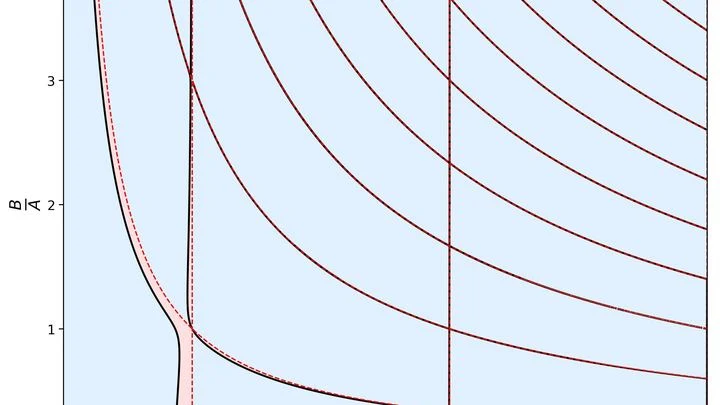
In a pot of boiling water, steam bubbles appear and disappear — a similar struggle takes place in two-dimensional materials. Here, electrons both create magnetism and try to extinguish it.
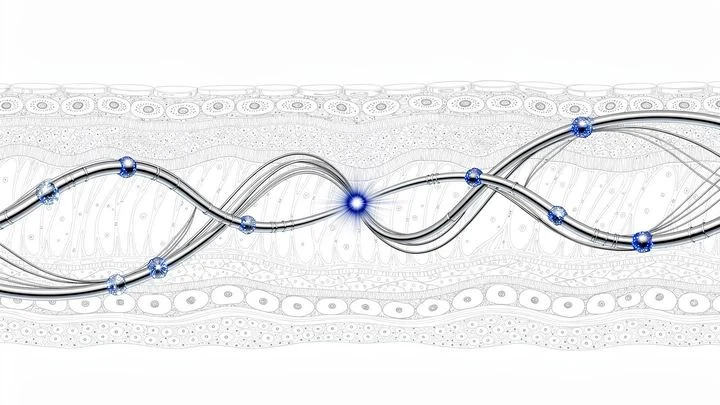
A thin silver thread nearly as long as a hair's width, and inside it, pristine quantum laws hold sway. Physicists built a conductor where electrons can only move forward or backward, like on a perfectly straight single-lane road with no shoulders. On such a road, any pothole or pebble would normally destroy the fragile quantum state.
An electron is not just a point. It is a probability cloud, smeared out in space. When such a cloud collides with a powerful laser pulse, it can emit a high-energy photon — a gamma quantum. And this photon can be not just ordinary but twisted, like a corkscrew, carrying orbital angular momentum.
The ring was assembled from several different segments. In each segment, particles behave in their own way, like musicians playing different notes. The most interesting part begins at the junctions: here particles often get stuck, like an echo trapped in a narrow corridor. This phenomenon is called the skin effect — particles pile up at the boundary, like a crowd at an exit.
But the authors noticed something new.
Each positron annihilation is like the birth of a pair of dancers, connected by an invisible thread of polarization. Two gamma quanta fly apart, but their states remain entangled: measuring one instantly determines the other — as if one partner senses every movement of the other, no matter the distance.
The quantum many-body world is a jazz ensemble, where each electron improvises, continuously listening to all the others, and the overall wave function is born from this tense dialogue.
A living cell constantly emits faint magnetic signals, as if whispering. Scientists eavesdrop on this whisper with two microscopic 'microphones'—magnetic field sensors.
Imagine a skyscraper assembled not from individual bricks but from entire studio apartments. That's exactly how the Au₆Te₁₂Se₈ crystal is built: its nodes are not atoms but superatomic clusters of gold and chalcogens that behave as single quantum objects.
A stone falls into water, and ripples spread in all directions. Throw a handful of stones at once, and the ripples overlap: you can no longer tell which ripple came from which stone. A neutron beam hitting a detector looks much the same: a bright spot blurred by many causes.
Twins enter a room from different doors. Each gets a box with a button, and each time they press it, either a red or a green light flashes. If the twins are perfectly identical, you'd expect their lights to follow the same internal rules. But what if the rules differ even though the twins are exact copies?
That's precisely the scenario the authors explored.
Neutrinos are the true ghosts of the microcosm. Nearly massless and chargeless, they pass through planets as if through empty space. But inside each neutrino hides not one particle but three — three 'flavors' (electron, muon, and tau) that constantly morph into one another. This dance is called oscillation.
A drop of water on a table lives a double life. Inside, molecules are surrounded by neighbors on all sides, but at the surface they have neighbors only below and to the sides — above is air. This difference creates the tension that holds the drop in shape.
Every quantum particle has spin — an intrinsic magnetic property, like a tiny arrow. In an experiment, a beam of such particles passing through a magnet splits in two, like a coin that lands either heads or tails. That’s exactly how particles like a hydrogen atom behave.
Drop two pebbles into a pond at the same time — the ripples will spread evenly and in sync. The same happens in a quantum interferometer: a particle is split into two waves that travel along different paths and then meet. Ideally, their crests align.
Gravitational waves are not vibrations of matter, but tremors of spacetime itself, predicted by Albert Einstein. They travel at the speed of light and pass through objects, stretching and squeezing them.
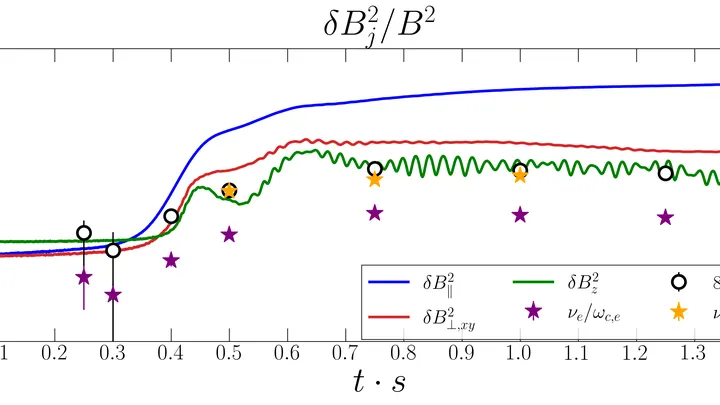
A crowd is trapped in a narrow corridor between two rows of mirrors. Every now and then, someone shoves the wall hard, and a rumble rolls down the corridor — similarly, in the plasma of galaxy clusters, whistler waves and ion-cyclotron waves appear.
Two electrically charged spheres attract each other with a certain force. If you replace their charges with magnetic poles, a spring scale shows exactly the same force. Black holes, it turns out, behave the same way — except instead of springs, the fabric of spacetime itself does the work.
A stone falls into a pond — ripples spread across the water. If the stone doesn't fall but whizzes over the surface at tremendous speed, a straight wave runs along the water. When it hits a floating log, ripples spread out from the point of impact. That's roughly how gravity works in the new study.
Two parallel streams of atoms, released from Bose condensates, begin their journey in free fall. In the classical picture, their separation remains unchanged — like two skiers gliding down a perfectly smooth slope. But if spacetime is not frozen snow, but a living, rippling membrane, then every tremble of it is transmitted to matter.
A photographer tries to capture light interference, but has only one lens and the ability to change exposure time. A similar challenge faces cosmologists studying quantum imprints in the cosmic microwave background — the afterglow of the Big Bang.
Quantum vacuum resembles a sea, constantly rippling with tiny splashes. An electron in an atom moves in this sea, and its path slightly changes due to the waves. Previously, such corrections were accurately calculated only for hydrogen-like ions with a single electron. But in highly charged ions with several electrons, the picture becomes more complex.
An ordinary crystal is like an apartment building: electrons move through shared hallways and staircases, influencing each other through the walls. Now, imagine removing all the walls, leaving just a single line of apartments. How would the residents behave?
Hydrogen has nothing to do with it, but the collective behavior of electrons takes center stage.
In the quantum world, electrons can behave like waves. If you create the right conditions for them, these waves start to feel something akin to gravity. In crystals known as Weyl semimetals, electrons move as if they were massless, and their energy depends on direction, like a tilted cone.
A deuterium molecule, two atoms of heavy hydrogen, falls apart under a laser pulse. One electron is ripped away, leaving an ion behind. At that moment, they are still linked: the direction of one immediately tells you which way the other went. This link is called quantum entanglement.
A laser beam hits an atom, and an electron is knocked loose. It accelerates, returns, and, crashing into the atom, emits a flash of light — a harmonic. If there are two light beams and they are crossed like an intersection, the electron can choose different routes. In the new experiment, the two beams had comparable strength and were directed at right angles.
Electrons in a crystal sometimes behave like a stadium crowd doing the wave: areas of higher density alternate with nearly empty ones. This wave blocks the free flow of charges — under normal conditions, the material is not superconducting. But apply pressure, and the wave vanishes, letting electrons move without resistance.
Two quantum dots are like two tiny pockets in a piece of silicon where an electron can sit, like a ball in a cup. When the pockets are far apart, each electron lives on its own, and its energy resembles the levels of a solitary atom.
In ordinary water, ripples from a thrown stone spread in even concentric circles. But imagine a liquid whose molecules are like tiny screws with a right-handed thread. In such a medium, the surface acts like a one-way street: waves can only travel in a certain direction.
Normally, electric current is the same in both directions, like water in a straight pipe. But at the boundary between a normal metal and a superconductor, this rule breaks down. Two waves on water, going around a wide obstacle from different sides, can arrive with different delays and meet ‘out of step’.
Two tiny emitters, each about the size of an atom, can together do what neither can do alone. We're talking about light scattering — when light hits particles and bounces off in all directions. Usually, a pair of particles scatters light only slightly more than a single one.
A semiconductor diode normally conducts current in only one direction, like a spring-loaded door: it opens easily one way but pushes back the other. But if you dope the crystal heavily, the door starts behaving strangely: under reverse bias, the current doesn't just flow: it shoots up.
Toss a handful of pebbles into a pond, and the spreading ripples intersect, creating splashes and calms. That’s roughly how gravitational waves, predicted by Einstein, behave. Except it’s not water that’s oscillating, but spacetime itself.
Quantum light is not just a stream of particles but an intricate pattern woven from space and time. A single photon can be stretched, squeezed, smeared across different directions.
Drop two pebbles into a pond: each sends out ripples, and on the water you'll see crests where waves reinforce each other and troughs where they cancel. Protons behave much the same way: when there are two, they create a double ripple that adds up into a recognizable pattern.
A stone drops into a pond — ripples spread across the water. Do short waves outrun long ones? No, in deep water it's the opposite: long waves overtake short ones. In metal, sound of one pitch travels at one speed, another pitch at another.