Magnetic Vortices That Current Can't Sweep Away express
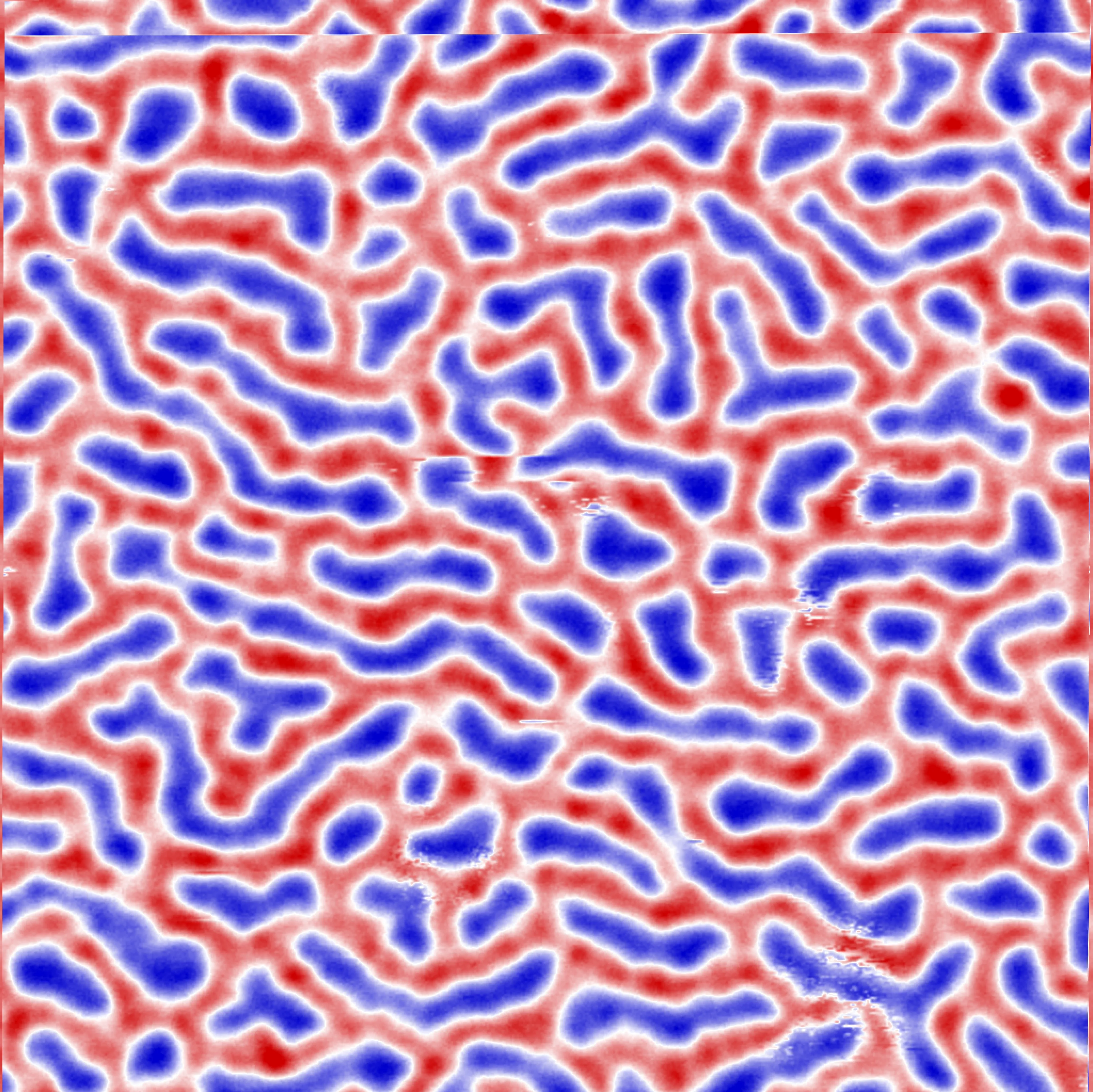
A magnetic vortex, or skyrmion, is like a tiny whirlpool in the sea of spins — the atoms' intrinsic magnetic moments. Like a whirlpool in a river, it twists the magnetization around itself, and this pattern is remarkably robust: hard to destroy with a random jolt. That's why skyrmions are considered as information carriers for future microchips — one vortex could store a bit, and they can move under small currents.
But there's a catch. An ordinary single vortex under current behaves like a race car that keeps drifting to the shoulder. This is the so-called skyrmion Hall effect. Also, they almost always need an external magnetic field to survive, like a fish needs water. The authors of the new study proposed solving both problems at once. They took two layers with opposite vortex chirality — a kind of 'anti-vortex pair' where one compensates for the drift of the other. And they placed this on a special magnetic substrate that acts as an invisible stand: it provides an internal field, allowing the vortices to exist even at zero external field.
The researchers used a magnetic force microscope — a device that probes the magnetic landscape of a surface with a sharp tip, much like a blind person reading Braille. This allowed them to directly see stable vortices without an external field and confirm that the size can be reduced to record values. Computer simulations showed that the substrate not only holds the vortices but also suppresses the formation of unwanted magnetic domains — regions with uniform magnetization that could spoil the picture.
This approach paves the way for dense, energy-efficient memory. A hard drive where the head doesn't move mechanically, but vortices glide along nanometer tracks, pushed by weak current pulses, and don't veer off course. The technology is still lab-scale, but the recipe 'layer-antilayer plus magnetic substrate' turned out to be surprisingly scalable: it can be transferred to other materials and architectures.
Skyrmions are named after British physicist Tony Skyrme, who in the 1960s came up with similar mathematical objects to describe nuclear particles, and had no idea that half a century later they would be found in magnets.
In the world of Star Wars, holographic maps store vast amounts of data in crystals; skyrmion memory could be a real step toward such dense and fast recording.